You do not have to visit Sardinia during Carnival to see the dark wooden faces, heavy bells and sheepskins of the Mamuthones. In Mamoiada, a Barbagia village about 16 kilometres from Nuoro, the Museum of Mediterranean Masks keeps the tradition accessible throughout the year. That makes it one of the most useful cultural stops for September travelers who are curious about Sardinia’s famous masked rituals but arrive months after the winter processions have ended.
The museum is more than a display of dramatic costumes. It places the Mamuthones and their elegant companions, the Issohadores, alongside other ritual masks from central Sardinia and from communities elsewhere in the Mediterranean and Europe. The result gives visitors context that is difficult to get from seeing a photograph of a masked figure on social media.
What are the Mamuthones and Issohadores?
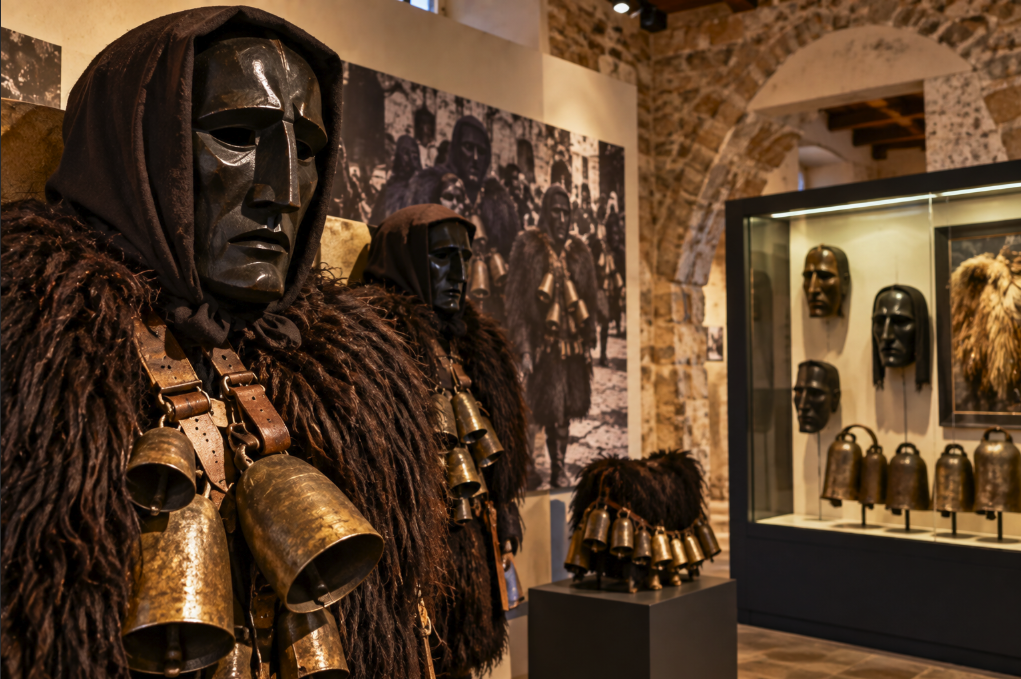
The Mamuthones are the best-known traditional masks of Mamoiada. Their appearance is deliberately severe: a dark wooden face mask, dark sheepskins and a large set of bells carried on the back. SardegnaTurismo says the bell load, known as sa carriga, can weigh around 30 kilograms.
The procession is built around rhythm. Mamuthones move in coordinated steps that make the bells sound together, creating the distinctive heavy pulse associated with Mamoiada’s Carnival.
The Issohadores provide a visual contrast. They wear a red bodice and a white mask and carry the soha, the rope from which their name derives. During traditional appearances they use it to lasso people in the crowd, an action that forms part of the ritual performance rather than a random Carnival prank.
Interpretations of the tradition’s origins vary, and visitors will encounter theories involving pastoral life, seasonal cycles, fertility, ancient ritual and relationships between humans and animals. It is better not to reduce the Mamuthones to a single definitive “pagan meaning.” The museum itself is valuable precisely because it presents the tradition in a wider comparative setting rather than pretending that every symbol has one universally proven explanation.
The Museum of Mediterranean Masks
The Museo delle Maschere Mediterranee in Mamoiada is the obvious first stop outside Carnival season. Official Sardinia tourism information describes it as a museum devoted to the connections between Sardinian mask traditions and similar ritual cultures around the Mediterranean.
The visit begins with images, sound and explanatory material about the Mamuthones before moving through displays of local and comparative masks. The collection includes examples connected with the Barbagia Carnival, such as the Boes, Merdules and Filonzana of Ottana and the Thurpos of Orotelli.
Another section expands the comparison beyond Sardinia, with masks and traditions from Alpine, Iberian and Balkan communities. Wooden faces, animal forms, skins and bells recur in different combinations, helping visitors see Mamoiada as part of a much larger European and Mediterranean ritual landscape.
One of the museum’s most important pieces is an old Mamuthone mask that SardegnaTurismo says may date from the early years of the 19th century.
This is why the museum works particularly well for an American visitor who has never encountered the Barbagia Carnival. Instead of seeing the Mamuthones simply as frightening costumes, you can understand the materials, sound, pastoral context and similarities with traditions elsewhere.
Can you see the Mamuthones in September?
September is not Carnival season in Mamoiada, so travelers should not arrive expecting a street procession simply because they are in town. The reliable way to encounter the tradition is through the museum and the village’s cultural heritage.
SardegnaTurismo explicitly notes that Mamuthones and Issohadores masks can be admired all year at the Museum of Mediterranean Masks. That makes the museum especially useful for visitors traveling in late spring, summer or September.
Actual public appearances happen on specific festival dates. The most important cycle begins in January. The first traditional outing, sa prima issida, is associated with the fires of Sant’Antonio Abate around January 17, followed by the principal Carnival events in February.
In 2026, Sardinia’s official tourism calendar placed Mamoiada’s historic Carnival between January 24 and February 21, with Mamuthones and Issohadores processions among the central events. The regional Carnival program specifically listed parades on February 15, 16 and 17.
Those dates change from year to year with the Carnival calendar, so travelers planning a future winter trip should check the current program rather than copying dates from an old blog.
The January fires: the most atmospheric first appearance
For travelers who want to experience the tradition rather than only study it, the feast of Sant’Antonio Abate is an important date. Mamoiada lights ritual bonfires around the village, and the Mamuthones and Issohadores make their first outing of the Carnival cycle.
The regional tourism description of the festival places the ceremonial bonfires across the historic districts. The masks move through the town and visit the fires, accompanied by the sound of bells and traditional dancing.
This is a very different experience from watching a staged folklore show. It takes place inside a living community celebration, so visitors should approach it as guests rather than treating participants as performers assembled for photographs.
Mamoiada outside Carnival is still worth the trip
The masks are the international calling card, but Mamoiada has enough cultural context to justify a visit even when nobody is processing through the streets.
The village lies around 650 metres above sea level in the Barbagia di Ollolai area, between the landscapes of Gennargentu and Supramonte. SardegnaTurismo highlights its pastoral traditions, vineyards, local cheeses and wines, particularly Cannonau and Granazza.
The territory also contains significant archaeological remains, including domus de janas, dolmens, giants’ tombs, nuraghi and the unusual Sa Perda Pintà, also known as the Boeli stele.
That makes a good day in Mamoiada more than a museum visit. The masks can be the starting point for understanding how pastoral life, archaeology, food, wine and ritual traditions overlap in inland Sardinia.
What about Autunno in Barbagia?
Travelers visiting outside winter should also watch the calendar for Autunno in Barbagia, the autumn festival circuit that brings local crafts, food, wine and traditions into villages across central Sardinia.
Mamoiada participates in the circuit, usually later in autumn rather than September itself. In 2025, its Sas Tappas weekend ran from November 7 to 9, and the official program included a Mamuthones and Issohadores procession on the Saturday.
The 2025 example is useful for understanding the type of event, but it should not be treated as a confirmed date for 2026 or later years. Anyone planning specifically around an autumn procession should wait for the current official program.
Photography and etiquette
Mamuthones are extraordinarily photogenic, but they are not generic Halloween characters. Their masks and processions belong to a specific community tradition.
Inside the museum, follow the current photography rules. During a live procession, avoid blocking the route or pushing into the formation for a close-up. The sound and coordinated movement are part of the experience, so standing back often produces a stronger photograph anyway.
If you visit a local artisan or mask-maker, ask before photographing the workshop or individual pieces. Hand-carved masks are not merely souvenirs; they are also the work of local craftspeople and can carry strong cultural significance.
How to build Mamoiada into a Sardinia itinerary
Mamoiada is particularly easy to combine with Nuoro and Orgosolo. Rather than rushing through all three as photo stops, dedicate a day to Barbagia and use the mask museum as the cultural anchor.
Start with the museum, then explore Mamoiada itself and, if available, a local artisan or wine experience. Archaeology enthusiasts can add one of the surrounding sites, while travelers continuing toward Orgosolo can shift from ritual masks to the town’s famous mural tradition.
For September visitors, this approach solves the main problem: you can understand the Mamuthones without pretending you are seeing Carnival. The real procession belongs to particular festival days; the museum preserves the objects, stories and comparative context year-round.
And if the museum leaves you wanting to hear sa carriga rather than simply see the bells behind a display, plan a second Sardinia trip for January or Carnival. Mamoiada is one of those places where seeing the mask and seeing the ritual are two genuinely different experiences.