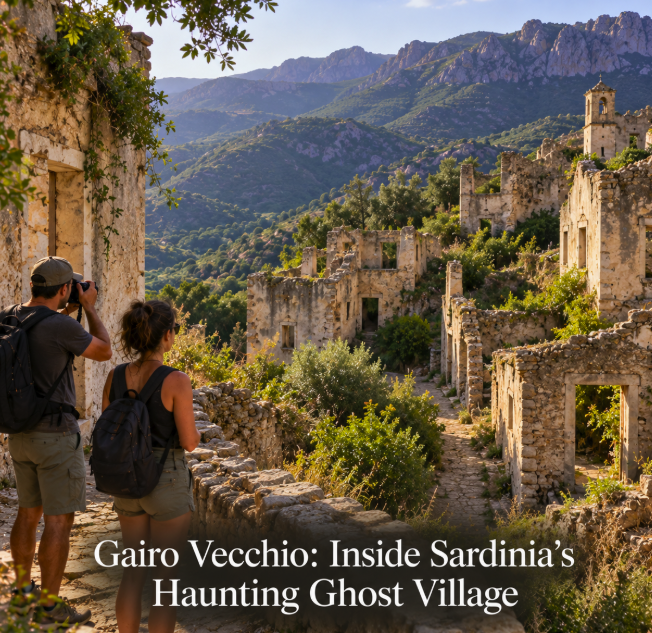
Gairo Vecchio is one of Sardinia’s most striking abandoned settlements: a hillside maze of empty houses, broken roofs and narrow streets in the mountains of Ogliastra. Often presented online as a mysterious “ghost village,” it is compelling precisely because its story is real. The old town was progressively abandoned after destructive floods and landslides in the early 1950s made the historic settlement unsafe, forcing the community to build elsewhere.
Today the ruins form a dramatic landmark below the modern town of Gairo, in east-central Sardinia. Vegetation has entered former homes, walls open onto the surrounding mountains and entire sections of the old settlement remain visibly damaged. It is an extraordinary place to photograph, but it should be approached as a fragile historic site rather than as an unrestricted urbex playground.
Why was Gairo Vecchio abandoned?
Gairo’s history is closely tied to the steep landscape of the Pardu valley. The name itself is commonly connected with the idea of flowing or moving land, an association that feels particularly apt given what happened to the old village.
During the severe weather that struck this part of Sardinia in 1951, floods and hydrogeological instability caused major damage to settlements in the valley. The disaster did not simply empty Gairo in a single night. Instead, the old center was abandoned progressively as residents were relocated and a safer settlement was developed uphill.
The same catastrophic period reshaped other nearby communities. Official Sardinian tourism material on neighboring Osini Vecchio records that it too was abandoned after the October 1951 flood, illustrating the scale of the event across the Pardu valley. citeturn0search16
Gairo’s population ultimately reorganized around new settlements, principally modern Gairo Sant’Elena, while Gairo Taquisara developed as another inhabited center in the municipal territory. The abandoned core became known as Gairo Vecchio — Old Gairo.
What makes the ruins so atmospheric?
Unlike a reconstructed heritage village, Gairo Vecchio still reads as a place interrupted. Streets continue between roofless houses, stairways lead toward empty rooms and fragments of plaster and masonry reveal how tightly the old settlement was built into the slope.
The mountain setting intensifies the effect. Ogliastra is one of Sardinia’s most rugged regions, and the abandoned village sits within a landscape of steep valleys, limestone formations and Mediterranean vegetation. Light changes quickly across the ruins, making early morning and late afternoon particularly attractive for exterior photography.
The appeal is different from Sardinia’s better-known archaeological sites. Gairo Vecchio is not Nuragic or Roman; its abandoned buildings belong to a much more recent human story. People who lived here moved away within living historical memory, and that gives the empty houses a different emotional weight.
Can you visit Gairo Vecchio?
Visitors can see the old settlement and its ruined streets, but caution is essential. Many buildings are in a deteriorated condition, and a structure that looks photogenic from outside may contain unstable walls, floors, roofs or debris. Do not interpret an open doorway as permission or proof that a building is structurally safe.
The best approach is to remain on clearly accessible outdoor routes, respect barriers and signs, and avoid entering unstable interiors. Good footwear is advisable because surfaces can be uneven and loose. After rain, extra care is sensible on slopes and around damaged masonry.
There is no need to climb through ruins to find compelling photographs. Views along the streets, vegetation growing through abandoned structures and the relationship between the village and surrounding mountains already tell the story from safer positions.
Gairo Vecchio as part of an Ogliastra itinerary
The village is best understood in the wider context of the Pardu valley rather than as an isolated social-media stop. Nearby Osini has its own abandoned historic settlement, Osini Vecchio, which official regional tourism material describes as a place of collapsed ceilings, crumbling walls and restored structures dominated by the parish church of Santa Susanna. It too was abandoned after the 1951 flood. citeturn0search16
Modern Gairo and Osini show what happened after the disaster: communities continued, rebuilt and adapted. Visiting both the old and inhabited settlements makes the landscape more meaningful than simply collecting photographs of ruins.
The surrounding Ogliastra territory also offers mountain scenery, archaeological sites and routes toward the eastern coast. Travelers driving through should allow time for winding roads rather than judging distances only by kilometres. Gairo is an inland mountain destination, and the journey is part of the experience.
A ghost village with a human story
The phrase “ghost village” works as shorthand, but Gairo Vecchio is more interesting when the people who once lived there remain part of the story. Its abandoned streets are the result of environmental danger and relocation, not an unexplained disappearance.
That distinction matters when photographing the site. Empty houses can produce cinematic images, especially as plants reclaim walls and windows frame the mountains, but these ruins represent homes and a community displaced by disaster.
Visitors should therefore resist the temptation to treat Gairo Vecchio as a set for extreme urbex. Photograph it, walk through the accessible parts of the old settlement and look across the Pardu landscape, but respect closures and unstable structures. The most memorable part of Gairo Vecchio is not the idea that nobody lives there anymore. It is the visible boundary between a village that had to be left behind and the Sardinian communities that carried on beyond it.