Sardinia’s abandoned mining landscapes have become irresistible to photographers: rusting machinery, silent processing plants, workers’ villages and tunnels appear against some of the wildest scenery on the island. Porto Flavia near Iglesias and the mining territory around Ingurtosu and Montevecchio are among the best-known examples. But visitors looking for “urbex” photographs should know an important distinction: the most memorable mining experiences do not require entering unsafe abandoned buildings or closed tunnels. Several major sites are protected, managed and accessible through official visits.
Southwestern Sardinia’s mining heritage is organized within the Historical and Environmental Geomining Park of Sardinia, a ministerial institution established in 2001. Its official Mining Route crosses ten municipalities and includes fourteen sites, bringing together tunnels, shafts, processing plants, transport infrastructure and former mining settlements. citeturn1search2
Porto Flavia: spectacular, but not actually a mine
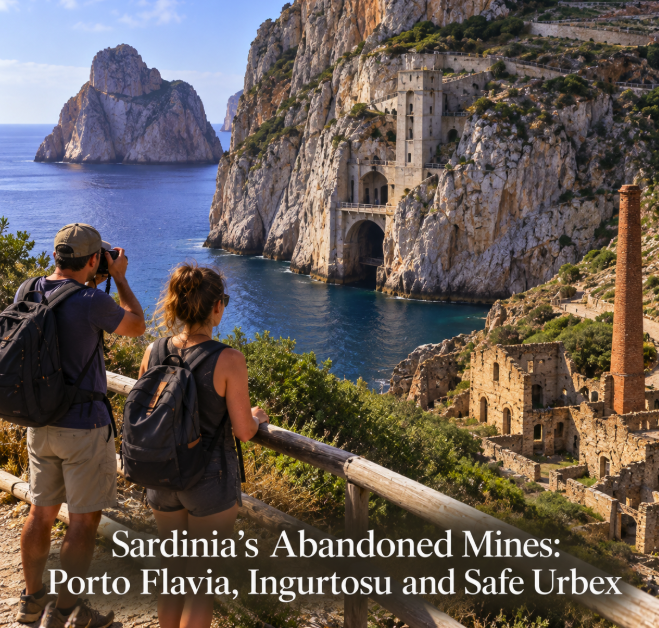
Porto Flavia is frequently described online as an abandoned mine, but technically it was a mineral loading port serving the Masua mining complex. Designed by engineer Cesare Vecelli and completed in 1924, it was carved into the limestone cliff above the sea. Two tunnels were excavated one above the other, connected to nine huge storage silos with a total capacity of around 10,000 tonnes. A retractable conveyor in the lower gallery allowed ore to be loaded directly onto ships. citeturn1search1turn1search5
The setting explains its appeal to photographers. The galleries emerge high above the Mediterranean opposite the sea stack of Pan di Zucchero, combining industrial engineering with a dramatic coastal landscape. Yet Porto Flavia is not an unrestricted urbex location. It was restored and is open to tourists through guided visits, with the Geomining Park listing a typical visit duration of around 50 minutes and directing visitors to the Iglesias tourism service for current opening information. citeturn1search1
In March 2026, Porto Flavia also gained a new educational and exhibition route created by the Municipality of Iglesias. The updated experience uses high-definition panels, digital material and historical interpretation along the visitor route, culminating in the view toward Pan di Zucchero. citeturn1search0
For photographers, that makes the official visit the sensible way to get inside. It provides legitimate access to the historic infrastructure without treating a century-old industrial site as an unregulated playground.
Ingurtosu: a mining landscape rather than one attraction
Ingurtosu, in the territory of Arbus, offers a different atmosphere. Here the attraction is the scale of the former mining landscape: settlements, industrial remains and the wider Montevecchio–Ingurtosu mining system stretch across an inland territory that eventually descends toward the Piscinas dunes and the west coast.
The Geomining Park’s documentation places Ingurtosu among the historic mining sites of Arbus and links the territory closely with Montevecchio. The managed visitor infrastructure in the area includes the Montevecchio Mine, where official tours explain both industrial production and everyday mining life. In the Guspini sector, visitors can choose among several routes, and the Galleria Anglosarda is a real mining tunnel adapted for tourism. A 4x4 itinerary also explores the wider mining area toward the Piscinas dunes. citeturn1search7
On the Arbus side, the former Montevecchio guesthouse houses mineralogical and mining-history collections. The Geomining Park lists a mineral collection containing specimens from both Montevecchio and Ingurtosu, providing useful context before photographing the abandoned landscapes outside. citeturn1search9
Why “urbex” needs caution here
Disused mines are visually compelling precisely because they have deteriorated. That deterioration is also the danger. Old industrial buildings can contain unstable floors, falling masonry, open shafts, unprotected drops and inaccessible underground workings. Ownership and access rights vary from site to site, and a building that appears abandoned is not automatically public or legal to enter.
The Geomining Park’s own approach to lesser-known mining locations is revealing. Its 2026 “Open Your Mine” program is designed to take small groups into unusual former mining sites and geosites accompanied by park guides, explicitly emphasizing safe guided discovery. citeturn1search3
For photographers, the practical rule is simple: photograph ruins from public roads, established paths and authorized visitor areas unless access has been explicitly permitted. Do not climb barriers, enter sealed galleries or assume that a social-media geotag means a structure is open to visitors.
Other mining sites worth adding to the route
The Iglesiente and southwest coast contain enough managed mining heritage to build an entire photography itinerary without trespassing. At Buggerru, Galleria Henry is a former transport tunnel carved into the cliff, with panoramic openings above the Mediterranean. The Geomining Park lists it as an official guided attraction, with a typical visit lasting about 90 minutes. citeturn1search11
Near Iglesias, Monteponi tells another major chapter in Sardinia’s lead and zinc industry. Its historic infrastructure included a remarkable underground drainage system and a private railway connecting the mining works with a port at Portoscuso. Mining activity ultimately closed during the crisis that affected Sardinia’s lead-zinc industry in the late twentieth century. citeturn1search10
Together with Porto Flavia, Masua, Nebida, Montevecchio and Ingurtosu, these sites show why southwestern Sardinia feels different from the island’s beach-resort image. Entire landscapes were reorganized around extraction, transport and workers’ communities, and those traces remain visible today.
A better way to photograph Sardinia’s mining ruins
For a first visit, Porto Flavia is the easiest introduction because access is organized and the engineering can be understood from inside. The Montevecchio area adds workshops, machinery, a tourist mining gallery and broader industrial landscapes. Ingurtosu is especially rewarding for exterior photography and for understanding how mining settlements became part of the remote Arburese countryside.
Good footwear is advisable around rough mining terrain, and photographers should avoid approaching unstable structures merely for a more dramatic angle. Check current opening days before traveling: managed mining sites can have seasonal schedules and some visits require or recommend advance booking.
The result is a version of “urbex” that respects both the place and its history. Sardinia’s mines are not simply abandoned backdrops. They are evidence of generations of industrial labor, engineering and community life, now forming one of the island’s most distinctive cultural landscapes. The photographs are better when the story behind the ruins comes with them.