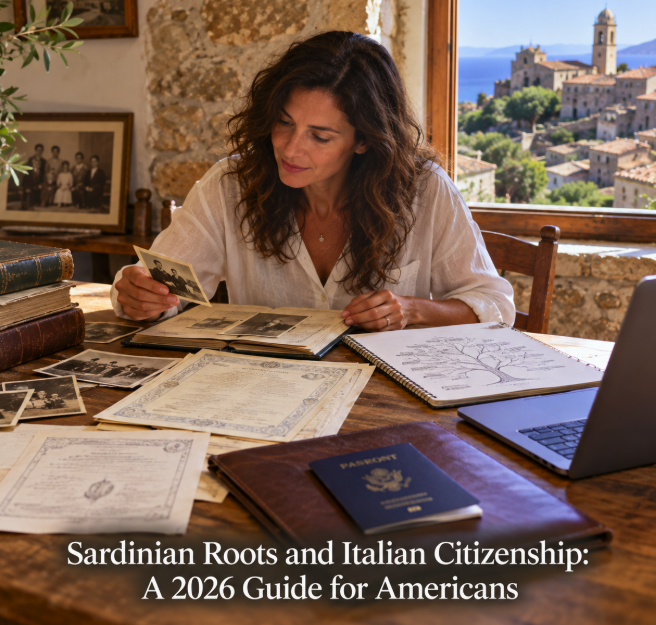
For generations of Sardinian-American families, finding an Italian-born great-grandparent could be the starting point for an Italian citizenship-by-descent application. That assumption is no longer enough. Italy substantially changed its iure sanguinis rules in 2025, and in 2026 an American born abroad with another citizenship generally needs to fit one of the new statutory exceptions. For descendants researching family roots in Sardinia, the first task is therefore not collecting every certificate in the family tree: it is establishing whether the current eligibility rules fit the case at all.
The reform came through Decree-Law 36 of 28 March 2025, converted with amendments into Law 74 of 23 May 2025. The Italian Ministry of Foreign Affairs confirms that automatic transmission of citizenship to people born abroad who possess another citizenship is now subject to the exceptions contained in Article 3-bis of Law 91/1992. citeturn0search2turn0search3
Having a Sardinian great-grandparent is no longer enough by itself
Under the current framework, a person born abroad who already holds another citizenship is generally not considered to have automatically acquired Italian citizenship unless one of the statutory exceptions applies. One of the most important exceptions is having a parent or grandparent — an ancestor in the first or second degree — who holds, or held at the time of death, exclusively Italian citizenship. citeturn0search2turn0search0
Another route applies when a parent or adoptive parent was resident in Italy for at least two continuous years after acquiring Italian citizenship and before the applicant's birth or adoption. citeturn0search2turn0search3
This makes family history much more specific than the old shorthand of tracing an uninterrupted line to an Italian ancestor. Someone whose only Italian-born ancestor was a great-grandparent from Sardinia should not assume that ancestry alone satisfies the current rules. The citizenship history of parents and grandparents — including whether they possessed another nationality — can now be decisive.
Older applications can fall under transitional protection
The reform includes important transitional provisions. Italian consulates state that cases can continue under the rules applicable before the reform where recognition followed an administrative or judicial application filed by 11:59 p.m. Rome time on 27 March 2025, subject to the statutory requirements. The legislation also protects certain applications submitted on an appointment date that had been officially communicated by the competent office by that deadline. citeturn0search0turn0search8
That date is therefore crucial for families who had already started a case. A person who had been researching Sardinian ancestry for years but had never actually filed an application is in a different position from someone whose qualifying application or protected appointment was already in the system before the cutoff.
Where does an American apply?
For people resident outside Italy, the competent authority is normally the Italian consular office responsible for their legal place of residence. The Ministry of Foreign Affairs states that jurisdiction for recognition is determined by residence, with the territorially competent consulate handling applicants who live abroad. citeturn0search2
This means a Sardinian ancestor's hometown does not determine which US consulate an American applicant uses. Someone whose family came from Sassari, Cagliari or a small Ogliastra village still follows the procedure of the Italian consular district covering the applicant's current US residence.
Consulates can also have their own appointment and document-submission procedures. For example, current US consular guidance reflects the 2025 reform and instructs applicants to follow the process of the specific office with territorial jurisdiction. citeturn0search1turn0search5
Why Sardinian civil records still matter
If the applicant fits a current legal route, documentary genealogy becomes central. The family line has to be proved through civil-status records, while citizenship and naturalization evidence may be needed to establish the nationality history required by the new law.
For a Sardinian ancestor, research often begins with the relevant Comune — the municipality where the birth, marriage or death was registered. The precise town matters more than a family story saying simply that an ancestor was “from Sardinia.” A province, port of departure or approximate region may not be enough to identify the correct civil record.
American records can be equally important. Names often changed spelling after migration, and Sardinian place names were sometimes recorded inaccurately on US certificates. Dates can also conflict between birth, marriage, death and naturalization documents. Applicants should expect to reconcile discrepancies according to the requirements of their competent consulate rather than assuming that similar-looking records will automatically be accepted.
Proving exclusive Italian citizenship
One of the biggest changes is the need, in relevant cases, to demonstrate that a qualifying parent or grandparent possessed only Italian citizenship. The Ministry of Foreign Affairs lists examples of evidence that can help establish exclusive Italian nationality, including negative citizenship certificates, evidence of renunciation of another citizenship and certificates showing non-enrolment in foreign electoral registers. For the separate two-year-residence exception, a historical Italian residence certificate can be used as evidence. citeturn0search2turn0search3
This is an area where an apparently simple genealogy case can become legally complex. US citizenship can arise by birth as well as naturalization, and the nationality status of each relevant ancestor must be assessed under the actual facts rather than inferred from where the person lived.
What about children of Italian citizens?
Law 74/2025 also introduced a procedure under Article 4, paragraph 1-bis for children of an Italian citizen by birth. The Ministry explains that parents or a guardian can make a declaration for the child to acquire citizenship. If the declaration is made within three years of birth — or the later date on which filiation is established — the child can acquire citizenship while continuing to reside abroad. When more than three years have passed, the child must generally reside legally in Italy for at least two continuous years for the declaration to have effect. citeturn0search2turn0search3
Families should therefore check the current rules promptly when a child is born rather than assuming that recognition can always be postponed indefinitely.
A practical starting checklist for Sardinian descendants
Before spending heavily on certificates, translations and professional services, identify the closest Italian ancestors in your family tree and document their citizenship history. Record each ancestor's full name, date and place of birth, marriages, naturalization or acquisition of US citizenship, and date of death where relevant. Then determine whether a parent or grandparent fits one of the current exceptions, or whether a pre-28 March 2025 application falls under the transitional provisions.
If the case still appears viable, obtain the current checklist from the Italian consulate responsible for your US residence. Only then begin ordering the complete set of Italian and American civil records, apostilles and translations required by that office.
For Sardinian families, genealogical research can still be valuable even when citizenship eligibility is uncertain. Comune archives and civil records can reconnect descendants with a specific village, branch of the family and migration story. But in 2026, “my great-grandfather was born in Sardinia” is the beginning of the research, not an answer to the citizenship question.
Because the 2025 reform is recent and individual cases can involve naturalization dates, maternal lines, adoption, prior court filings and transitional rules, applicants with complicated histories should consider advice from a qualified Italian citizenship lawyer or another professional familiar with the current law. Official consular guidance should remain the reference point for the administrative procedure.