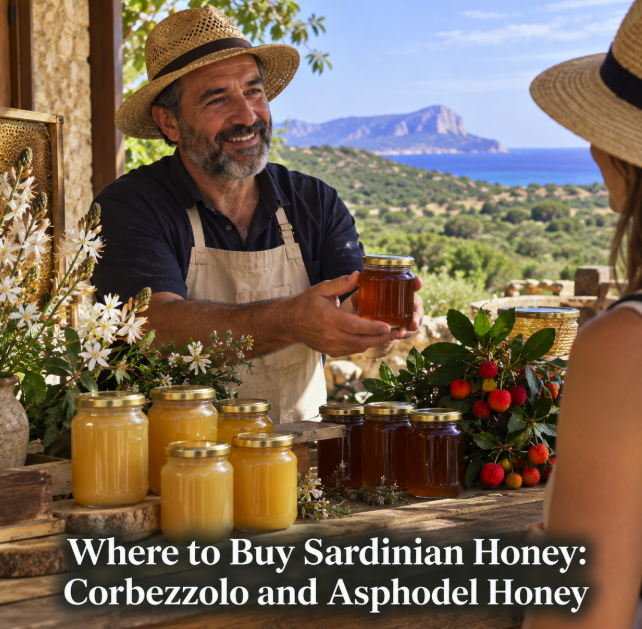
If you want to bring home a food souvenir that genuinely tastes of Sardinia, look beyond generic jars labeled simply “Italian honey.” Two of the island’s most distinctive varieties are miele di corbezzolo, the famously bitter honey made from strawberry-tree flowers, and miele di asfodelo, a much paler, delicate floral honey. Both are produced by Sardinian beekeepers, and several local producers currently sell them directly rather than only through tourist shops.
A useful place to start is with producers that clearly identify the botanical variety, Sardinian origin and jar size. Current 2026 online shops from Sardinian beekeepers show just how different the two honeys are in both flavor and price: corbezzolo is usually considerably more expensive because its production is difficult and highly dependent on autumn weather.
Corbezzolo: Sardinia’s bitter honey
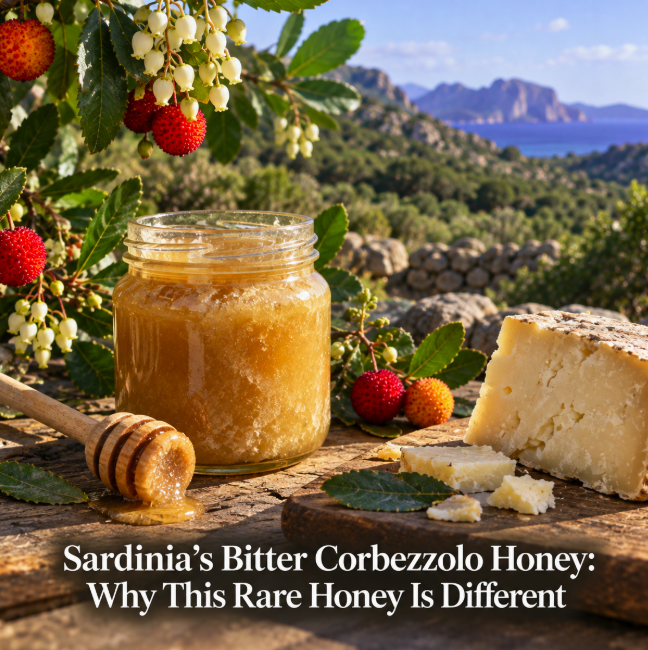
Corbezzolo honey comes from Arbutus unedo, the strawberry tree that grows throughout Mediterranean scrub. Unlike the sweetness most travelers expect from honey, a good corbezzolo has a pronounced bitter finish, often accompanied by herbal, roasted or coffee-like notes.
That unusual flavor is exactly why it has become one of Sardinia’s best-known honeys. It works particularly well with fresh or creamy cheeses, ricotta and nuts, and it is a traditional match for seadas, the Sardinian fried pastry filled with cheese.
Production is challenging because strawberry trees flower in autumn and early winter, when rain, wind and cooler temperatures can limit the bees’ ability to forage. Availability and price can therefore vary substantially from one harvest to another.
Asphodel honey: pale, delicate and very Sardinian
Asphodel honey is almost the opposite experience. The Sardinian regional product specification describes it as a traditional honey produced across the island from spontaneous asphodel flowers, generally during the spring flowering period.
Its color is light and can be almost transparent when liquid. The aroma is gentle, with delicate floral and vegetal notes, and its flavor is far less assertive than corbezzolo.
Because it is subtle, asphodel honey is worth tasting on its own before pairing it with strongly flavored food. It also works naturally at breakfast, with yogurt or in Sardinian sweets.
Travelers who want to understand the island’s honey rather than simply buy one souvenir jar should taste these two side by side. Corbezzolo demonstrates the bitter, intense side of Mediterranean scrub; asphodel shows the lighter spring character of Sardinia’s open countryside.
Sardinian producers selling both varieties
Asphodel is a Sardinian community of beekeepers created to bring together small local producers. Its current shop lists both corbezzolo and asphodel honey. At the time of checking, a 250 g jar of asphodel was listed at €6.40, while its corbezzolo products were around €15–€16.50 for 250 g, depending on the listing. The company describes its production as local, natural and organically certified.
Apicoltura Pala is another useful direct source because its current Sardinian honey shop carries both varieties. Its asphodel honey is listed at €5–€9 depending on jar size, with 250 g and 500 g formats, while bitter corbezzolo is currently listed at €7–€13 depending on size. The producer also sells cardoon, eucalyptus, wild lavender and Mediterranean scrub honey, making it useful for anyone who wants to compare several Sardinian monofloral styles.
Prices are current 2026 shop references, not fixed island-wide prices. Harvest size, jar weight and producer all matter, and corbezzolo in particular can vary sharply between seasons.
Other local producers worth looking for
Near Cagliari, Apicoltura Monte Arcosu is a family operation based near Uta. The company says its bees forage around Monte Arcosu and surrounding areas where strawberry tree, heather, wild lavender, asphodel, cistus and myrtle grow. It emphasizes direct sales as well as distribution through selected typical-food shops, wine shops, agriturismi and restaurants.
In northwest Sardinia, Favo Sardo produces honey locally and offers apiary visits as well as online sales. Its current shop lists Sardinian asphodel honey at €7.50. Visiting or buying from a beekeeper can be more interesting than choosing a jar at an airport because you can ask where the hives were located and which flowering season produced the honey.
In the Olbia area, Apicoltura Derosas produces Sardinian honey sold through Kara Sardegna. Current listings identify its asphodel honey as produced in Olbia and price a 250 g jar at €7.90. Its bitter corbezzolo is also listed, with a 125 g jar currently around €10.87.
These examples are not intended as a ranking. Honey production is agricultural, and individual varieties can sell out after a poor harvest even when a producer normally carries them.
How to recognize a useful jar
Read the label. If you specifically want Sardinian honey, look for an origin statement rather than relying on Sardinian-looking packaging. The botanical name or variety should also be clear: corbezzolo, asfodelo, cardo, eucalipto or another declared honey.
Crystallization is not evidence that honey has spoiled. It is a normal physical process, and different varieties crystallize at different rates and with different textures. Asphodel honey can become very pale when crystallized.
With corbezzolo, do not reject a jar because the taste is unexpectedly bitter. The bitterness is the defining characteristic people seek.
Buying from a market, food shop or beekeeper
Local markets and specialist food stores can be convenient, especially when traveling without time to visit an apiary. They may also stock several producers in one place. But availability changes, so it is better to ask specifically for miele sardo di corbezzolo or miele sardo di asfodelo than to ask only for “local honey.”
Buying directly from a beekeeper has another advantage: provenance is easier to discuss. Sardinian beekeepers often move hives according to flowering periods, a practice known as nomadic beekeeping. The location of the hives can therefore change depending on the variety being produced.
If you are driving around Sardinia, a producer visit or farm shop can become a small food experience rather than just a shopping stop. Always contact the producer before making a special journey, because an agricultural business may not keep conventional retail opening hours.
Which one should you take home?
Choose corbezzolo if you want the most surprising Sardinian honey: rare, bitter and unlike a standard breakfast honey. It is the jar most likely to start a conversation when you serve it with cheese back home.
Choose asphodel if you prefer something lighter and more immediately approachable. Its delicate flavor makes it easier to use every day, and it is generally much less expensive.
Or buy a small jar of each. Tasted together, they explain why “Sardinian honey” is not one flavor at all. The island’s scrub, spring pasture, changing weather and mobile hives create radically different products within a surprisingly small geographic area.
For travelers looking for a local food souvenir rather than a generic gift, that contrast is the point: one jar is pale and gentle, the other famously bitter, and both tell a very Sardinian story.