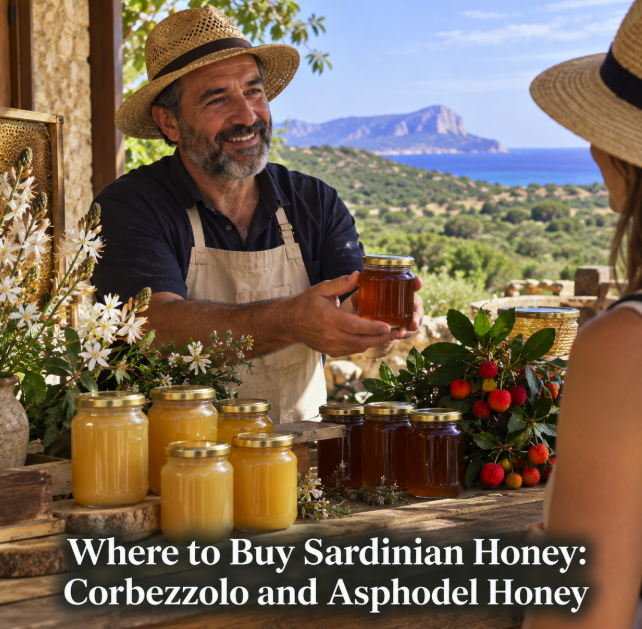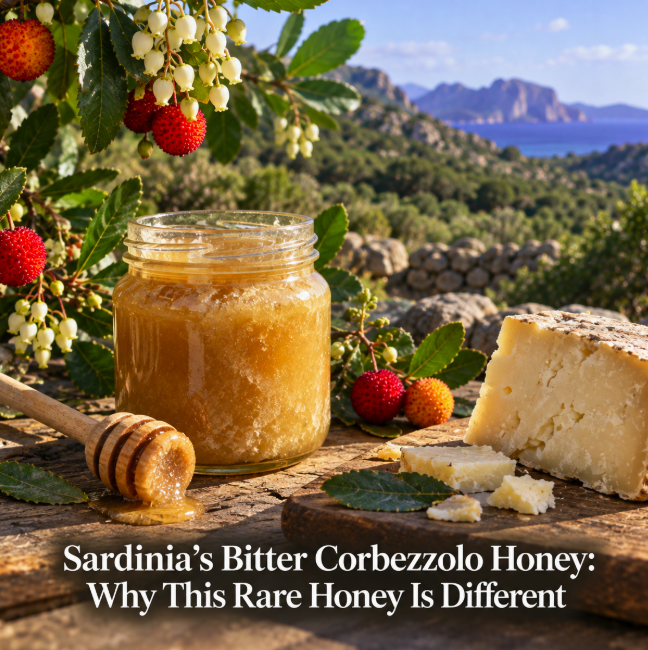
Sardinia has a honey that can surprise anyone expecting pure sweetness. Miele di corbezzolo, made from the flowers of the strawberry tree, begins with only restrained sweetness before developing a distinctly bitter, persistent finish. It is one of the island’s most characteristic honeys, and its limited, weather-dependent autumn production helps explain why small jars can cost considerably more than everyday wildflower honey.
In September 2026, Sardinian corbezzolo honey is available from specialist producers and shops, but prices vary dramatically. Current direct-producer examples include 250 g jars around €11–€16.50, while some specialist retail and online listings are above €20 for roughly the same quantity. The price reflects both the product’s niche appeal and a harvest that is inherently difficult to predict.
What is corbezzolo?
Corbezzolo is the Italian name for Arbutus unedo, the strawberry tree, an evergreen plant typical of Mediterranean scrub. It is widespread in Sardinia, particularly in inland areas and mountain or macchia mediterranea environments.
The plant is visually unusual because fruit and flowers can appear at around the same time. Its round fruits mature from yellow-orange to red, while clusters of small pale bell-shaped flowers provide nectar for bees late in the year.
That timing is the key to the honey’s rarity. Sardinian agricultural material places corbezzolo among the island’s autumn honey resources. The main flowering period arrives when temperatures are falling and rain becomes more likely, conditions that can limit the number of hours bees are able to forage.
Why is Sardinian corbezzolo honey rare?
Unlike a spring flower that blooms during reliably warm weather, the strawberry tree asks bees to work during a more uncertain part of the year. A Sardinian producer specializing in corbezzolo explains that the harvest typically falls around October, November and December, when lower temperatures and increased rainfall can make bee activity difficult or sometimes impossible.
Regional agricultural analysis also shows how small the autumn share of Sardinian honey production can be in a normal year. Historical sector data estimated autumn honey at only around 5% of annual production, compared with much larger spring and summer shares. Corbezzolo was identified as one of the characteristic autumn honeys.
That does not mean every jar is automatically scarce or that the island produces the same amount each year. Weather can create a good crop in one season and a very poor one in another. For buyers, “rare” is therefore more than a marketing adjective: the flowering and harvest window really is unusually vulnerable.
What does bitter honey actually taste like?
Sardinia’s official agricultural description is unusually vivid. Corbezzolo honey is initially only slightly sweet, then becomes decisively bitter and astringent, with a long-lasting bitter component. Its aroma can be intense and pungent, with associations ranging from bitter herbs to roasted coffee.
That profile makes it one of those foods people tend to remember. Someone expecting acacia or ordinary supermarket blossom honey may initially wonder whether something is wrong. The bitterness is the point.
The honey also crystallizes quickly after harvest. In its liquid state it can range from light to darker amber, sometimes with orange or greenish reflections; crystallized honey becomes beige to darker beige with fine crystals. A solid or creamy jar is therefore not evidence that the honey has spoiled.
How much does corbezzolo honey cost in 2026?
Current Sardinian prices illustrate the wide range. Monte Arcosu currently lists a 250 g jar at €11. Isola del Miele and Apicoltura Pala list corbezzolo products in ranges reaching around €13, depending on jar size. Asphodel currently lists a 250 g jar at €16.50.
Other sellers are higher. Made by Sardinia currently lists 250 g at €12.50, while specialist marketplace listings for Sardinian corbezzolo can exceed €20 for 250–280 g. A current Gallura organic honey listing, for example, is €24.75 for 280 g.
Those figures should not be read as an official island price. Producer, organic certification, harvest, packaging, retail margin and shipping all affect what a traveler pays. Buying directly from an apiary can produce a very different price from ordering a small jar through an international-facing specialty retailer.
How Sardinians use it
The bitterness makes corbezzolo honey particularly effective with foods that can stand up to it. Sardinian producers commonly recommend it with mature and strongly flavored cheeses, including pecorino. The salty richness of cheese and the honey’s aromatic bitterness create a more complex pairing than an ordinary sweet topping.
It is also associated with Sardinian sweets. Producers recommend it with seadas or sebadas, the fried pastry filled with cheese that is traditionally served with honey. Using corbezzolo changes the dish substantially: instead of straightforward sweetness, it adds a bitter counterpoint to the warm cheese and fried pastry.
Apicoltura Pala also notes its use in traditional Sardinian nougat. At home, it can be tried in small amounts with ricotta, yogurt, toast or coffee, although its assertive character means it is worth tasting before using it as a direct substitute for mild honey.
What to look for when buying a jar
If the goal is to take home an authentically Sardinian product, read the label carefully. “Sold in Sardinia” and “produced in Sardinia” are not the same thing. Look for a named beekeeper or producer, origin information and a clear description of the honey as corbezzolo.
Do not reject a jar because the honey is crystallized. Rapid crystallization is characteristic of this variety. Nor should you expect every batch to have exactly the same color: natural honey changes with harvest conditions.
Travelers buying directly from a beekeeper can also ask about the harvest year and production area. Because the crop is so dependent on autumn weather, those questions can reveal far more about the jar than decorative packaging.
Where is it produced?
Corbezzolo grows widely around Sardinia, and current products come from several parts of the island. Examples on sale in 2026 include honey from Gallura, Olbia, Ogliastra and southern Sardinia. Monte Tamara has its shop and laboratory in Nuxis, while other specialist producers work in areas such as Ulassai and elsewhere across the island.
This is not a product that belongs to one tourist town. Its identity comes from Sardinia’s Mediterranean vegetation and the seasonal relationship between the flowering plant, bees and autumn weather.
A small jar with a very Sardinian character
Corbezzolo honey is an excellent example of why Sardinian food is more interesting when travelers move beyond the most familiar products. It comes from a common Mediterranean plant but requires unusually cooperative weather to produce a strong monofloral harvest. It is honey, yet bitterness rather than sweetness defines its flavor.
For a first taste, a small 100–250 g jar is enough. Try it beside a mature Sardinian cheese before deciding whether you love it. The reaction may be immediate: corbezzolo is not designed to disappear politely into the background.
That distinctive bitterness, together with its uncertain autumn harvest, is precisely why this unusual Sardinian honey continues to attract people looking for foods that are genuinely tied to the island’s landscape rather than simply packaged as souvenirs.