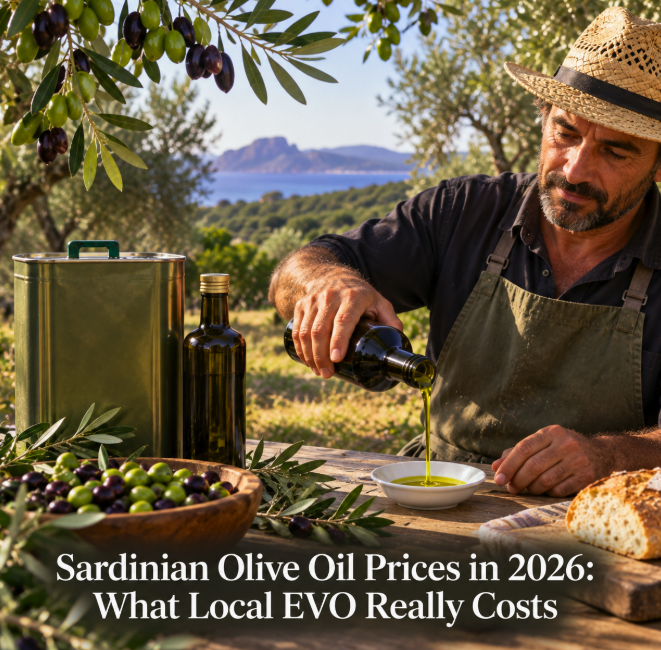
Local extra virgin olive oil in Sardinia is not a €5 souvenir. In September 2026, a realistic retail price for a good Sardinian EVO is roughly €12 to €17 per liter when buying larger formats or straightforward local bottlings, while Sardegna DOP and premium bottled oils can approach or exceed €20 per liter. Current producer and retailer prices show why the answer depends heavily on format, certification and where you buy.
For travelers who want a simple benchmark, a 5-liter tin or bag-in-box from a Sardinian producer is currently often around €62 to €85, equivalent to approximately €12.40–€17 per liter. A 500 ml or 750 ml premium bottle costs more per liter because packaging, positioning and certification all affect the final shelf price.
What Sardinian producers are charging in 2026
Current prices from several Sardinian producers provide a useful snapshot. Solevita Sardinia, which describes its EVO as 100% Sardinian and produced in Sassari, currently lists a 5-liter pack at €62, or about €12.40 per liter.
Oleificio Pianura del Maestrale in Siamanna lists its 2025–26 Lugori extra virgin olive oil at €66.90 for 5 liters, roughly €13.38 per liter. Its organic Biolike oil is €71.90 for 5 liters, about €14.38 per liter.
Oleificio Sociale di Seneghe lists a 5-liter tin of Senolio EVO at €65, equivalent to €13 per liter, before shipping. In Gonnosfanadiga, Frantoio Foddi currently sells its 5-liter monovarietal Nera di Gonnos EVO for €74.99, just under €15 per liter.
Other current examples sit higher. Sardissimo lists a 5-liter Sardinian EVO from Oleificio Podda in Ussaramanna at €72, or €14.40 per liter. Casa Bonaria lists a 5-liter tin at €85, equivalent to €17 per liter, produced from Sardinian cultivars including Tonda di Cagliari, Bosana and Semidana.
Azienda Cannavera explicitly labels its current oil as the 2025/2026 vintage and lists 1 liter at €17, 3 liters at €49.50 and 5 liters at €80. The larger pack therefore works out at €16 per liter, compared with €17 for the one-liter format.
Supermarket prices can look very different
Buying from a Sardinian producer is not the same as buying the cheapest bottle labeled extra virgin olive oil in a supermarket. Current Sardinian online supermarket listings illustrate the spread.
Nonna Isa currently lists San Giuliano Alghero's L'Originale EVO at €12.40 for one liter, while the same brand's 500 ml bottle works out at €13.60 per liter. Its premium Fruttato Collezione bottle is €12.99 for 750 ml, or €17.32 per liter.
A current CRAI online listing shows San Giuliano's one-liter L'Originale at €12.90. The same page also carries cheaper supermarket-brand extra virgin olive oil, demonstrating why “the price of EVO in Sardinia” cannot be reduced to one number. Origin, producer, cultivar and certification matter.
For a traveler specifically looking for local Sardinian oil, read the origin information rather than assuming that every bottle sold on the island was produced from Sardinian olives.
How much does Sardegna DOP cost?
Sardegna DOP is a protected designation with a defined production specification, so it is useful to distinguish it from a generic extra virgin olive oil.
A current retail example from Accademia Olearia in Alghero is its Sardegna DOP Fruttato Verde. One retailer lists the 750 ml bottle at €14.89, equivalent to €19.85 per liter. That is noticeably above many 5-liter local EVO formats, but it is not an apples-to-apples comparison: this is a smaller certified premium bottle rather than a household-size tin.
The Sardegna DOP specification protects oil produced in the designated Sardinian territory and sets requirements for the olives and production process. For visitors looking for a clearly identifiable regional product to take home, the DOP logo is therefore more meaningful than a rustic label or a bottle simply purchased in Sardinia.
Why wholesale olive-oil prices are much lower
Travelers sometimes see commodity olive-oil prices online and wonder why a local bottle costs two or three times as much. The comparison is misleading.
ISMEA's latest September 2026 production-market quotations show Italian extra virgin olive oil varying substantially by producing area. Recent examples include €4.45 per kilogram in Foggia, €4.80 in parts of Puglia, €6.70 in Palermo and €9.50 in Pescara. Certified origin oils can be higher still, with some DOP quotations above €10 per kilogram.
These are agricultural or wholesale-style market quotations, not the price a traveler pays for a finished bottle. Retail EVO includes bottling, packaging, certification where applicable, distribution, retailer margin and taxes. A small Sardinian producer selling a 750 ml bottle is also operating in a different market from bulk commodity oil.
Is a 5-liter tin worth buying?
If you consume olive oil regularly and can transport it conveniently, the 5-liter format often offers the clearest value. Current Sardinian examples show that buying five liters does not necessarily mean buying cheap oil: several producers sell their own local or monovarietal EVO in tins or bag-in-box formats precisely for households that use it every day.
For tourists flying home, however, five liters is heavy and may be impractical. Airline baggage rules, leakage risk and customs rules at your destination matter. A 500 ml or 750 ml dark-glass bottle is easier to pack and may make more sense as a gift even though the price per liter is higher.
For Americans returning to the United States, check current US Customs and Border Protection and airline rules before packing food products, particularly if carrying a large quantity.
What to look for beyond the price
Price alone does not tell you whether an olive oil is good. Look for a clear producer, origin and harvest information when available. Dark glass, metal tins and well-designed bag-in-box packaging help protect oil from light, while heat and prolonged exposure to air are enemies of freshness after purchase.
Sardinia has important local cultivars including Bosana, Semidana, Tonda di Cagliari and Nera di Gonnos. A producer may make a blend or a monovarietal oil, and flavor can range from relatively delicate to intensely green, bitter and peppery.
Fresh, high-quality EVO can legitimately taste bitter or produce a peppery sensation in the throat. Those sensations are not defects. If you visit a mill or producer that offers tastings, comparing oils before buying is far more informative than choosing the most expensive bottle on the shelf.
A realistic 2026 budget
For practical trip planning, use €13–€16 per liter as a reasonable target for a good local Sardinian EVO bought in a larger format, while accepting that current examples range from about €12.40 to €17 per liter. A premium 750 ml bottle may be around €15 and can approach €20 per liter or more when calculated by volume.
Sardegna DOP, organic oils, single-cultivar bottlings, award-winning oils and gift packaging can all move above that range. Conversely, a cheap supermarket EVO may cost less but should not automatically be described as local Sardinian oil.
The most useful question at a shop or mill is therefore not simply “How much is olive oil?” Ask where the olives were grown, whether the oil is from the current harvest, what cultivar was used and whether the price is for a small bottle or a larger family-size container. In Sardinia in 2026, those details explain the price far better than the word extravergine on its own.