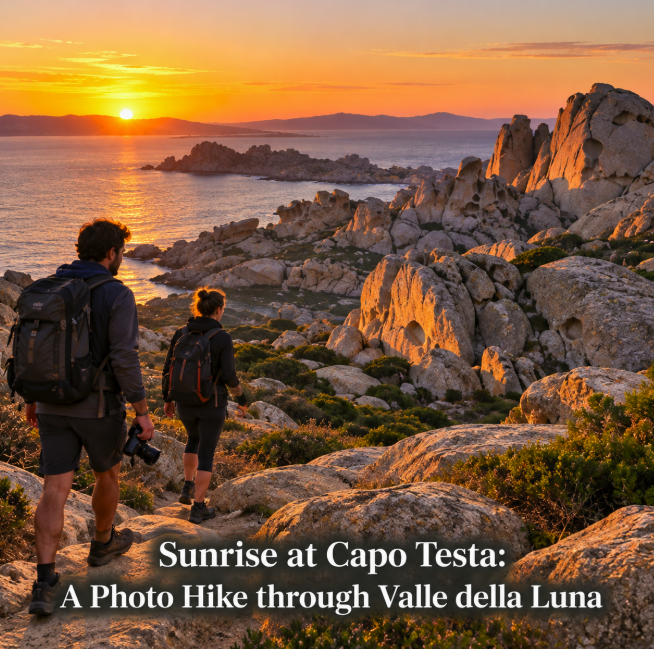
A sunrise walk at Capo Testa, near Santa Teresa Gallura, offers something different from the classic Sardinian beach morning. The headland is a maze of pale granite, low Mediterranean scrub, small coves and open views across the Strait of Bonifacio. Nearby Valle della Luna, also known as Cala Grande, adds a wilder landscape of rounded boulders and informal paths. For photographers, arriving around dawn means softer light and fewer people, but it also means walking rough ground before the day is fully bright.
Capo Testa is not one single marked hiking trail. The promontory has several short paths and rocky approaches, including the lighthouse and Cala Spinosa side and the western side leading toward Valle della Luna. That variety is part of the appeal, but it makes preparation important when you plan to arrive before sunrise.
Why early morning works for photography
The granite is the main photographic subject. Low-angle light emphasizes its texture, cavities and wind-shaped forms much more strongly than the flatter light around midday. Even when the sun itself is not positioned exactly where you imagined, the first warm light can transform rocks and vegetation across the promontory.
Capo Testa also faces multiple directions because it projects into the sea. Instead of thinking only about photographing the sun on the horizon, look for reflected color, side lighting on granite, silhouettes and views across the Strait of Bonifacio.
Conditions change with cloud, haze and wind. Corsica can sometimes be visible across the strait, but visibility should never be treated as guaranteed. A hazy morning may produce softer photographs even when distant land disappears.
Capo Testa or Valle della Luna first?
If your priority is an uncomplicated dawn viewpoint, the more open parts of Capo Testa around the lighthouse side can be easier to understand in low light than descending immediately into the maze of Valle della Luna.
Valle della Luna lies on the western side of the promontory and leads down through sculpted granite toward Cala Grande. Current hiking guides describe the terrain as easy to moderate overall, but with irregular granite, short climbs and descents and places where hikers may use their hands for balance.
The access paths are informal rather than a perfectly signed tourist promenade. That matters before sunrise. A route that looks obvious at noon can be surprisingly confusing when rocks and scrub are still in shadow.
For a first visit, one practical approach is to be near an open Capo Testa viewpoint for the first light and enter Valle della Luna once visibility improves. You still get the quiet early-morning atmosphere without making the roughest navigation the first task of the day.
How long should you allow?
A short photographic visit can be completed without doing a full circuit. Recent route descriptions put a Valle della Luna exploration at roughly 45 minutes to two hours depending on how far you wander and how often you stop, while a recently documented Capo Testa loop is approximately 5.3 kilometres with modest elevation but varied surfaces.
Photographers should allow more time than the walking distance suggests. Granite formations create dozens of possible compositions, and the changing light can make the same viewpoint look completely different ten minutes later.
If you want to combine the lighthouse area, Valle della Luna and Cala Grande, treat the outing as a substantial morning rather than a quick sunrise stop.
Bring a headlamp, not just your phone
Starting before dawn means a proper light is essential. A headlamp keeps both hands available for balance and leaves your phone battery available for navigation and emergencies.
Wear shoes with reliable grip. The terrain includes rock, dirt, gravel and sand, and exposed granite can be awkward when damp. Hiking shoes are a better choice than beach sandals for the approach.
Carry water even if the morning feels cool. Once you leave the roadside and developed areas, services are extremely limited and shade is scarce. By later morning, exposed rock can heat quickly.
Wind can matter more than temperature
Capo Testa is highly exposed to the Strait of Bonifacio. A calm forecast in Santa Teresa Gallura does not necessarily mean the outer headland will feel equally sheltered.
Check wind speed and direction before leaving. Strong wind makes exposed rocks less comfortable, complicates tripod use and can make drone photography inappropriate even when aviation rules would otherwise permit a flight.
For conventional cameras, keep the tripod low and stable. A small travel tripod that works perfectly in a sheltered city may vibrate on an exposed granite viewpoint.
Parking before sunrise
Capo Testa is around a short drive from Santa Teresa Gallura. Parking is limited around the headland, and summer parking arrangements are managed seasonally. Current 2026 local guidance indicates that paid parking resumed from June 1, while the latest published municipal tariff cited by local guides covered daytime charging rather than the pre-dawn period.
Do not assume that arriving before the attendants or charging hours allows you to park anywhere. Use legal spaces, keep narrow roads and entrances clear and read the signs at the location. Parking rules and seasonal arrangements can change.
The seasonal beach bus is useful during the day but is not a sunrise solution: current 2026 information shows the first service from Santa Teresa Gallura leaving well after dawn. For a true sunrise outing, a car, taxi or other privately arranged transport is more realistic.
September is particularly comfortable for an early walk
Late September brings cooler mornings than the height of summer and generally less pressure on paths and parking than peak August. The sea can still retain summer warmth, making a swim after the hike appealing when conditions are safe.
There is still very little shade on the exposed headland. If you remain after sunrise, sun protection becomes useful quickly even though you started the walk in cool air.
Because daylight changes every day, check the actual sunrise time for Santa Teresa Gallura the evening before rather than relying on a generic Sardinia sunrise chart. Aim to be in position before the official sunrise if you want the blue-to-gold transition.
Photography without damaging the landscape
The most dramatic photograph does not require standing on the highest boulder. Capo Testa offers strong foregrounds almost everywhere: granite textures, low shrubs, narrow sea channels and rock silhouettes.
Avoid trampling vegetation to create a new angle, and do not move rocks or leave markers for a photograph. Staying on existing tracks also reduces the chance of losing the route in a landscape where similar-looking formations can make orientation difficult.
For portraits, use people as scale against the granite rather than placing them close to cliff edges. The landscape is visually powerful enough without manufacturing risk.
A simple sunrise plan
Arrive while there is enough pre-dawn light to orient yourself safely, use an open Capo Testa viewpoint for the first photographs, then explore the rocky paths toward Valle della Luna as visibility improves. Carry water, a headlamp and shoes suitable for uneven granite, and keep the route shorter if wind or footing feels uncomfortable.
After the golden light fades, continue toward Cala Grande if conditions and your experience allow, or return toward the lighthouse and nearby coves. There is no need to complete a long loop simply because you started early.
Capo Testa works so well for photography because the attraction is not one famous viewpoint. The changing light moves across an entire landscape of granite and sea. At sunrise, that gives photographers the freedom to walk slowly, change direction and let the terrain — rather than a single social-media composition — decide where to stop.