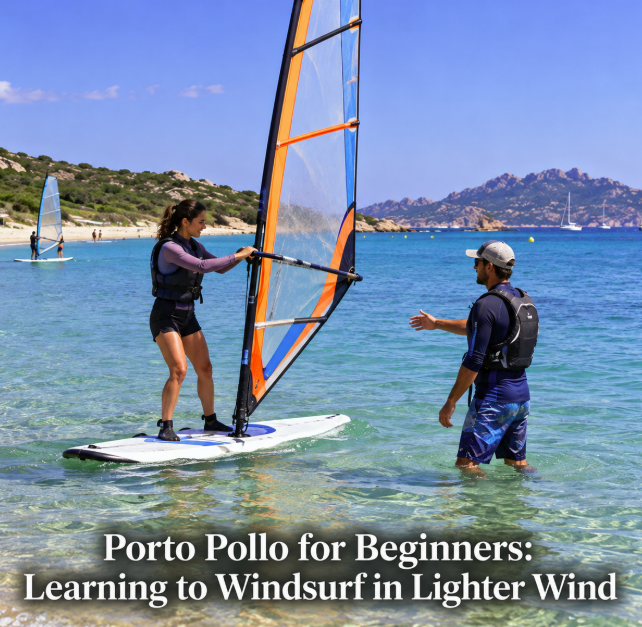
For a first windsurfing lesson in Sardinia, Porto Pollo near Palau is one of the most practical places to start. The reason is not simply that it is famous for wind. Its narrow isthmus creates two different water environments: one side can be windier and more demanding, while the more sheltered side offers flatter, calmer water that local schools use for learning. Beginners looking for gentler conditions should also favor the earlier part of the day, before the wind commonly strengthens.
This distinction matters because Porto Pollo has a reputation for strong Mistral conditions. That reputation is deserved, but it does not mean every beginner lesson involves fighting a powerful wind. Established schools adapt the equipment, teaching area and lesson time to the conditions.
Why Porto Pollo works for first lessons
Porto Pollo lies on a narrow strip connecting the mainland with Isuledda, also known as Isola dei Gabbiani. The geography creates two contrasting sides within a very small area.
Wind Porto Pollo, one of the established local schools, describes the spot as exposed to sometimes strong wind on one side while offering flat, calm water on the other, specifically identifying the calmer side as suitable for learning safely. Porto Pollo Pro Center similarly highlights shallow water and natural protection from the bay as reasons the area works for people approaching windsurfing for the first time.
For a complete beginner, flat water is often more valuable than simply finding the weakest possible wind. Small waves and chop make balancing, lifting the sail and controlling direction more difficult. A sheltered training area allows the student to concentrate on stance, steering and turning.
Look for lighter morning wind
Porto Pollo's wind can build during the day. Current local spot guidance describes mornings as generally gentler for beginners, with the thermal component often strengthening from midday onward.
This does not create a guaranteed daily schedule. The Mistral can be strong even in the morning, and weather systems can completely change the pattern. But if your priority is learning in lighter wind, asking a school for an early beginner session is sensible.
Do not choose a lesson time solely from a generic weather app. A local instructor can judge which side of the bay and which sail size fit the actual conditions.
How much wind does a beginner need?
A first lesson does not require the powerful wind associated with advanced windsurfing. Beginners normally use large, stable boards and relatively small, manageable sails so they can learn to move, turn and return without needing to plane at high speed.
This is visible in the way Porto Pollo schools separate their courses. Sporting Club Sardinia's current windsurf program lists beginner lessons independently from funboard instruction; its funboard courses specify wind above 15 knots, while the introductory beginner courses do not impose that stronger-wind threshold.
That is a useful clue for travelers: you do not need to wait for a dramatic Mistral day to try windsurfing. In fact, very strong or gusty conditions can make a first session less productive.
Current beginner lessons at Porto Pollo
Wind Porto Pollo currently offers beginner instruction in English and Italian with certified instructors. Its 2026 beginner pricing lists a trial lesson at €55 for participants aged 15 and over and €50 for ages 7–14. A daily package with two lessons plus one hour of rental is listed at €110 for adults and €100 for ages 7–14.
Sporting Club Sardinia's current published price list similarly lists a beginner trial at €55 and a daily package at €110, with longer multi-session courses available for people who want to progress beyond the first start and turn.
Prices and availability can change, so these figures are useful as a 2026 reference rather than a guaranteed walk-up rate. Reserve directly with the school and confirm what equipment, insurance and supervision are included.
Do not confuse the beginner side with the advanced side
The beauty of Porto Pollo is also what can confuse first-time visitors. Walk a short distance across the isthmus and the water can look completely different.
The more exposed side can develop stronger gusts and chop and attracts experienced windsurfers, kiters and riders looking for more dynamic conditions. The sheltered side is where a novice can work on basic sail control without immediately dealing with the same sea state.
Follow the school's assigned teaching zone rather than simply launching wherever experienced riders are congregating. Strong wind is exciting to watch but is not automatically better for learning.
When to go
Porto Pollo has a long water-sports season, broadly from spring into autumn. Wind-focused travel guides identify April through October as the useful period, with the core summer months providing frequent wind.
June and September are attractive choices for learners because they combine warm Mediterranean conditions with fewer peak-season crowds than August. September in particular can work well for travelers who want to combine a lesson with a wider Gallura road trip.
However, there is no month when every day provides gentle beginner wind. The north of Sardinia is exposed to the Mistral, and conditions can change rapidly. Build some flexibility into the itinerary rather than scheduling one non-negotiable two-hour window.
Can children learn at Porto Pollo?
Yes. Current local programs include dedicated children's instruction. Sporting Club Sardinia lists play-oriented windsurf sessions for ages four to six and beginner courses from age seven upward. Wind Porto Pollo also publishes junior pricing and small-group formats.
For children, the same principles become even more important: appropriately sized equipment, shallow or protected water, professional supervision and conditions matched to the student's size and confidence.
What to bring
For a first lesson, renting locally is far easier than transporting windsurf equipment to Sardinia. Schools at Porto Pollo have boards and sails designed for different levels, allowing the instructor to change equipment as the wind changes.
Bring swimwear, strong sun protection, drinking water and a towel. Ask the school whether a wetsuit, buoyancy aid and footwear are included or recommended for the date of your lesson. Water temperature and wind chill vary through the season.
If you already windsurf but remain a beginner, tell the instructor exactly what you can do — for example, whether you can start, tack and return to your launch point. That makes it easier to choose the right board and lesson rather than repeating skills you already have.
Porto Pollo or somewhere with almost no wind?
Completely calm water is not the objective. Windsurfing needs enough wind to power the sail and teach the relationship between wind direction, board direction and sail position.
What beginners need is manageable wind combined with forgiving water. Porto Pollo's sheltered side provides that combination more reliably than a random Sardinian beach where the breeze may be weak but offshore, gusty or unsupported by a school.
For someone who has never touched a windsurf board, the sensible strategy is to book a morning lesson, let the instructor select the protected teaching area and avoid chasing a particular wind number from an app.
Porto Pollo may be famous for high-wind action, but its quieter side tells the other half of the story. With shallow water, flat sections, beginner equipment and established instruction, it is also one of Sardinia's most approachable places to learn what to do with a sail before the stronger wind arrives.