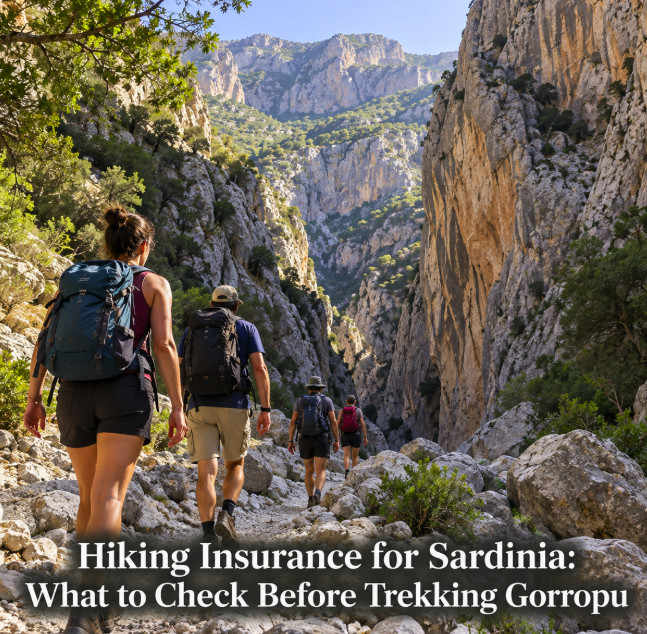
If hiking Gorropu is part of your Sardinia trip, do not assume that an ordinary travel insurance policy automatically covers everything that can happen on a remote trail. Before buying or relying on a policy, check that recreational hiking is covered at the difficulty you plan to attempt and look separately at emergency medical treatment, medical evacuation, search and rescue, activity exclusions and any altitude limits. Gorropu is a wild limestone canyon in the Supramonte, and the official operator offers routes ranging from easier approaches to panoramic and more physically demanding full excursions.
This does not mean travelers need a special “Gorropu insurance” product. The goal is to make sure the policy you already have — or the travel policy you are considering — actually covers the activity you will be doing rather than discovering an exclusion after an accident.
Why Gorropu deserves more attention than a beach walk
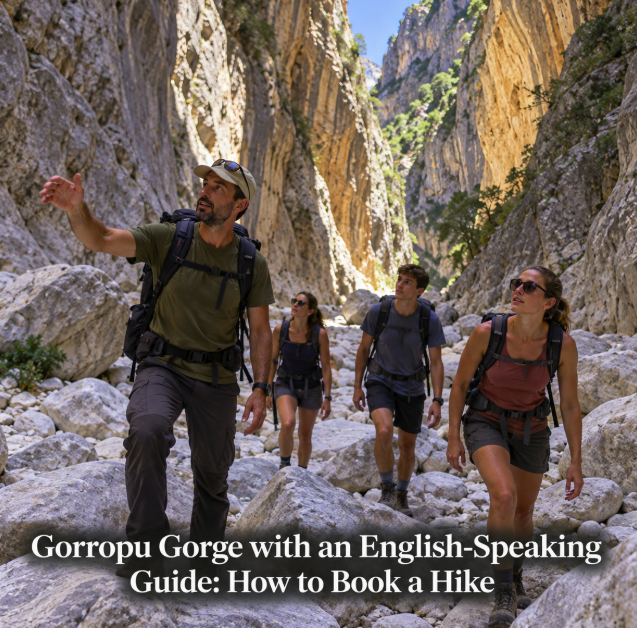
Gorropu lies between Urzulei and Orgosolo in rugged inland Sardinia. The official canyon operator, Chìntula, describes a gorge around 1.5 kilometres long, cut deeply into the limestone, with sections narrowing to only a few metres.
Visitors can choose different approaches. The official excursion program includes an easier option using an off-road transfer, a panoramic route from Ghenna Silana for stronger walkers, a more demanding full route, and a longer approach from Ponte s’Abba Arva.
Those differences matter to an insurer. A straightforward marked hike may fall within standard recreational hiking coverage, while technical scrambling, climbing, canyoning, abseiling or an activity requiring specialist equipment can fall into a different category or require an adventure-sports add-on.
Describe what you plan to do accurately when checking the policy. “Walking in Sardinia” and “technical canyoning” are not interchangeable insurance descriptions.
Check hiking and trekking coverage first
Read the activity list or sports section of the policy wording, not only the marketing page. Look for terms such as hiking, trekking, walking, scrambling, mountaineering and canyoning.
If hiking is covered only on recognized trails, check whether your planned route meets that definition. If the policy sets an altitude limit, confirm that the entire itinerary remains within it. If you plan to leave normal hiking routes with a guide for a more technical excursion, ask the insurer in writing whether that specific activity is covered.
A useful policy should also explain whether hiking must be recreational rather than competitive and whether a licensed or qualified guide is required for certain activities.
Medical evacuation is not the same as search and rescue
This is one of the most important details to understand. Travel insurance may advertise emergency medical evacuation, but that term can refer primarily to transporting an injured traveler to an appropriate medical facility after assistance has reached them.
Search and rescue can be a separate benefit. It concerns locating, reaching and recovering someone from a remote or difficult environment. Policy definitions vary, so do not assume that a large medical-evacuation limit automatically means an equally large mountain-rescue benefit.
When comparing policies, look specifically for language covering search, rescue, recovery or mountain rescue. Check the monetary limit, exclusions and whether the insurer's emergency-assistance service must authorize expenses when circumstances allow.
How mountain rescue works in Italy
Italy's Corpo Nazionale Soccorso Alpino e Speleologico — CNSAS — operates within the public emergency system for mountain, cave and difficult-terrain rescues. In an emergency, the European emergency number is 112.
CNSAS clarified in July 2026 that the rescue organization itself does not ask rescued people for payment and does not decide whether costs are charged. Any patient contribution or charge that applies in particular circumstances is governed by regional or provincial rules and handled by the relevant health authority.
CNSAS also stresses that uncertainty about cost should never delay an emergency call. If someone is in danger or a situation is becoming unmanageable, requesting help is the correct action.
That public rescue framework is not a reason to skip insurance. A travel policy may also cover medical treatment, later transportation, repatriation, trip interruption and other costs that are separate from the initial rescue operation.
Helicopter rescue: read the wording carefully
Helicopters are used by Italian mountain rescue when the medical situation, terrain and conditions justify them. CNSAS explains that helicopter operations are integrated with the emergency health system and are used to reach people in hostile environments and speed hospitalization.
A travel policy may refer to helicopter evacuation, but the exact conditions matter. Some benefits apply only when medically necessary; others distinguish between rescue from the incident site and medical transport after stabilization.
Do not choose a policy merely because a comparison table contains the word “helicopter.” Read the definitions and limits in the actual policy certificate.
Medical expenses still matter
For international visitors, emergency medical coverage remains fundamental even when the planned activity is hiking. A fall can result in fractures, imaging, surgery, hospitalization or follow-up treatment that has nothing to do with the eventual cost of the rescue itself.
US travelers should not assume that their domestic health plan provides the same benefits abroad. Medicare generally has very limited coverage outside the United States, and private US insurance varies. Check your existing plan before relying on it in Italy.
Travel medical insurance should be assessed alongside hiking coverage rather than as a substitute for it.
What exclusions should you look for?
Common policy issues include activities excluded above a specified altitude, off-trail hiking, technical climbing, canyoning, participation while intoxicated, deliberate disregard of official warnings and activities requiring specialist equipment.
Weather is particularly relevant at Gorropu. The official operator says the gorge is generally visitable from around mid-March to mid-November and discourages visits outside that period because adverse weather can increase rockfall risk, days are shorter and visitor services may be incomplete.
It also advises contacting the concessionaire when forecasts are adverse. Ignoring a closure or explicit safety warning can create obvious danger and may complicate an insurance claim depending on the policy.
Guided or independent?
Gorropu offers both guided and unguided options at different levels. Hiring a guide does not replace travel insurance, and insurance does not replace good route judgment.
For visitors unfamiliar with the Supramonte, a guided excursion can simplify navigation, transport and route selection. The official operator offers several formulas matched to different fitness levels and provides off-road transfers from the canyon area during operating periods.
If your insurance requires a qualified guide for a particular activity category, verify that requirement before booking rather than assuming any organized tour satisfies it.
What to carry on the hike
Insurance is useful after something goes wrong; preparation reduces the chance of needing it. Carry enough water, sun protection, suitable footwear and an offline map or route information. Tell someone your route and expected return time.
CNSAS promotes GeoResQ, a mountain-safety app that can transmit a rescue request with the user's location and help emergency coordination. Mobile reception is never guaranteed in rugged terrain, so an app should be considered an additional tool rather than a reason to take fewer precautions.
Save 112 in your phone, keep the battery charged and be prepared to describe your location, route, condition of the injured person and number of people in the group.
A practical insurance checklist for Gorropu
Before departure, confirm in the policy wording that your exact type of hiking is covered. Check the medical-expense limit, emergency medical evacuation, explicit search-and-rescue benefit, any altitude restriction, off-trail rules, guided-activity requirements and exclusions for scrambling, climbing or canyoning.
Then check the claims procedure. Save the insurer's 24-hour assistance number and policy details offline. If an emergency occurs, contact 112 first when immediate rescue is required; insurance administration comes after safety.
Finally, do not buy coverage based solely on a generic phrase such as “adventure travel.” The useful question is much more specific: would this policy cover the exact Gorropu route and activity I plan to do?
For a standard hiking visit, many travel policies may be suitable when hiking is an included recreational activity. For technical excursions or canyoning, the answer can be very different. Ten minutes spent reading the activity definitions before flying to Sardinia is far easier than arguing about them after an accident in the Supramonte.