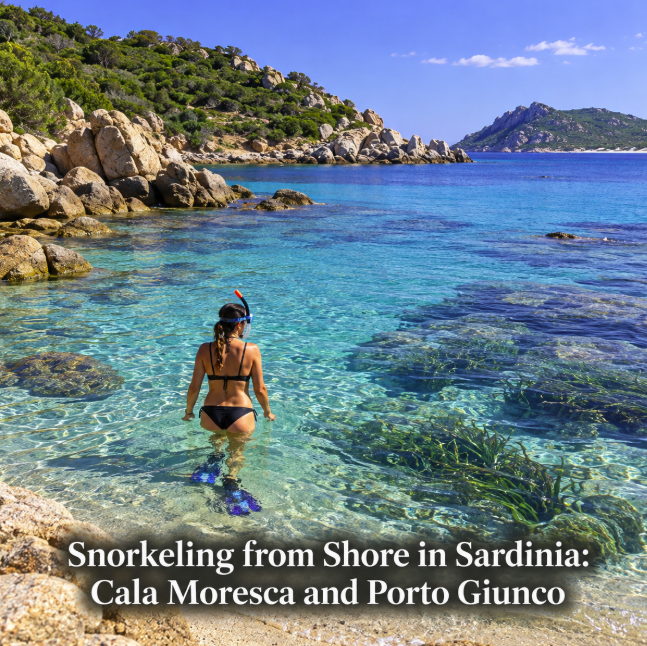
You do not need a boat to find worthwhile snorkeling in Sardinia. Two useful examples are Cala Moresca near Golfo Aranci in the northeast and Porto Giunco at Villasimius in the southeast. Both let you enter the water directly from shore, but they offer different experiences: Cala Moresca is a small, natural cove with rocks close to the beach, while Porto Giunco is a much larger sandy beach inside the protected marine environment of Capo Carbonara.
For snorkeling, the prettiest sandy patch is rarely the most interesting place to swim. Fish and other marine life are generally easier to observe where sand meets granite, rock or seagrass. At both beaches, that means moving away from the center of the swimming area and exploring the rocky margins only when sea conditions are calm.
Cala Moresca: a compact cove made for exploring
Cala Moresca lies on the Capo Figari promontory, a little over two kilometres from the center of Golfo Aranci. The Comune di Golfo Aranci describes two small beaches with shallow water for the first few metres, followed by deeper water, with rocky formations emerging through clear emerald and turquoise sea.
The municipality's tourism information specifically identifies the cove as suitable for snorkeling. Its mixed rocky and sandy seabed, together with possible Posidonia seagrass, gives swimmers more variety than a completely sandy bottom.
The island of Figarolo sits offshore and dominates the view, but a shore snorkeler does not need to swim toward the island to have an interesting session. Staying around the protected cove and its rocky margins is the more sensible plan, particularly for casual swimmers.
Cala Moresca is also sheltered by its shape and surrounding granite, although no cove is calm in every wind direction. Check the sea before entering and abandon the plan if waves are pushing strongly onto the rocks.
You have to walk to Cala Moresca
The cove's natural character comes with a practical limitation: you cannot drive directly onto the beach. The Comune di Golfo Aranci lists access by land or sea but excludes motor vehicles at the final approach, and current local tourism information describes roughly a ten-minute walk after leaving the vehicle.
There are no normal beach services at the cala. Bring drinking water, sun protection and whatever snorkeling equipment you need. That also means carrying everything back out with you.
The lack of a beachfront road is part of the appeal. Once in the cove, the setting feels far removed from the nearby port and town despite being only a short distance from Golfo Aranci.
Porto Giunco: easy beach access inside a marine protected area
At the other end of Sardinia, Porto Giunco is one of the best-known beaches at Villasimius. It forms part of the Capo Carbonara Marine Protected Area, an 86-square-kilometre protected marine environment of beaches, granite formations, Posidonia meadows and diverse marine habitats.
SardegnaTurismo specifically identifies Porto Giunco as a destination for snorkeling and diving enthusiasts. The main beach is broad and sandy, so for snorkeling the more interesting terrain is generally toward rocky edges rather than directly over the central sand.
Recent shore-snorkeling guidance for Capo Carbonara points to the rocky sides of Porto Giunco as areas where granite and Posidonia create more varied habitat close to the surface. As always, what you actually see depends on visibility, season and luck; no beach can guarantee a particular fish or animal.
Porto Giunco is easier for travelers who want facilities. The beach has parking nearby, bathing services and refreshment points, and official cultural information describes the final walk from the parking area as short and easy.
Respect the protected water at Villasimius
Porto Giunco's underwater environment is valuable partly because it sits inside the Capo Carbonara Marine Protected Area. The reserve is divided into zones with different levels of protection, and the rules are not the same everywhere.
Ordinary swimming and surface snorkeling are compatible with the accessible parts of the area, but some reserve zones carry stronger restrictions. Spearfishing is prohibited throughout the marine protected area, and Zone A integral-reserve waters have much stricter access rules, including restrictions on swimming.
For a simple beach snorkel at Porto Giunco, stay in the normal bathing area and follow local signs and lifeguard instructions. Do not collect shells, marine organisms or plants, and avoid standing on or pulling at Posidonia.
What you may see
Nearshore Sardinian snorkeling is about habitat more than spectacular guaranteed encounters. Over sand, you may see small fish moving across the bottom. Around rocks, cracks and seagrass, the environment becomes more complex.
The wider Capo Carbonara ecosystem supports species including sea bream, mullet, octopus, groupers and numerous smaller reef-associated fish, while the protected waters around Capo Figari and Figarolo also support varied marine life. That does not mean all of those animals will appear on a short swim from the beach.
Go slowly. Many first-time snorkelers swim too quickly and spend the entire session looking for a large animal. Stop above the transition between rock and sand, float quietly and watch the small movements below you.
Morning is often the easiest time
For shore snorkeling, calm water matters more than the name of the beach. Early morning can often bring lighter local wind and fewer swimmers, although Sardinia's weather does not follow a guaranteed daily pattern.
Check the wind and waves on the actual day. If one coast is exposed, a beach on another side of the island may be much calmer. Visibility can deteriorate after strong wind or waves stir sand and sediment.
September can be particularly pleasant because the sea retains much of its summer warmth while beaches are generally less crowded than in August. A rash vest or thin thermal layer can still make a long snorkeling session more comfortable.
Basic shore-snorkeling safety
Use a well-fitting mask and snorkel, and consider fins if you are comfortable using them. Enter where footing is easy rather than scrambling across slippery rocks just to reach a more dramatic starting point.
Do not snorkel alone in unfamiliar water. Keep an eye on your distance from shore, especially when wearing fins: they can make the outward swim feel effortless while hiding how far you have traveled.
A brightly colored surface marker or snorkeling buoy can improve visibility where local rules permit it, particularly outside tightly controlled bathing lanes. Never assume boats can see a swimmer simply because the water is clear.
Most importantly, turn back before you are tired. Snorkeling should remain an easy swim, not become an endurance exercise.
Cala Moresca or Porto Giunco?
Choose Cala Moresca if you are staying around Olbia or Golfo Aranci and want a smaller natural cove where rock, sand and seagrass are close together. The short walk and lack of services make it feel more secluded, but you need to arrive prepared.
Choose Porto Giunco if you are around Cagliari or Villasimius and want a famous sandy beach where snorkeling can be combined with a full beach day. Facilities and easier access make it convenient, while the protected Capo Carbonara environment gives the surrounding water real ecological interest.
Neither requires a boat, and neither requires swimming far offshore. That is the useful lesson for snorkeling in Sardinia: some of the island's most enjoyable underwater exploring begins only a few metres beyond the beach, wherever clear water meets granite, seagrass and a little patience.