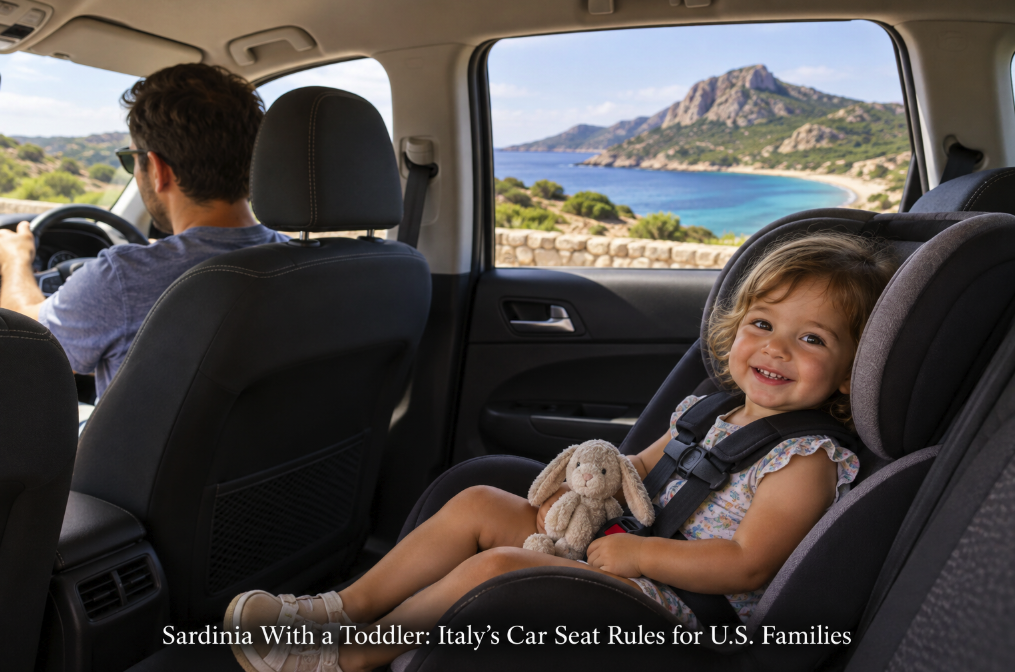
For American parents planning to explore Sardinia by rental car, the most important rule is simple: Italian child-restraint law applies while you are driving in Italy, including on the island. Under Article 172 of Italy’s Highway Code, children under 1.50 metres (about 4 ft 11 in) must be secured with an approved child-restraint system appropriate for them. That makes the car seat an essential part of planning a Sardinian road trip with a toddler, not an optional rental-car extra.
The 150 cm rule in Italy
Italian law requires children shorter than 1.50 metres to use an approved child-restraint system. The rule is based primarily on the child’s size rather than the familiar U.S. pattern of relying only on age thresholds. The restraint must be suitable for the child and homologated under the applicable standards.
For visiting families, the practical approach is to check the approval label on the seat rather than assuming that a seat acceptable at home automatically meets the requirements used in Europe. Current European child-restraint standards include UNECE Regulation No. 129, commonly associated with the i-Size system, which classifies restraints according to a child’s height. Italy’s Automobile Club, ACI, advises parents to check the homologation label and follow the seat manufacturer’s installation instructions.
This is particularly important for U.S. travelers considering bringing their own car seat. American and European approval systems are not identical. Before flying with a seat bought for the U.S. market, check its certification label and confirm that it is approved for legal use in Italy. When in doubt, reserving an appropriate approved seat from a reputable rental company can avoid uncertainty.
Rear-facing seats and the front passenger seat
Italy specifically prohibits carrying a child in a rear-facing restraint on a front passenger seat when the frontal airbag is active. A rear-facing seat may be placed there only if the airbag has been deactivated appropriately. For most families renting a car in Sardinia, installing the child seat correctly in the rear is the simpler arrangement.
Parents should also verify how the seat attaches to the particular rental vehicle. Depending on the approved restraint, installation may use ISOFIX anchor points or the vehicle’s seat belt. Do not assume every rental-car model has exactly the same mounting arrangement, even within the same vehicle category.
What about Italy’s anti-abandonment device?
Italy also has a rule concerning anti-abandonment alarm devices for children under four. The wording of Article 172 is important for foreign visitors: the requirement applies to vehicles registered in Italy, or vehicles registered abroad when driven by residents of Italy. A U.S. tourist renting an Italian-registered car should therefore ask the rental company how the vehicle and supplied child seat comply with the applicable requirement rather than assuming the rule can be ignored because the driver lives abroad.
If you are reserving a child seat with the car, tell the rental company the child’s age, height and weight in advance and ask exactly what type of restraint will be provided. At collection, inspect the seat, check its approval label, make sure all required components are present and install it according to its instructions before leaving the rental area.
Taxis are a special case
Italian law contains an exception for taxis and chauffeur-driven hire vehicles. Children no taller than 1.50 metres may travel without a child-restraint system in these vehicles provided they sit in the rear and are accompanied by a passenger aged at least 16. That legal exception should not be confused with a recommendation that young children travel unrestrained. Families who want a child seat for airport transfers or taxi journeys should arrange one in advance with the transport provider.
This can matter immediately after landing at airports such as Alghero, Olbia or Cagliari. If the plan is to collect a rental car at the airport, reserve the child restraint at the same time as the vehicle. If someone else is providing the transfer, ask whether an appropriate approved child seat can be supplied.
A useful checklist before driving in Sardinia
- Record your child’s current height and weight before booking the car.
- Reserve the appropriate child restraint in advance rather than relying on availability at the rental desk.
- If bringing a U.S.-purchased seat, verify its homologation for use in Italy before departure.
- Check the restraint’s approval label and condition when collecting a rental seat.
- Follow the manufacturer’s installation instructions and confirm compatibility with the vehicle.
- Never use a rear-facing restraint in front of an active passenger airbag.
- For a child under four, ask the rental company about compliance with Italy’s anti-abandonment-device requirement.
- Arrange a child seat in advance for private transfers if you do not want to rely on the legal taxi exception.
These rules apply across Italy, so there is no separate Sardinian car-seat law for visitors. What changes in Sardinia is the practical importance of getting the setup right: a car is often the easiest way for families to move between towns, beaches and rural areas, and journeys can involve winding roads and substantial distances. Sorting out the restraint before leaving the airport or rental office makes the rest of the trip much easier.
For the legal text, travelers can consult Article 172 of the Italian Highway Code published by ACI. ACI also provides guidance on child restraints and homologation standards. Because regulations and approved products can change, families should verify the rules again shortly before travel.