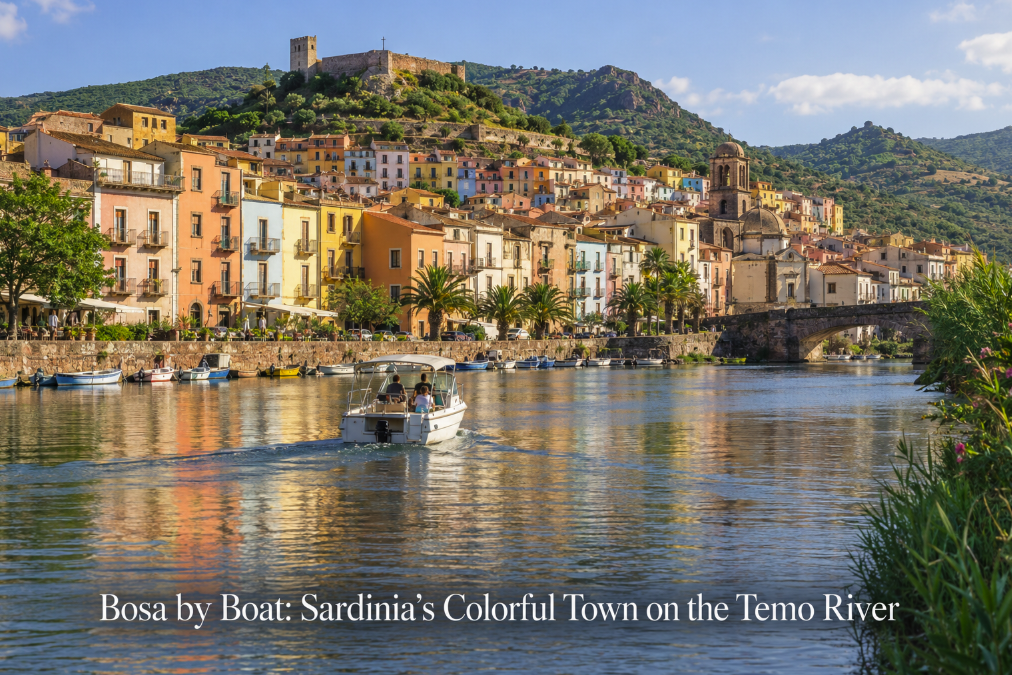
Bosa has the kind of view that works instantly on a phone screen: pastel houses climbing a hillside, a medieval castle above them and boats floating between colorful reflections. But the river running through the picture is more than a photogenic backdrop. The Temo is the only navigable river in Sardinia, and seeing Bosa from the water offers an unusual perspective on one of the island’s most distinctive historic towns.
Recent travel coverage has again been highlighting Bosa as one of Sardinia’s prettiest and most colorful towns. Its visual appeal is easy to understand, although claims that a particular description is “viral” on TikTok should be treated cautiously unless supported by public platform data. What can be verified is the geography behind the images: Bosa’s municipal authority describes the Temo as Sardinia’s only navigable river, for approximately six kilometres, while Italy’s official tourism portal identifies Bosa as the island’s only village that developed along the banks of a river.
Why Bosa looks different from the rest of Sardinia
The historic center rises from the northern bank of the Temo toward Serravalle hill. The closely packed houses of the Sa Costa quarter form a patchwork of pink, yellow, ochre and other Mediterranean shades, with the Malaspina Castle dominating the skyline above. From river level, the town appears almost layered: water and boats in the foreground, the riverside streets in the middle and the steep medieval quarter behind.
On the opposite side of the river, another part of Bosa’s identity survives in the old tanning district of Sas Conzas. Leather production was once closely connected to the Temo, and the former tanneries remain one of the town’s most recognizable architectural features. Italy’s official tourism portal notes that the complex was declared a national monument in 1989.
The river therefore gives visitors more than a scenic boat ride. It connects several chapters of Bosa’s history: fishing and small craft, the tanning industry, the old urban center and the route toward the sea at Bosa Marina.
Exploring the Temo by boat
Small-scale recreational boating is part of the river’s present-day use. In 2025, the Municipality of Bosa approved a plan regulating mooring areas along the Temo, including stretches associated with small recreational craft and seasonal tourism. That makes the river a living part of the town rather than simply a landscape feature.
Visitors interested in going out on the water should check locally for current operators, departure points, schedules and river conditions rather than assuming that services run every day. Availability can be seasonal and may change with weather, water conditions and local regulations. The useful distinction is that the Temo is navigable; this does not mean every section is permanently served by scheduled tourist boats.
A river outing can also be combined easily with exploring Bosa on foot. Around the waterfront, the old bridge and the riverbanks provide classic views of the houses reflected in the water. From there, the lanes and stairways of Sa Costa climb toward the castle. The contrast is part of Bosa’s appeal: from a boat the town looks like a compact wall of color, while inside the historic quarter it becomes a maze of narrow streets and changing viewpoints.
A west-coast stop that works beyond summer
Bosa sits on Sardinia’s western side in the Planargia area, with Bosa Marina and the Mediterranean coast close to the historic center. This makes it possible to combine river, town and coast without treating Bosa as only a beach destination.
For travelers coming from the north, the coastal journey between Alghero and Bosa is itself one of the memorable approaches to town. Once in Bosa, however, the Temo changes the rhythm completely. Instead of looking outward to the open Mediterranean, visitors can follow the water inland through an urban landscape found nowhere else on the island.
That combination also explains why Bosa performs so well in photographs and short travel videos. The colorful facades are immediately recognizable, but the more interesting story is what sits behind the image: Sardinia’s only navigable river, a medieval hillside settlement, an industrial heritage tied to tanning and a town whose relationship with water is different from the island’s familiar seaside resorts.
For anyone planning a visit, the best approach is not to chase a single social-media viewpoint. Walk both banks of the Temo, look across to Sa Costa, explore the former tannery district and, when current local conditions and services allow, see Bosa from a small boat. The river is not an accessory to the town’s beauty. It is one of the reasons Bosa exists in the form visitors see today.