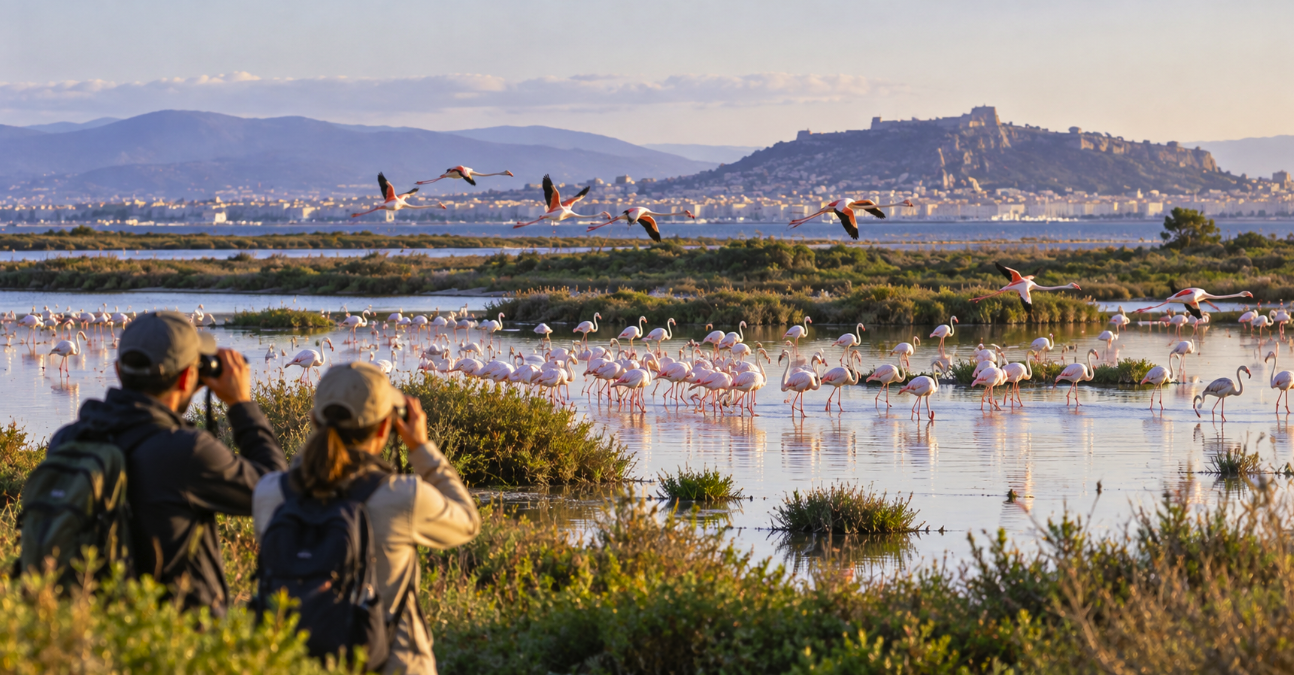
Pink flamingos are one of Sardinia’s most memorable wildlife encounters, and visitors do not need to travel deep into the countryside to find them. The Molentargius-Saline Regional Natural Park, between Cagliari and Quartu Sant’Elena, combines remarkably accessible flamingo watching with a protected wetland of international importance. For birders who want to go beyond the best-known site, the Stagno di Cabras on Sardinia’s west coast offers a quieter second wetland experience.
Molentargius: flamingos beside Cagliari
Molentargius covers roughly 1,600 hectares of former saltworks, ponds and wetland habitat immediately beside the urban area of Cagliari. The site was included under the Ramsar Convention in 1977, and the regional park was established in 1999. Today the greater flamingo is its emblematic bird.
Cagliari’s official tourism information notes that flamingos can be seen in the shallow waters alongside a much broader list of wetland species, including ducks, herons, little egrets, black-winged stilts, pied avocets, cormorants, terns, kingfishers and gulls. That diversity makes Molentargius much more than a quick flamingo photo stop.
Do you need a Molentargius flamingos tour?
No. General access to the park is free, and visitors can walk or cycle through public areas and use the park for birdwatching. For casual visitors, this makes Molentargius one of the easiest wildlife excursions to add to a stay in Cagliari.
A guided tour, however, can provide access to protected areas that ordinary visitors cannot enter independently. The official guided EcoSafari promoted by Città del Sale uses an electric minibus through the former saltworks and reaches the ecosystem area associated with flamingo nesting. Guides provide wildlife interpretation, and binoculars and a telescope are available for observation.
The current EcoSafari is approximately 1.5 hours. Third-party booking pages checked in September 2026 list it at around €25 per adult, but visitors should verify the current price and schedule directly when booking.
Flamingos are wildlife, not an attraction on a timetable
A tour improves access and interpretation; it does not guarantee that hundreds of flamingos will stand conveniently beside the vehicle. Birds move according to water levels, food, weather, breeding activity and disturbance. Numbers and viewing distances therefore change from day to day and season to season.
Bring binoculars even for a casual visit. Cagliari’s tourism office specifically recommends them, and binocular rental has also been offered through the park infopoint. A longer lens is useful for photography, but keeping distance is more important than getting a close image.
Birdwatching at Stagno di Cabras
After Molentargius, birders can build a broader Sardinian wetland itinerary around the Stagno di Cabras, near Oristano on the west coast. Cabras provides a different experience: a large lagoon landscape with fewer of the visitor facilities that make Molentargius so immediately accessible.
Flamingos can occur in the Cabras lagoon system along with other waterbirds and waders. For dedicated birdwatchers, the attraction is precisely that it feels less like an urban nature park and more like patient lagoon birding. A spotting scope becomes more useful here, since birds may be considerably farther away.
Rather than approaching the water’s edge or trying to reach resting birds, use established roads and appropriate observation points. Wetlands are feeding and breeding habitat, and maintaining distance is especially important when birds are nesting or resting.
Molentargius or Cabras: which should you choose?
If flamingos are your main objective and you have limited time, Molentargius is the easier first choice. It is close to Cagliari, has public paths, visitor infrastructure and official guided experiences. It is particularly suitable for travelers who want to combine a city break with two or three hours of nature.
Cabras makes more sense for visitors already exploring western Sardinia or for birdwatchers who want a second, less structured wetland environment. The two sites should not really be treated as competitors: together they show two different sides of Sardinia’s lagoon ecosystems.
A two-wetland Sardinia birdwatching itinerary
Start around Cagliari with a morning at Molentargius. Choose either an independent walk or an official guided excursion if access to protected areas and interpretation are priorities. Allow additional time rather than rushing away immediately after a flamingo sighting: stilts, herons, avocets and other species often provide some of the most rewarding observations.
On a separate day, travel west toward the Oristano and Cabras area and approach the lagoon as a slower birding session. Binoculars are essential; a spotting scope is even better. The west-coast stop can also form part of a wider nature and cultural itinerary rather than requiring a dedicated birding-only holiday.
Responsible flamingo watching
Stay on permitted routes, follow park and local regulations, avoid loud approaches and never attempt to force birds into flight for photographs. Molentargius has observation routes and hides specifically designed to let visitors watch wildlife while reducing disturbance. Some sensitive routes or areas may only be accessible with park guides or under specific conditions.
The reward for that restraint is a much better kind of Sardinia wildlife experience: flamingos feeding naturally in shallow water, wetland birds moving between lagoons and a chance to understand why these coastal habitats matter beyond the photograph.
Information checked September 2026. Molentargius access, birdlife and guided-tour information were verified against Cagliari’s official tourism portal and the park’s official guided-tour operator. Wildlife presence is never guaranteed, and visitors should check current access rules and tour schedules before setting out.