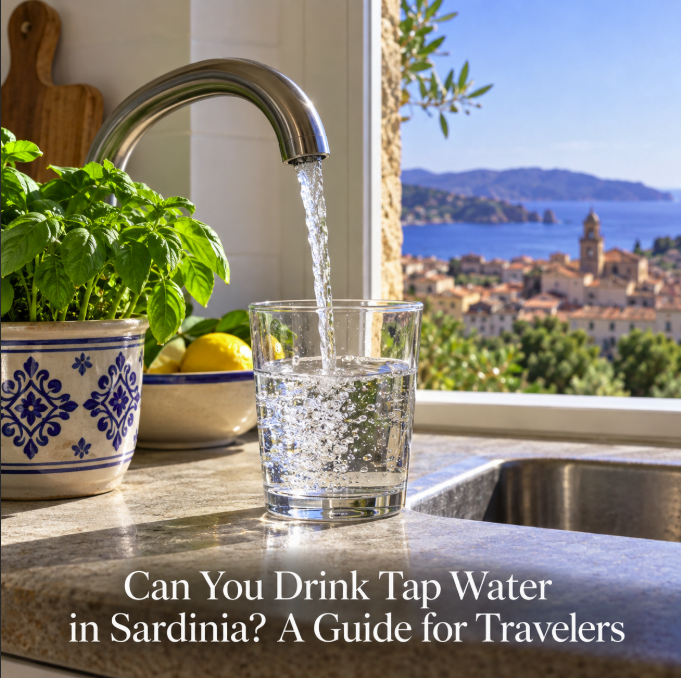
Yes: in Sardinia, tap water supplied through the public drinking-water network is generally intended for human consumption and is monitored under Italian and European drinking-water rules. For American travelers wondering whether they need to buy bottled water throughout their holiday, the practical answer is usually no. There is, however, an important local caveat: temporary restrictions can occur in individual towns or water networks, so visitors should pay attention to official notices at their destination.
Sardinia’s main integrated water operator, Abbanoa, says drinking-water quality is controlled under Italy’s Legislative Decree 18/2023, which implements the EU Drinking Water Directive. The company publishes water-quality data and says it performs around 12,000 samples a year, covering roughly 315,000 chemical and bacteriological parameters across the water supply process.
Why travelers sometimes hear conflicting advice
The confusion is understandable. Sardinia is a large island with a complex water system, and much of its raw water comes from reservoirs before treatment. Conditions can vary between areas and through the year, particularly during hot, dry periods when reservoir levels and raw-water characteristics may change.
This does not mean that Sardinian tap water is broadly unsafe. It means that local conditions matter. Abbanoa states that any restrictions caused by non-compliance are published through its official communications, while health authorities and municipalities can also issue or lift local ordinances concerning the use of water.
A useful recent example comes from the southwest of Sardinia. In July 2026, Abbanoa reported a deterioration in the quality of raw water reaching the La Tavernetta treatment plant, which serves Sarroch, Villa San Pietro, Pula and Domus De Maria. Treatment procedures were intensified, but the operator explicitly stated that the water distributed through the network remained suitable for human consumption and that the local health authority had been informed.
Temporary restrictions do happen. In July 2025, for example, authorities were able to lift restrictive ordinances affecting Sarroch, Villa San Pietro, Pula and Domus De Maria after the local health service issued a positive judgment on potability. That episode illustrates why a traveler should treat a specific municipal warning as more important than a generic answer found on a travel forum.
What should an American visitor actually do?
If you are staying in a hotel, B&B or holiday apartment connected to the normal municipal water network and there is no current restriction, tap water is generally intended to be drinkable. Filling a reusable bottle from the tap can therefore be a perfectly normal choice.
If your host tells you not to drink the water, ask why. There may be a temporary local notice, maintenance work, an issue within the building, or a private water supply rather than the standard public network. In those situations, follow the specific local guidance instead of assuming that advice applies to the whole island.
Travelers should also distinguish safety from taste. Mineral content, treatment and the characteristics of local water sources can make tap water taste different from what someone is used to in the United States. A noticeable mineral or chlorine taste does not by itself establish that the water is unsafe. Conversely, water that looks or tastes normal should not override an official non-potability notice.
Check the destination, not just “Sardinia”
The best question is therefore not simply “Can I drink tap water in Sardinia?” but “Is there a current drinking-water restriction where I am staying?” Before or during a trip, visitors can check Abbanoa’s official notices and the website or communications of the relevant municipality. Accommodation owners should also be aware of restrictions affecting their property.
This is particularly useful during periods of drought, infrastructure work or temporary changes in water supply. In August 2026, for example, Abbanoa reported an aqueduct failure affecting the Gallura coastal area from La Maddalena toward San Teodoro. The operator said supply was maintained from municipal reservoir stocks while repairs and system recovery were underway. Such events can affect pressure or continuity without automatically meaning that water is unsafe to drink.
For most visitors, then, there is no reason to arrive in Sardinia assuming that all tap water must be avoided. Public-network water is subject to regulated monitoring, and Abbanoa publishes detailed quality information. The sensible travel habit is simple: use tap water normally when no restriction is in force, and check official local information whenever your accommodation, municipality or water operator issues a warning.
That answer may be less dramatic than some forum discussions, but it is more useful: Sardinia does not have one permanent island-wide “yes” or “no” warning. Tap water from the public network is generally drinking water; temporary local conditions are the exception travelers need to watch for.