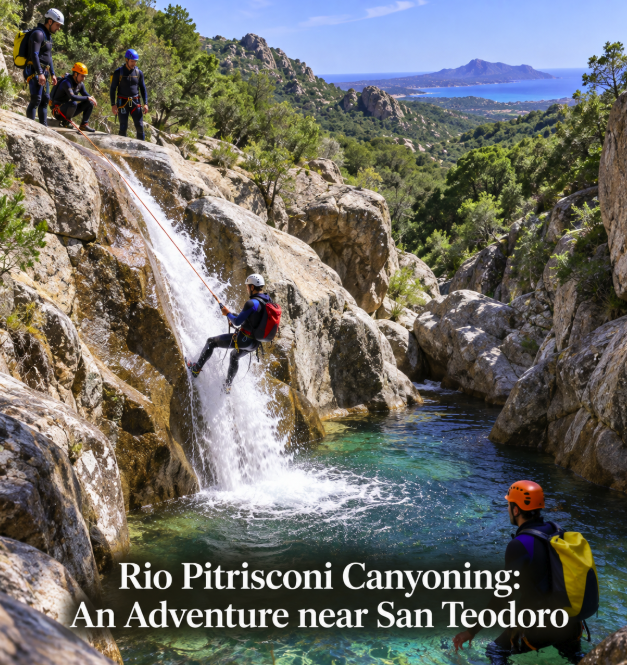
A few kilometers inland from the beaches of San Teodoro, Rio Pitrisconi offers a very different way to experience northeastern Sardinia. The stream cuts through the granite landscape of Monte Nieddu, creating natural pools, waterfalls and smooth rock passages that have become one of the island’s established canyoning routes. Current 2026 operators continue to run guided trips here, including options designed for first-time canyoners.
The experience typically combines walking, swimming, rappelling on ropes, natural slides and optional jumps. It is an adventure activity rather than a casual swim in a river, so physical condition, weather and professional guidance matter.
Where is Rio Pitrisconi?
Rio Pitrisconi lies in the Monte Nieddu massif behind San Teodoro, in Gallura in northeastern Sardinia. The landscape changes quickly once you leave the busy coast: granite mountains, Mediterranean vegetation and valleys replace the resort streets and beaches below.
Current local canyoning operators generally organize the approach from the San Teodoro area, with 4x4 transport used on the rougher road toward the forest area and canyon entrance. One current operator begins from the Straulas side of San Teodoro and reaches the forest station after roughly 20 minutes on an unpaved panoramic road.
This is useful for visitors staying around San Teodoro, Budoni or Olbia because the activity can fit into a vacation based on the northeast coast without requiring an expedition across Sardinia.
What happens during the canyon?
Once equipped with a wetsuit, helmet and harness, participants enter a granite watercourse shaped into pools, cascades and narrow passages. Depending on the route and current conditions, the day can involve rope descents, swimming, slides and jumps into natural pools.
A specialist Sardinian canyoning operator rates Rio Pitrisconi overall as PD, or slightly difficult, with a technical classification of V3A3II. It lists the highest vertical section at 18 meters. Another current San Teodoro operator describes its guided version as approximately 3 kilometers long, with three rappels and a maximum descent of 22 meters. These figures differ because operators can use different versions and sections of the canyon.
That is why travelers should pay attention to the exact excursion they book rather than assuming every “Rio Pitrisconi canyoning” tour follows an identical itinerary.
Is Rio Pitrisconi suitable for beginners?
Several current operators explicitly market Rio Pitrisconi as suitable for beginners. Prior rappelling experience is generally not required on introductory guided trips because guides provide a technical briefing and manage the rope systems.
Beginner-friendly does not mean effortless. One current operator requires good physical condition and says participants must not suffer from vertigo. Another describes the activity as requiring the ability to swim and a reasonable level of fitness.
The route involves wet and slippery rock, uneven terrain and time spent moving through a mountain environment. Travelers with medical, mobility or strong height-related concerns should discuss them with the guide before booking rather than deciding after reaching the first rappel.
How long does it take?
Current guided products generally take around five hours, although some operators quote five to seven hours depending on group speed and the version of the route. A specialist canyoning operator also distinguishes between a half-day route and a longer complete version.
This means Rio Pitrisconi is best treated as the main activity of the day. Avoid planning a fixed lunch reservation or airport transfer immediately afterward. Group pace, equipment, road transfers and canyon conditions can all influence the finishing time.
How much does canyoning cost in 2026?
Prices depend on the operator and booking channel. A current direct listing from Wild Project Sardinia advertises Rio Pitrisconi at €75 per person, with groups of four to twelve participants, a minimum age of eight and an estimated five-hour duration.
Third-party booking platforms can show higher prices because they may package the activity differently or apply their own commercial terms. Check what the price includes before comparing offers: canyoning equipment, 4x4 transport, photos, insurance arrangements and meeting-point transfers are not necessarily identical across providers.
Prices and availability can change, so the operator’s live booking page should be checked for the actual date of the excursion.
What should you bring?
The technical equipment is normally supplied on a guided trip, but participants should confirm the inclusion list before arrival. Wear or bring the footwear specified by the operator; secure shoes with suitable grip are far more appropriate than sandals or ordinary beach flip-flops.
Bring water and compact food or snacks according to the guide’s instructions. One current operator specifically recommends a sandwich, dried fruit or another durable snack and advises against glass bottles.
A dry change of clothes and towel are useful for afterward. Leave unnecessary valuables behind, and ask the guide how phones, cameras and car keys are handled during the wet sections.
Water levels change the experience
Rio Pitrisconi’s natural pools can retain water through the year, but the actual flow of the stream varies with season and rainfall. Specialist route information notes that summer flow can be intermittent even when the pools remain full.
This distinction matters. Photos showing a powerful waterfall do not guarantee identical conditions on your date, while heavy rain can create an entirely different safety situation. A responsible guide decides whether conditions are appropriate for the planned descent.
Do not judge canyon safety solely from the weather at a San Teodoro beach. Conditions in a mountain drainage system depend on recent rainfall and the wider catchment as well as sunshine at the coast.
Can you do Rio Pitrisconi without a guide?
Experienced canyoners may find technical route information for independent descents, but a tourist with no canyoning background should not treat Rio Pitrisconi like a self-guided swimming hole. Rope technique, anchors, route choice, water conditions and emergency management are part of the activity.
For beginners, a qualified guide and supplied technical equipment are the sensible way to experience the canyon. The fact that introductory commercial trips exist does not remove the underlying risks of moving through waterfalls and rappelling in wet terrain.
Why it works so well with a San Teodoro vacation
San Teodoro is usually associated with beaches such as Cala Brandinchi and Lu Impostu, shallow turquoise water and summer nightlife. Rio Pitrisconi shows the mountainous landscape immediately behind that coastline.
A canyoning day therefore creates a useful contrast during a beach-focused trip. Instead of another day on the sand, visitors move through granite pools and Mediterranean vegetation in Monte Nieddu, then return to the coast later in the day.
The route is also close enough to northeastern Sardinia’s main tourism base to work for travelers staying around Olbia or the Costa Smeralda, although exact meeting points and travel times should be confirmed with the chosen operator.
Before you book
Ask five practical questions: what version of Rio Pitrisconi will the group descend, how long should you allow, what equipment is included, what footwear is required and what is the cancellation policy if conditions are unsafe.
Also confirm the minimum age and fitness requirements for your specific provider. Current tours vary, and an age limit published by one operator should not be assumed to apply to every excursion.
Rio Pitrisconi is popular precisely because it can introduce newcomers to canyoning without removing the sense of adventure. The combination of granite, water, rappels and natural pools offers a side of San Teodoro that beach visitors can easily miss — but it is most rewarding when treated as a real mountain activity rather than an amusement-park attraction.