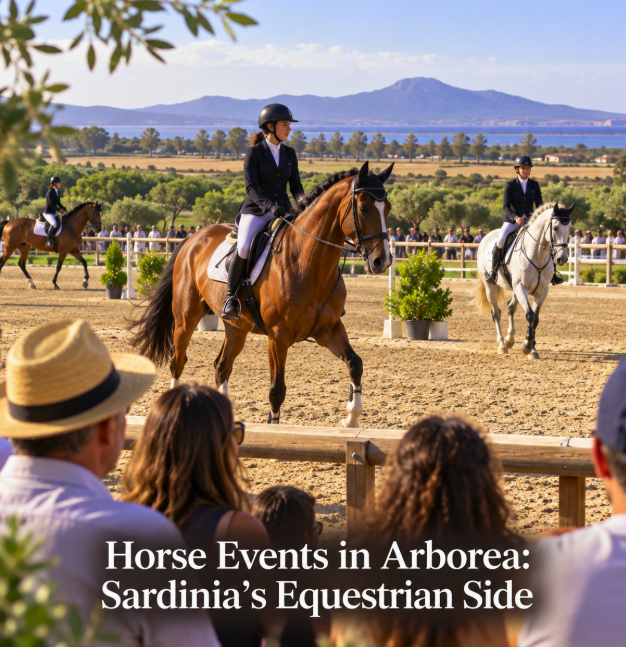
Arborea is one of the places where Sardinia’s strong relationship with horses is easy to see beyond the island’s famous traditional festivals. The flat countryside around the Gulf of Oristano, nearby beaches and lagoons have developed a genuine equestrian culture, and in August 2026 Arborea hosted a major regional event for young horses at the Ala Birdi Equicenter. For travelers searching for a “horse festival in Arborea,” however, it is useful to distinguish competitive breeding events from the spectacular traditional festivals held elsewhere in Sardinia.
The most important verified Arborea equestrian appointment of 2026 was the regional young-horse prize, part of Italy’s MASAF breeding circuit. It took place at Ala Birdi Equicenter from August 20 to 23 after the dates were moved forward from the originally scheduled August 27–30 weekend.
Nearly 200 young horses at Ala Birdi
The 2026 event was the 64th regional Sardinian young-horse prize and was organized by Circolo Ippico Grighine in collaboration with Circolo Ippico Usignolo. According to specialist equestrian reporting after the event, 192 young horses were presented to the judging panel during the first Arborea appointment.
The program focused on horses born in 2024 and 2025 as well as foals, with categories including Italian sport horses and Anglo-Arabs. This makes the Arborea meeting particularly interesting for visitors curious about breeding and Sardinia’s modern horse industry rather than only folkloric riding displays.
The official calendar change was made in July by the Italian Ministry responsible for the equestrian breeding circuit. The Arborea dates were brought forward to August 20–23 while the venue and organizing committee remained unchanged.
Why Arborea works for horse tourism
The equestrian identity of Arborea is not limited to competitions. Sardinia’s official tourism portal highlights the beaches and countryside around Arborea as a particularly suitable area for horse riding, with riding centers and services that take advantage of the unusual landscape.
Unlike the dramatic mountain trails associated with central Sardinia, the Gulf of Oristano around Arborea offers broad, relatively flat terrain. Riding excursions can connect pinewoods, beaches and lagoon environments where birdlife is an important part of the scenery.
This is one reason Arborea can make sense for a traveler who wants horses to be part of a broader Sardinia itinerary. You can combine an equestrian activity with the wetlands and coastline of the Oristano area rather than planning the entire trip around a single festival date.
Do not confuse Arborea with Sardinia’s traditional horse festivals
If your idea of a Sardinian horse festival involves costumed riders, high-speed ceremonial races and centuries-old religious traditions, other parts of the island offer more famous examples.
At Carnival, Sa Sartiglia in Oristano is one of Sardinia’s best-known equestrian celebrations, with masked riders, the race to spear a suspended star and acrobatic pariglie. In July, Ardia di San Costantino at Sedilo brings riders into a fast and deeply rooted devotional event around the sanctuary of San Costantino.
Nearby Palmas Arborea also has an equestrian tradition connected with its April festivities. Sardinia’s regional tourism portal describes the Pariglie Palmaresi, including a horseback procession, folk groups, an event in which riders attempt to spear three rings and subsequent acrobatic displays.
These events are culturally different from a breeding-circuit competition at Ala Birdi. They should not be treated as interchangeable simply because horses are central to all of them.
Arborea’s agricultural calendar
Arborea’s best-known annual public fair is actually agricultural rather than specifically equestrian. In 2026 the town’s Agriculture Fair was held on April 18 and 19 at the exhibition center on Strada 19 Est.
The program focused on agriculture and livestock, including the regional Italian Friesian cattle show, agricultural machinery, horticulture and the local strawberry festival. It reinforces Arborea’s identity as one of Sardinia’s important farming and livestock centers, but travelers should not assume that the spring fair is a dedicated horse festival.
That distinction matters when planning a trip around an online search result. A photo of horses in Arborea or a reference to livestock events does not guarantee an equestrian program on the dates of the Agriculture Fair.
Planning a horse-focused visit
If you want to watch a formal equestrian competition, check the current MASAF breeding-event calendar and the organizers at Ala Birdi before booking flights. The August 2026 event has already taken place, and future dates should not be assumed to fall on the same weekend.
For recreational riding, contact a local riding center in advance and ask about route, duration, required experience and minimum age. Beach riding can depend on season, local access rules and conditions, so a responsible operator may change the itinerary rather than promise a specific stretch of sand.
Travelers with no riding experience should say so when booking. Sardinia’s equestrian culture is accessible to visitors, but a calm guided excursion is very different from the athletic riding seen at competitive or traditional events.
Build an Oristano-area horse itinerary
Arborea works especially well as part of a wider western Sardinia trip. The town lies south of Oristano and within reach of the Gulf’s wetlands, beaches and agricultural landscape. A horse-focused itinerary could combine a riding excursion around Arborea with Oristano itself and, when dates align, one of the region’s traditional equestrian events.
That approach also shows the different roles horses play in Sardinia. At Ala Birdi, the emphasis is sport, breeding and evaluation. On a coastal excursion, the horse becomes a way to explore the landscape. At Sartiglia, the Ardia or the Pariglie Palmaresi, riding is embedded in ceremony, community and tradition.
For visitors who associate Sardinia only with beaches, Arborea offers a useful correction. The island has a deep equestrian identity, and the countryside around the Gulf of Oristano is one of the places where that identity remains visible both as a modern sport and as part of everyday rural life.