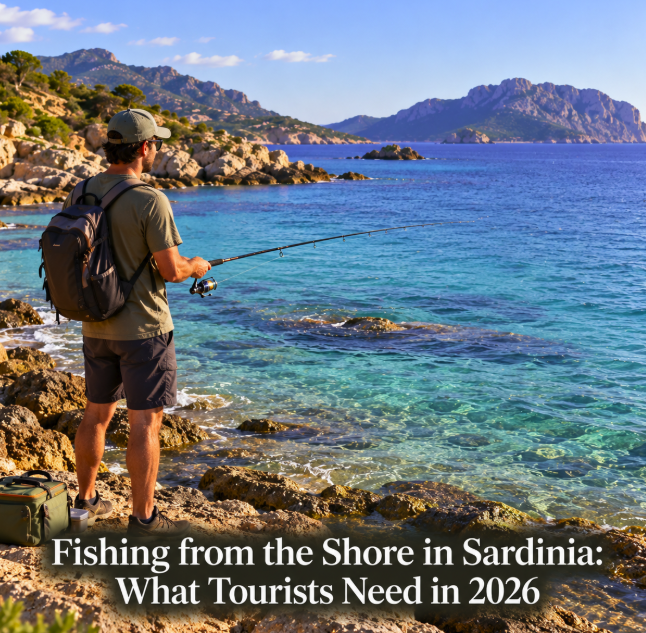
Tourists can fish recreationally from Sardinia’s coastline, but in 2026 the paperwork is more complicated than simply buying a traditional fishing license at a tackle shop. For sea fishing, Italy uses a national recreational-fishing registration system, and the Ministry of Agriculture, Food Sovereignty and Forestry (MASAF) provides a dedicated route for foreign users. The rules are different again if you plan to fish in Sardinia’s inland waters.
For a visitor who simply wants to cast a rod from a beach, rocks or a pier into the sea, the first thing to understand is that this is marine recreational fishing. Do not confuse it with Sardinia’s regional inland-water license, which applies to rivers, lakes and other inland waters.
Sea fishing: register with the national system
MASAF operates the national communication and census procedure for recreational and sport fishing at sea. Its current service page includes a specific online access route for foreign users, useful for travelers who do not have Italy’s SPID, electronic identity card or national services card.
The Ministry’s system produces the national recreational-fishing document, often referred to as a fishing card or registration rather than a conventional paid angling license. Travelers should complete the current procedure before fishing and keep the resulting documentation available.
The system changed again in 2026. A ministerial measure published in May introduced additional electronic registration and catch-reporting arrangements through the European RecFishing application. MASAF’s explanatory note states that people over 16 who practice recreational fishing underwater or using recreational vessels must also register through RecFishing and connect the resulting code to the national fishing card.
That wording is important for shore anglers: the Ministry’s May explanatory note specifically identifies underwater fishing and fishing using recreational vessels for the additional RecFishing registration requirement. A tourist fishing only from shore should still complete the national marine recreational-fishing communication, while checking the current MASAF instructions before the trip in case the electronic reporting scope changes.
Foreign visitors have their own online route
American and other foreign tourists should not assume they need an Italian tax code or SPID just to complete the marine fishing registration. MASAF’s current official service page explicitly provides a separate SIAN link for foreign users.
Use the official Ministry instructions rather than unofficial websites offering a generic “Italy fishing license.” The relevant requirement is tied to recreational fishing at sea throughout Italy, including Sardinia, and the government procedure can change from year to year.
If the online process is unclear, MASAF currently lists a recreational-fishing help desk at censimentopescasportiva@masaf.gov.it.
There is a daily catch limit
Recreational fishing does not mean unlimited fishing. Italy’s rules generally prohibit a recreational or sport fisher from taking more than 5 kilograms of fishery products per day, except when the catch includes a single fish weighing more than 5 kilograms.
The current sanctions framework is substantial: exceeding the daily recreational catch limit can lead to administrative fines, with penalties increasing according to the amount over the limit.
There are also species-specific restrictions. The long-standing national recreational rules, for example, limit the daily catch of grouper, while highly regulated species such as bluefin tuna are subject to dedicated rules and annual measures. MASAF issued updated recreational bluefin-tuna provisions again in September 2026.
For a casual tourist, the practical rule is simple: identify what you catch before keeping it, respect minimum sizes and protected species, and release a fish when you are uncertain about its legal status.
You cannot sell your catch
Fish caught recreationally is not commercial product. Italian rules prohibit selling catches taken through recreational or sport fishing.
That applies even if you happen to catch something valuable. A vacation fishing session remains recreational, and the catch cannot become an informal sale to a restaurant, market or another person.
Can you fish from any Sardinian beach?
No. Completing the national registration does not give unrestricted access to every stretch of coast. Local maritime ordinances, bathing rules, ports, marine protected areas and site-specific restrictions can limit where and when shore fishing is permitted.
This matters particularly in summer and early autumn, when many beaches are still actively used by swimmers. Casting hooks and sinkers through a bathing area is both unsafe and potentially contrary to local rules. The regional government approved Sardinia’s 2026 seasonal maritime framework in June, while individual maritime authorities and other competent bodies retain their own regulatory roles.
Before choosing a fishing spot, check the relevant Capitaneria di Porto or local maritime ordinance for that stretch of coastline. In a marine protected area, check the protected area’s own zoning and fishing regulations as well. Do not assume that an isolated-looking cove is automatically open to recreational fishing.
Beach, rocks or harbor?
For straightforward holiday fishing, an open coastal location outside bathing zones and protected restrictions is usually easier to understand than a busy harbor. Ports can have access, navigation and safety rules that make casual casting inappropriate or prohibited in certain areas.
Rock fishing offers access to deeper water but introduces obvious physical risks. Sardinian coastal rock can be uneven and slippery, and Mediterranean swell can change quickly. Wear shoes with reliable grip, stay back from exposed edges and avoid fishing alone in rough conditions.
On sandy beaches, early morning, evening or periods outside active bathing use may be more practical, but legality still depends on the applicable local ordinance. “Nobody is swimming” is not itself a legal test.
Inland fishing uses a different Sardinian license
If your plan involves a lake, river or other inland water, stop before applying the sea-fishing rules. Sardinia has its own regional procedure for sport fishing in inland waters.
The Region states that non-residents use a Type C inland fishing authorization with three-month validity. The regional procedure involves the required communication and concession-tax arrangements through Sardinia’s online services. The regional documentation also covers foreign applicants and the procedure for people without an Italian tax code.
In other words, a marine fishing registration does not automatically authorize a tourist to fish Sardinia’s inland waters.
A practical checklist for tourists
- Decide whether you are fishing in the sea or inland waters; the procedures are different.
- For shore fishing in the sea, complete the current MASAF recreational-fishing communication before fishing.
- If you are a foreign visitor, use MASAF’s dedicated foreign-user registration route.
- If your fishing activity falls within the 2026 RecFishing requirements, complete the app registration and reporting obligations.
- Check species rules, minimum sizes and the general daily catch limit before keeping fish.
- Never sell recreational catches.
- Check the local maritime ordinance and any marine protected area rules for your exact fishing location.
- Avoid bathing zones, busy swimmers and places where casting creates a safety risk.
- For rivers or lakes, follow Sardinia’s separate regional inland-fishing procedure.
For an American tourist carrying a travel rod to Sardinia, the key message is that shore fishing is possible, but the phrase “no license needed” is too simplistic for 2026. Marine fishing uses a national registration system, foreign visitors have a dedicated online procedure, catch and species limits still apply, and local coastal restrictions can override your choice of fishing spot.
Complete the paperwork before heading to the beach and verify the exact location with the relevant maritime authority. That leaves more time for the enjoyable part: finding a quiet stretch of Sardinian coast and waiting for the first bite.