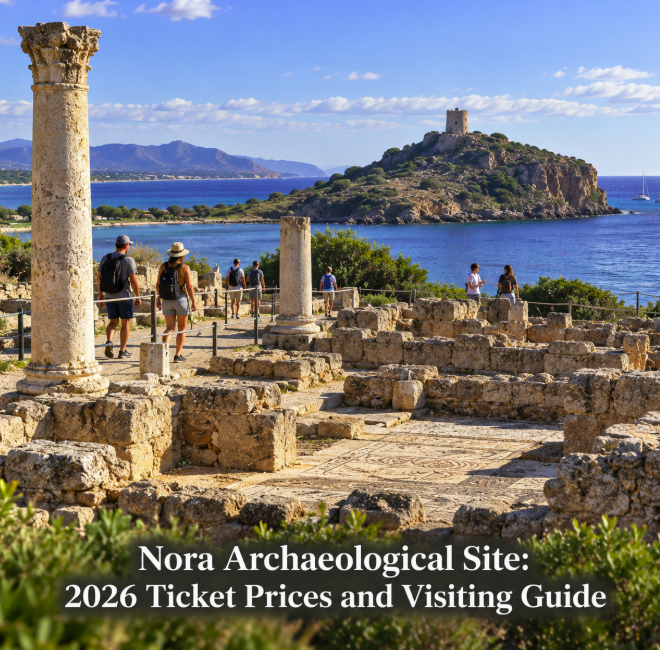
The archaeological site of Nora, near Pula in southern Sardinia, currently costs €10 for a standard adult ticket. That is the verified 2026 price published both by Fondazione Pula Cultura, which manages ticket sales, and by Italy's Ministry of Culture. For travelers already staying around Pula, Chia or Santa Margherita, Nora is an easy cultural stop to combine with the coast: the ruins occupy a promontory between the sea and the lagoon, only a short distance from modern Pula.
Nora is particularly useful for visitors who want to understand Sardinia beyond its beaches. The site preserves evidence from several phases of Mediterranean history, from Phoenician and Punic settlement to the much more visible Roman city, with streets, baths, mosaics and a theatre overlooking the coastal landscape.
How much does Nora cost in 2026?
The current standard admission to the Scavi di Nora is €10 for adults. Fondazione Pula Cultura lists a reduced price of €6 for visitors under 18, €8.50 per person for groups of more than 20, and €7.50 for university students and FAI members.
Children under five are admitted free, as are several other eligible categories listed by the foundation, including visitors with disabilities and their accompanying carers, licensed tourist guides, journalists and university students studying archaeology or cultural heritage. Anyone claiming free admission must have the appropriate documentation validated at the ticket office.
There is also a combined ticket for Nora and the Giovanni Patroni Museum in Pula. The current adult price is €16.50, with reduced combined fares for eligible categories. This can be worthwhile if you want to connect the ruins with archaeological material displayed in town rather than treating Nora as an isolated monument.
Another combined option links Nora with the FAI-managed Saline Conti Vecchi. The current adult price published by the foundation is €17, with reduced options for younger visitors and FAI members.
Buying online does not include a guided visit
Fondazione Pula Cultura recommends buying tickets in advance to make entry faster. Online buyers receive a PDF ticket with a QR code, which can be printed or shown on a smartphone.
There is an important detail: the online ticket itself does not include the service of a physical guide. The foundation asks visitors who want an expert-led tour to contact the Nora booking service separately.
This distinction is worth checking before arrival because older reviews and travel pages sometimes describe guided visits as if they were automatically included. Current official ticket information specifically says that online admission and the guided-tour service are separate.
Current opening hours
The Ministry of Culture currently lists the Nora archaeological area as open every day from 09:00 to 20:00, with the ticket office operating from 09:00 to 19:00. It also lists guided-visit hours from 10:00 to 19:00.
Opening hours can change seasonally, so travelers visiting outside the present September period should verify them again shortly before the trip. Special events, archaeological work and weather can also affect access to particular sections without closing the entire site.
What you see at Nora
Nora's position is part of its appeal. The ancient settlement developed on the Capo di Pula promontory, a strategic point for maritime connections. The Ministry of Culture traces its foundation to the Phoenician period, around the late eighth or seventh century BC, followed by Punic and Roman phases.
Today, the most immediately legible remains are largely Roman. Visitors walk through parts of the ancient street plan and can see residential and public buildings, baths and surviving mosaic floors. The Roman theatre is one of the site's best-known monuments and remains a striking example of how archaeology and the coastal landscape overlap at Nora.
Earlier Punic and Phoenician evidence is also important, even if it is less visually obvious to a visitor expecting monumental Roman ruins. That layered history is one reason a guided visit can add value: Nora is not simply a Roman town frozen at one moment in time.
How long should you allow?
For a first visit, allow roughly 90 minutes to two hours rather than trying to fit Nora into a quick half-hour stop. The site is open-air, and much of the interest comes from understanding how different structures relate to one another.
A guided visit or a slower walk with the explanatory panels can easily justify the longer end of that range. The current visitor route includes 28 explanatory panels with infographics and QR codes providing access to 3D imagery, audio descriptions and Italian Sign Language content.
If you add the Giovanni Patroni Museum in Pula or the nearby coastal landscape, Nora can comfortably become a half-day outing.
Go early or late on warm days
The archaeological area is exposed to the sun and sea breeze. In September, temperatures are generally more comfortable than in the height of summer, but there is still limited shade across much of the route.
Morning is a sensible choice for visitors who want cooler walking conditions. A later visit can bring softer light over the ruins and sea, but make sure you arrive well before the ticket office closes rather than treating 20:00 as the last possible admission time.
Bring water, a hat and shoes suitable for uneven ancient surfaces. The visit is not technically difficult, but this is an archaeological landscape rather than a level indoor museum.
Nora and Pula in the same day
Nora sits just outside Pula, so there is little reason to visit the archaeological area without also seeing the town if your schedule allows. Pula has restaurants, cafés and the Giovanni Patroni archaeological museum, making it an easy place for lunch or an evening walk after the ruins.
The surrounding coastline also means a cultural visit can be combined with beach time, but avoid packing too many separate stops into the hottest part of the day. Nora rewards a slower visit more than a rushed photo stop.
What American visitors should know
The ticket price is in euros, and the most reliable figure is the official euro price rather than a converted dollar amount that changes with the exchange rate. At €10, the standard Nora ticket remains relatively straightforward compared with many major European archaeological attractions.
If you want an English-language guided visit, arrange it in advance rather than assuming an English group will be departing at the moment you arrive. The foundation publishes telephone and email contacts specifically for guided-tour reservations.
Also remember that Nora is not in Cagliari itself. It is at Pula, south of the city, so visitors staying in Cagliari need to allow for the journey rather than treating it as a walkable city attraction.
For travelers already based in Pula, however, the logistics are simple: the archaeological site is one of the area's defining cultural attractions, and the current €10 adult admission makes it easy to add to a beach-focused Sardinia itinerary without turning the day into a major expedition.