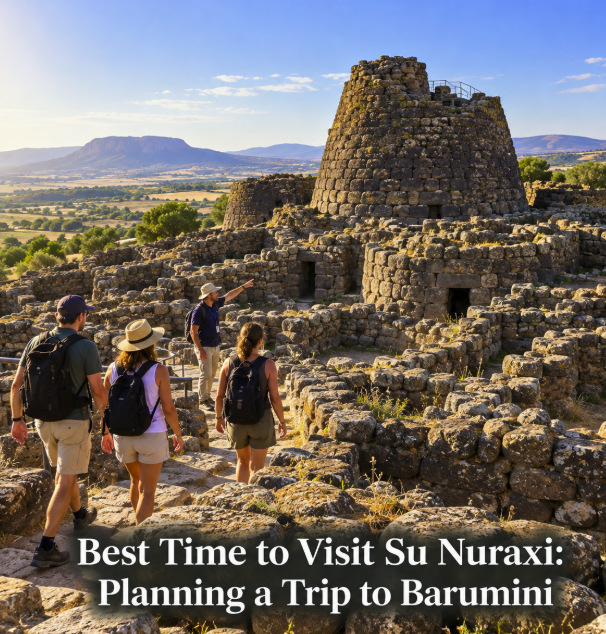
For most travelers, the most comfortable time to visit Su Nuraxi at Barumini is in spring or early autumn, when central Sardinia is generally easier to explore on foot than during the hottest part of summer. If you visit in July or August, aim for the first tours after the archaeological area opens at 9:00, or consider the later part of the afternoon after the strongest heat has eased. This matters at Su Nuraxi because the UNESCO site is an outdoor archaeological complex with stone surfaces, exposed sections and a guided visit lasting about an hour.
The site is open all year, so there is no single correct month. The best timing depends on whether your priority is comfortable walking, long daylight, fewer peak-season visitors or fitting Barumini into a wider Sardinia itinerary.
Why Su Nuraxi is worth planning around
Su Nuraxi is not simply another nuraghe visible beside a Sardinian road. UNESCO inscribed the archaeological site on the World Heritage List in 1997, describing it as the pre-eminent and most complete example of the island's distinctive Bronze Age nuragic architecture.
The complex developed around a central tower and later defensive structures, with a village of stone huts extending around the fortress. The Barumini Foundation dates its history from the Middle Bronze Age through later phases of Sardinian occupation, while UNESCO notes occupation continuing into Roman times.
The central tower originally rose to almost 19 metres. Today, moving through the surviving basalt architecture gives a much clearer sense of how sophisticated nuragic construction was than simply viewing the site from outside.
Spring: comfortable conditions for archaeology
April and May are particularly practical months for a cultural trip through inland Sardinia. Days are long enough to combine Barumini with other stops, while visitors are not automatically dealing with the intense heat that can affect the interior in midsummer.
The official 2026 schedule also becomes generous in spring. Su Nuraxi opens at 9:00 throughout the year. In April, the last archaeological tour begins at 18:30 and the site closes at 19:30. In May, the last tour begins at 19:00, with closing at 20:00.
Spring also gives the surrounding Marmilla countryside a different appearance from late summer, when the landscape is typically much drier and more golden.
Summer: go early and check heat alerts
June, July and August provide the longest opening hours. According to the official 2026 timetable, Su Nuraxi opens at 9:00 and closes at 20:00 in all three months, with the final guided tour normally starting at 19:00.
But summer requires more attention to temperature. The Barumini Foundation currently displays a high-temperature notice warning that opening hours may be changed when necessary to protect visitors and staff. It specifically asks visitors to check official channels for daily updates during periods of extreme heat.
That is a strong reason to choose a morning tour in high summer. The archaeological area includes exposed outdoor walking, and the dark basalt stone can add to the feeling of heat.
If morning is impossible, a late-afternoon visit can be more comfortable than midday, but do not arrive assuming the published last tour will operate during an exceptional heat alert. Check the same day.
September and October: a strong combination
September is another useful month for Barumini because travelers can combine archaeology with a wider Sardinian holiday while avoiding some of the intensity of August.
In September 2026, Su Nuraxi is scheduled to open from 9:00 to 19:30, with the last tour at 18:30. October runs from 9:00 to 18:30, with the last tour at 17:30, although the official timetable notes that hours adjust when the clocks change.
For travelers interested in villages, food and archaeology rather than spending every day at the beach, early autumn can be an especially natural time to explore inland Sardinia.
Winter visits are possible
Su Nuraxi remains open during winter. In January, February, November and December, the archaeological area opens at 9:00, the last tour begins at 16:00 and closing is at 17:00.
The advantage is obvious: cooler temperatures and a very different atmosphere from the summer tourism season. The disadvantage is shorter daylight and a greater chance that rain or bad weather affects an outdoor visit.
The Barumini Foundation states that access to Su Nuraxi may be restricted in bad weather for safety reasons. Casa Zapata and the Giovanni Lilliu Centre, both part of the wider Barumini cultural network, are indoor alternatives that can be visited in all weather conditions.
You cannot visit Su Nuraxi independently
This is one of the most important practical details. A guided tour is mandatory. The Foundation currently schedules departures every 30 minutes, and the Su Nuraxi visit lasts approximately one hour.
Tours are available in Italian, English and French. Organized groups, schools and travel agencies must reserve in advance through the Foundation.
UNESCO also notes that visits are controlled in small groups as part of managing tourism pressure on the archaeological site. This is not an open ruin where visitors can simply wander through the central structures alone.
Allow time for more than the nuraghe
The Barumini cultural ticket includes three sites: Su Nuraxi, the Casa Zapata Museum Complex and the Giovanni Lilliu Centre.
Casa Zapata is particularly interesting because the sixteenth-century noble residence was found to stand over another nuragic structure, known as Su Nuraxi ’e Cresia. The museum allows visitors to see archaeological remains beneath the historic building.
The official visit information currently gives guided visits of roughly 30 minutes for Casa Zapata and 30 minutes for the Giovanni Lilliu Centre, with departures every half hour. If you want to see the full Barumini heritage system rather than only Su Nuraxi, plan a half day rather than a rushed one-hour stop.
What to wear
The Foundation recommends comfortable clothing and non-slip shoes. That advice is worth taking seriously. The visit involves ancient stonework, steps and uneven surfaces rather than a smooth museum floor.
In summer, bring water, sun protection and a hat. In cooler or wet weather, footwear with good grip becomes even more important.
Animals are not admitted to Su Nuraxi except guide dogs, and visits involving guide dogs require advance reservation.
Getting to Barumini
Barumini lies in south-central Sardinia, inland from Cagliari. UNESCO notes that public transport connections to the World Heritage property are limited, so a car is the simplest option for many independent travelers.
The drive also makes it easier to combine Su Nuraxi with other inland sites and villages rather than treating Barumini as an isolated excursion. Travelers without a car should investigate organized tours or current public transport before setting out, because rural Sardinian schedules are not as frequent as urban services.
The best time of day
Outside summer, there is no need to obsess over a particular hour. A morning visit gives you plenty of time to continue through Casa Zapata and the surrounding area, while a later tour can offer softer light across the stone landscape.
In July and August, however, 9:00 is the practical target if you want to minimize exposure to the hottest part of the day. Because tours leave every 30 minutes, arriving near opening also gives you flexibility if the first group is already forming.
Before driving to Barumini, check the official Foundation website for the day's opening information, especially during heat waves or bad weather.
So when should you go?
For a trip focused on archaeology and comfortable outdoor exploration, April, May, September and early October are excellent periods to consider. Summer is still entirely workable, but early morning becomes more important and heat-related schedule changes are possible. Winter offers a quieter experience but shorter hours and more weather uncertainty.
Whatever the season, Su Nuraxi deserves more than a quick photo stop. Its value lies in walking through the layered architecture with a guide and understanding why these massive stone towers are unique to Sardinia. Visiting Barumini turns the nuraghe from an island symbol into a real place — one that helps explain thousands of other prehistoric structures scattered across the Sardinian landscape.