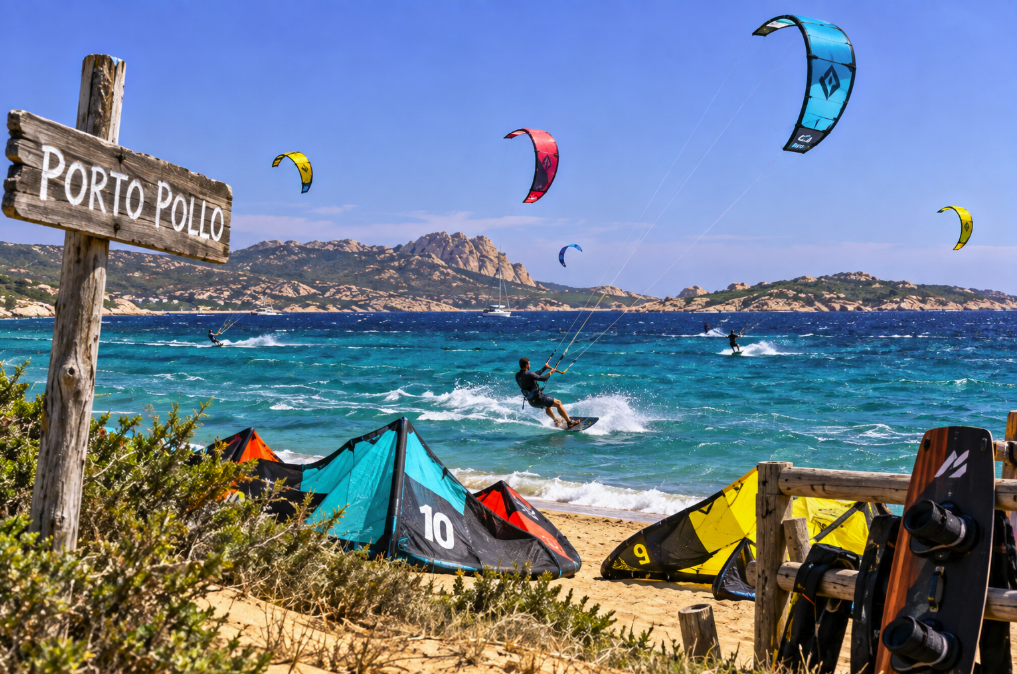
Porto Pollo is the name that repeatedly comes up when wind-sports travelers search for kitesurfing in Sardinia, and September is one of the most appealing months to consider it. Located near Palau in northern Gallura, the spot combines exposure to the mistral with an unusual two-bay geography, dedicated schools and equipment rental. By September, the peak August crowds have also begun to ease while the main wind-sports season is still active.
The setting explains much of Porto Pollo’s reputation. A narrow sandy isthmus connects the mainland with Isuledda, often called Isola dei Gabbiani, separating two bodies of water with different exposure. Local water-sports operators describe one side as more wind-exposed while the other can offer flatter, calmer water. That gives instructors options for teaching and allows experienced riders to adapt to conditions without driving to a completely different part of the island.
Why September works for a kitesurf trip
Porto Pollo’s useful wind season extends well beyond the busiest weeks of summer. Current spot guides generally place the main season between spring and autumn, with June through September among the most reliable periods. The mistral is the key wind in this part of Sardinia, and the geography around the Strait of Bonifacio can reinforce airflow across northern Gallura.
September has another practical advantage: it is no longer the absolute peak of the beach season. Wind Beach Porto Pollo’s current pricing, for example, switches back to its lower-season beach tariff from 1 September after the July–August high-season rate. That does not guarantee empty water — good wind naturally attracts riders — but it illustrates the broader seasonal change once August ends.
No traveler should interpret Porto Pollo’s reputation as a promise of wind on a specific day. Forecast strength, direction and gusts vary, and strong mistral conditions can be inappropriate for inexperienced riders. Anyone booking a short trip should ideally allow several days rather than expecting one predetermined afternoon to deliver perfect conditions.
Beginners can learn here — but use a school
Porto Pollo has established schools offering kitesurf, windsurf and wing-foil instruction. Wind Porto Pollo, for example, advertises individual and group kitesurf courses ranging from initial kite control through advanced jumping, with certified instructors and equipment available at the spot.
The combination of professional instruction and different water conditions makes the area attractive to beginners, but learning to kitesurf independently is not advisable. Launching, landing, right-of-way, weather assessment and emergency procedures are fundamental parts of the sport. Local zoning also matters: riders need to use the permitted kitesurf areas rather than assuming that every section of the beach is open for launching throughout the tourist season.
For that reason, first-time visitors should check the current local rules with a recognized school before rigging. The beach can host swimmers, windsurfers, wing foilers and other users, and designated areas can be seasonal. A lesson or supervised session removes much of the uncertainty for someone unfamiliar with the spot.
Porto Pollo is also a windsurf and wing-foil destination
Kitesurfing may dominate many current searches, but Porto Pollo’s wind-sports identity is older than the kite scene. Windsurfing remains central to the area, and the same local centers now offer wing foil as well. This makes Porto Pollo particularly useful for mixed groups in which not everyone wants to practice the same discipline.
Current facilities include equipment rental, instruction and beach services, so travelers do not necessarily need to fly to Sardinia with a full quiver of boards and kites. Serious riders may still prefer their own equipment, but renting locally can simplify a trip from the United States, especially when airline baggage charges and European connections are involved.
Is Porto Pollo a surf spot?
Travelers searching for “Sardinia surf spots” should distinguish between surfing and wind-driven board sports. Porto Pollo is primarily famous for kitesurfing and windsurfing, not for consistent classic wave surfing with a paddle-in surfboard. Strong winds can produce chop and waves, but that is a different experience from planning a dedicated surf trip around Mediterranean swell.
Sardinia does have conventional surfing locations elsewhere around the island, with the west coast generally offering greater exposure to Mediterranean swells. Conditions are highly weather-dependent, however, so travelers whose priority is traditional surfing should research swell forecasts and local breaks separately rather than choosing Porto Pollo solely because it is famous among windsurfers and kiters.
Getting to Porto Pollo
Porto Pollo is near Palau in northeastern Sardinia, with Olbia the most useful major airport for many international itineraries. A rental car is the simplest option for travelers carrying equipment or staying outside the immediate beach area. Palau also serves as the ferry gateway to La Maddalena, making it possible to combine a wind-sports stay with time in the archipelago.
For U.S. visitors planning a September trip, the combination can work especially well: fly into Olbia through a European hub, rent a car, spend several days around Porto Pollo to give the wind a chance to cooperate, and use lighter-wind days for Palau, La Maddalena or the surrounding Gallura coast.
The reason Porto Pollo remains Sardinia’s reference point for wind sports is not that it guarantees perfect conditions every day. It is the combination of geography, frequent wind, two contrasting bays and established infrastructure. In September, when northern Sardinia begins to move beyond its busiest holiday period but the wind-sports season is still very much alive, that combination is particularly compelling.