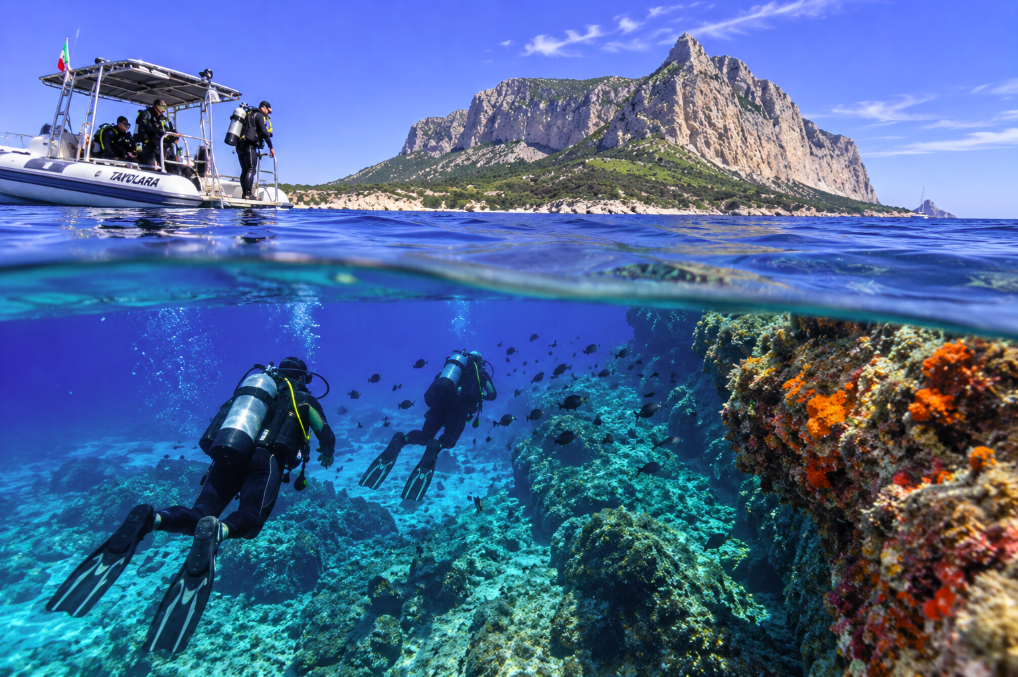
For scuba divers arriving in northeastern Sardinia, Tavolara and Punta Coda Cavallo offer something more substantial than another day beside turquoise water. The protected marine area stretches across roughly 15,000 hectares of sea between Capo Ceraso and Cala Finocchio and includes Tavolara, Molara and Molarotto. Its Posidonia meadows, rocky underwater habitats and fish life make this one of the most compelling diving areas close to Olbia — and one where choosing an authorized local dive operator matters because underwater activities are regulated.
Tavolara is the unmistakable landmark. Rising dramatically from the sea off Porto San Paolo, the long limestone island dominates the surface scenery before a dive even begins. Below water, however, the attraction is the wider marine ecosystem rather than the island silhouette alone. The managing authority specifically identifies the area's well-preserved Posidonia oceanica meadows, colorful sponges and fish fauna among the natural features that justify its protection.
Why Tavolara stands out for scuba diving
The Area Marina Protetta Tavolara–Punta Coda Cavallo was established in 1997 and is divided into zones with different protection levels. That zoning is important for divers: this is not an unrestricted stretch of coastline where visitors can simply anchor anywhere and enter the water. The regulations determine which activities are permitted in Zones A, B and C, with the most sensitive locations receiving the strongest protection.
In the fully protected Zone A, ordinary swimming and recreational access are restricted, while authorized guided scuba dives can take place on approved routes under the rules of the Marine Protected Area. Elsewhere in the reserve, scuba diving is permitted subject to the measures designed to protect the seabed. Underwater fishing is prohibited throughout the protected area.
For visiting divers, that controlled access is part of the appeal rather than an inconvenience. A professionally organized dive provides the boat, tanks and local knowledge while ensuring that the chosen site and route comply with the day's rules. The Marine Protected Area has a formal authorization system for commercial guided underwater visits, and its 2025–2027 framework specifically covers operators carrying out guided scuba-diving and seawatching activities.
Where do dives depart from?
Porto San Paolo is one of the most practical bases because it faces Tavolara directly. Other diving operations serve the protected area from communities along the northeastern coast, including the Olbia and San Teodoro sides. The best departure point therefore depends on accommodation, the dive center and the sites selected for the day's sea and wind conditions.
This flexibility matters in Sardinia. A famous dive-site name is not a guarantee that a boat will visit it on a particular morning. Wind, visibility, diver experience and restrictions inside the protected area can all influence the plan. Visitors should book with an operator that selects sites according to conditions rather than promising one exact location regardless of the sea state.
What can divers expect underwater?
The underwater landscape mixes rocky formations with seagrass habitat and deeper reef environments. Posidonia oceanica is especially important: these underwater meadows are a key Mediterranean habitat and one of the reasons anchoring is regulated in protected Sardinian waters. Divers should expect a Mediterranean ecosystem rather than a tropical coral reef, with marine life adapted to rocky walls, crevices, seagrass and open-water environments.
The Marine Protected Area highlights its fish fauna and multicolored sponges, while the variety of depths and habitats allows local centers to match dives to different experience levels. Some routes are appropriate for recreational divers, while deeper or more demanding sites require suitable certification and experience. Anyone returning to diving after a long break should tell the center when booking rather than waiting until the boat is leaving the harbor.
Visibility can be excellent, but no responsible operator can guarantee a fixed underwater visibility figure for a future date. Weather, plankton, currents and recent sea conditions all matter. The same applies to wildlife: encountering particular species should be treated as a possibility, never as a promise.
When to dive Tavolara
Summer offers warm weather and the greatest concentration of tourism services, but it is also the busiest period around Olbia, San Teodoro and the Costa Smeralda gateway. Divers who can travel outside the peak weeks may find late spring or early autumn attractive, subject to water temperature, weather and operator schedules.
American travelers often build Tavolara into a broader northern Sardinia itinerary after flying into Olbia. That works particularly well because the protected area is close to the airport compared with many of Sardinia's other major outdoor destinations. A traveler can base near Porto San Paolo or San Teodoro for diving and beaches, then continue north toward Costa Smeralda and the La Maddalena Archipelago or drive elsewhere on the island.
What to check before booking
Certification requirements, equipment rental, medical declarations, insurance, maximum depth and minimum experience should all be confirmed directly with the dive center. Divers should also ask whether the quoted trip is inside the Marine Protected Area, whether the operator holds the required authorization, how many dives are included and whether tanks, weights and full equipment are part of the price.
In 2026, the Marine Protected Area introduced a new unified online authorization portal for operators working within its boundaries. The authority also maintains its current rules and notices online. That makes the official protected-area website the best place to check regulatory information before the trip, while the dive center remains responsible for explaining the operational details of a specific excursion.
Tavolara deserves its place on a shortlist of Sardinia scuba destinations because the experience combines a striking island landscape with a genuinely protected underwater environment. For divers flying into Olbia, it is also unusually accessible. The best approach is not to chase a single Instagram-famous site, but to choose an authorized local center, state your certification and experience clearly, and let conditions determine the day's dive. In a marine reserve, that flexibility is exactly what helps keep the underwater scenery worth traveling for.