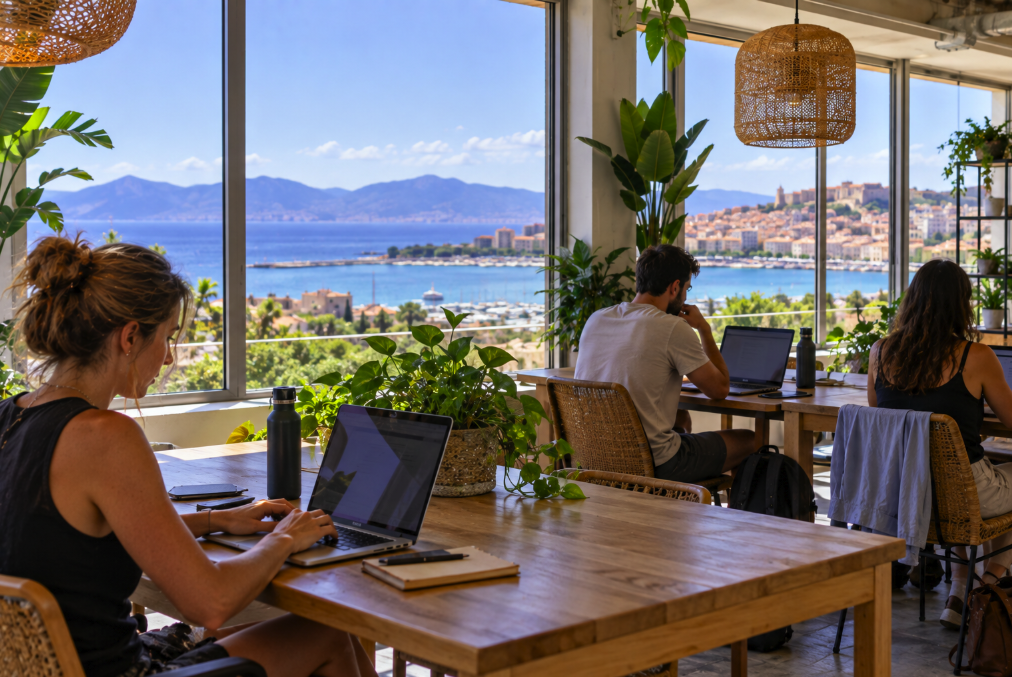
For an American remote worker spending a month in Sardinia, Cagliari currently has the stronger conventional coworking ecosystem, while Olbia offers a smaller but improving work infrastructure with exceptionally easy access to north-eastern beaches. The important correction to the usual digital-nomad fantasy is that “fast Wi-Fi plus sea view” is rarely one package: Sardinia’s most dependable professional workspaces are not necessarily beachfront, so the practical solution is often to rent a reliable desk and choose accommodation near the sea.
That distinction matters when your stay lasts four weeks rather than four days. A terrace overlooking turquoise water is attractive until a video call drops, there is nowhere ergonomic to sit and the nearest quiet phone booth is twenty minutes away. For a working month, connectivity, opening hours and workspace design should come before the Instagram view.
Cagliari: the safer choice for a full working month
Cagliari has several established coworking options with published services and current prices. Open Campus is the largest and most complete example. Operating since 2013 at the Tiscali Campus, it describes itself as Sardinia’s largest coworking space and offers high-speed Wi-Fi and wired connections, meeting rooms, phone booths, a kitchen, café and canteen, parking and a large professional community.
For someone staying exactly one month, its current pricing is unusually straightforward. A fixed personal desk costs €180 plus VAT per month and includes unlimited 24/7 access, high-speed wired and wireless internet, meeting-room use and reception services. A day pass costs €15 including VAT, while ten weekday entries cost €90 and can be used within two months.
The compromise is location. Open Campus is in the Tiscali complex outside the historic center, surrounded by greenery and overlooking the Santa Gilla lagoon rather than the open Mediterranean. The company says it is around ten minutes from central Cagliari. Its living area has lagoon views, but this is not a desk on Poetto Beach.
That may actually be an advantage for serious remote work: calls and deadlines happen in a purpose-built office, then the waterfront becomes somewhere to go when the laptop closes.
More central coworking in Cagliari
Remote workers who want to live without a car have other choices. Hub/Spoke is in Viale Trieste 30 in central Cagliari and offers daily hot desks, fiber connectivity, meeting rooms and membership access that can include 24/7 entry.
Etechus Business Center, in Via Giuseppe Mercalli, currently lists coworking desks at €25 plus VAT per day and shared-office subscriptions from €300 plus VAT per month. It advertises fiber connectivity and flexible access, with standard opening hours Monday to Friday from 09:00 to 18:00 and Saturday morning.
Another option is Coworking Sardinia in Via Calamattia, which lists high-speed Wi-Fi, a terrace, parking, refreshment area and meeting-room services.
For early risers working partly on U.S. time, Quimica has an unusual schedule: its coworking runs from 07:00 to 14:00 Monday to Friday. Current published prices are €22 plus VAT for a day, €70 plus VAT for a week and €159 plus VAT for a month. High-speed Wi-Fi and wired internet, air conditioning, coffee, water, printer access, an outdoor area and parking are included. It is near Cagliari’s waterfront and only a few minutes from the sea, although the workspace itself should not be sold as having an open-sea desk view.
Where does the sea fit into a Cagliari workday?
Cagliari’s great remote-work advantage is that a functioning city and a long urban beach coexist. Poetto stretches along the coast east of the center, making it possible to live near the beach while using a professional coworking space elsewhere.
For a one-month stay, that can be more useful than insisting on a coworking office directly above the water. Rent an apartment with a verified fixed internet connection around Cagliari or Poetto, use coworking on meeting-heavy days and work from home when you need to match U.S. hours.
Before booking a monthly apartment, ask the host for a recent speed test from the exact property. “Wi-Fi included” tells you almost nothing about the quality of the connection. Also ask whether the router is inside the apartment or shared with another unit, and whether there is a proper table and chair.
Olbia: improving quickly, but a different proposition
Olbia is the gateway to Costa Smeralda and many of north-eastern Sardinia’s beaches, but its coworking market is less mature than Cagliari’s. That changed in May 2026 when Poste Italiane opened Sardinia’s first location in its “Spazi per l’Italia” coworking project at the post office in Via Acquedotto.
The new Olbia facility provides work areas aimed at companies, professionals and citizens, including private offices, open-space areas, informal meeting zones, meeting rooms and training spaces. The launch was part of a national network planned across 250 properties.
Olbia also has the UniOlbia Student Hub in Via Porto Romano 8, opened as a study and coworking environment with 62 seats, 12 tables, Wi-Fi, a refreshment area and staffed reception. Its current published hours are Monday to Friday from 09:00 to 19:00 and Saturday from 09:00 to 13:00. However, it is primarily a university community facility, so a visiting digital nomad should confirm eligibility before treating it as a commercial coworking option.
The practical conclusion is that Olbia now has credible places to work, but visitors should verify access terms and pricing directly before building a month-long routine around them.
Olbia wins when weekends matter as much as weekdays
The reason to choose Olbia is not that it has more desks. It is geography. The city puts a remote worker close to Golfo Aranci, Pittulongu, Porto Rotondo, the Tavolara coast and the wider north-east, with Olbia Costa Smeralda Airport immediately outside town.
If your ideal month means working intensively Monday to Thursday and spending long weekends exploring beaches, snorkeling, sailing or driving around Gallura, Olbia can be a strong base.
The tradeoff is that a car becomes more useful once you want to move beyond central Olbia. The glamorous “work from Costa Smeralda” idea can also become expensive quickly if accommodation is chosen in a resort area rather than the city.
Can you really work with a sea view?
Yes, but the most credible route is usually accommodation rather than coworking. Sardinian holiday-rental companies now actively market apartments for smart working with high-speed Wi-Fi and sea-view terraces. Those claims should still be checked property by property.
A sea-view apartment can work brilliantly for asynchronous work, writing and routine calls. It is less reassuring when you have a client presentation, multiple time zones and no backup connection.
For a one-month stay, consider a two-layer setup: a home base with verified broadband plus a coworking membership or day-pass option. Add a mobile-data backup from an Italian or EU provider rather than relying on café Wi-Fi.
U.S. time zones change the decision
A Sardinia workday can become unusual if your company operates on U.S. hours. Sardinia uses Central European time, so East Coast colleagues are generally six hours behind for much of the year, with brief differences around daylight-saving transitions. The U.S. West Coast is normally nine hours behind.
That means a 9:00 AM meeting in New York is typically 3:00 PM in Sardinia, while a 5:00 PM New York call can land at 11:00 PM. Standard coworking opening hours may therefore be less important than 24/7 access if you regularly work a full American day.
Open Campus’s fixed-desk plan and Hub/Spoke’s membership access are relevant for exactly this reason. A workspace closing at 18:00 or 19:00 is fine for European clients but may be frustrating for someone whose main meetings start in the Sardinian afternoon.
One month in Cagliari or Olbia?
Choose Cagliari if work infrastructure is the priority. It has a broader choice of established coworking spaces, transparent monthly and daily pricing, fiber and high-speed connections, meeting facilities and a larger urban environment. Poetto means the beach is still part of daily life without needing to turn the beach into your office.
Choose Olbia if access to north-eastern Sardinia is the priority and you are comfortable doing more work from your accommodation. The city’s coworking infrastructure is expanding, and its position is hard to beat for after-work and weekend exploration.
There is also a third option for travelers who care more about community than city life: Sardinia has rural coworking and coliving projects aimed specifically at remote workers, including Treballu in Laconi. These can offer a more social nomad experience, but they are a completely different lifestyle from spending a month in Cagliari or Olbia.
For most first-time American remote workers, Cagliari is the easier place to test Sardinia for a month. It gives you more backup plans when work becomes demanding. Olbia becomes more compelling when the purpose of working remotely is to maximize time on the north-east coast.
Either way, do not book on the words “fast Wi-Fi” and “sea view” alone. Ask for the actual connection speed, check where you will take calls, confirm coworking access after normal Italian office hours and make sure your apartment can function as an office when necessary. Sardinia can be a very good place to work remotely — but the best setup is the one where you can forget about the internet long enough to enjoy the sea after you log off.