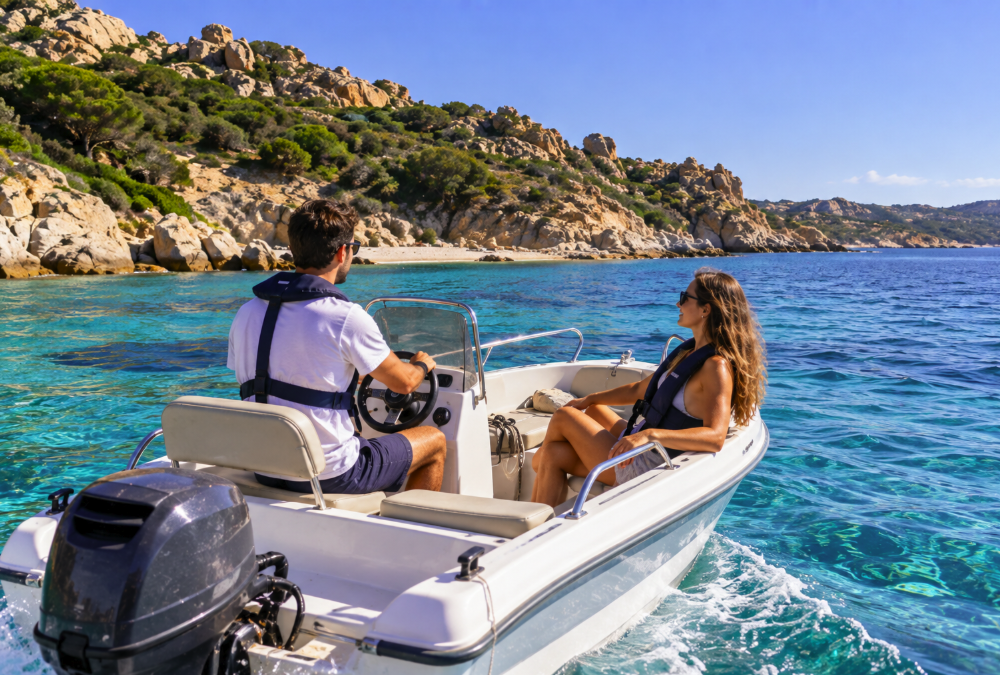
No, you do not always need a boating license to rent and drive a small motorboat in Sardinia. This is why rental companies around the island advertise 40 HP dinghies and small boats as “no license required.” But the familiar 40 HP rule is only shorthand: under Italian law, the actual threshold is 30 kW, equivalent to 40.8 horsepower, and engine displacement and how far you navigate from the coast can also trigger a license requirement.
For a visitor who simply wants to rent a small gommone for a day and explore nearby coves, license-free boating is possible. The important part is to rent a boat specifically approved for unlicensed operation, stay within the permitted navigation area and listen carefully to the rental company's safety briefing.
The 40 HP rule is really 40.8 HP — and there is more to it
Italy's Ministry of Infrastructure and Transport states that a nautical license is required within six nautical miles of the coast when the installed engine exceeds 30 kW, or 40.8 HP. That is the origin of the “40 horsepower without a license” phrase used by rental businesses.
However, horsepower is not the only engine test. A license can still be required when the engine displacement exceeds statutory thresholds, even if power remains at or below 30 kW.
The Ministry currently lists the relevant displacement limits as more than 750 cc for two-stroke carbureted engines; more than 1,000 cc for four-stroke outboards or direct-injection engines; more than 1,300 cc for four-stroke inboards; and more than 2,000 cc for diesel engines.
This detail is easy for tourists to miss. The Ministry's own current nautical-license examination material includes examples where a 29 kW engine still requires a license because its displacement exceeds the applicable limit.
In practice, visitors do not need to become marine-engine experts before a holiday. Rent from a legitimate operator and ask for a boat explicitly offered for operation without a nautical license. The rental company should know whether the exact engine configuration qualifies.
You cannot simply take a license-free boat anywhere
Another major limit is distance from the coast. The Ministry states that a nautical license is required for navigation beyond six nautical miles from the coast regardless of engine power.
That does not mean every license-free rental automatically allows you to travel six miles offshore. Rental companies can impose a much smaller operating area, and local maritime ordinances, protected areas, weather and the boat's own navigation certification can further restrict where you may go.
A small 40 HP rental is designed for coastal exploration, not for deciding halfway through the day to cross open sea toward a distant island.
How old do you have to be?
For a motorized natante da diporto that can legally be operated without a license, the Ministry lists 16 as the minimum age. Different age rules apply to other categories of pleasure craft.
Rental companies can set stricter contractual requirements, however. A company may require the renter or designated driver to be 18 or older even where the statutory minimum for operating a particular small craft is lower.
Always check the rental terms before paying, especially if the youngest person in the group expects to drive.
Jet skis are completely different
Do not apply the 40 HP idea to a jet ski. Italy requires a nautical license to operate a personal watercraft regardless of engine power.
The Ministry's current guidance is explicit on this point, and its 2025 examination material again confirms that the license requirement for an acquascooter applies in every case.
So a rental stand may legally offer a small 40 HP boat to an unlicensed customer while requiring a license for a personal watercraft at the same marina.
What happens when you rent without a license?
Italian nautical law specifically addresses rental boats used by people who do not hold a license. Where a nautical license is not legally required, the rental operator must explain the essential instructions for commanding the boat and provide those instructions in writing.
Take that briefing seriously. It should cover the controls, starting and stopping the engine, safety equipment and the basics needed to operate the boat. A good local operator will also explain the permitted navigation zone, dangerous shallows, anchoring restrictions and the day's wind and sea conditions.
If you have never driven a boat, say so. A short demonstration at the dock is much better than pretending you understand the throttle and discovering the difference between forward and reverse while approaching another boat.
Where license-free rentals make sense in Sardinia
Small motorboats and inflatable dinghies are popular because much of Sardinia's coastline rewards short-distance exploration. Around Alghero, the north-east, the Gulf of Orosei and southern coastal resorts, rental companies commonly offer compact boats intended for day use.
But some of Sardinia's most beautiful waters are also environmentally protected. Marine protected areas can have zones where navigation, anchoring, access or speed is restricted, and rules may change by zone and season.
La Maddalena Archipelago, for example, is a national park with its own rules and authorization system for recreational navigation. The Tavolara-Punta Coda Cavallo Marine Protected Area and other protected coastal zones also regulate activities within their boundaries.
A “no license required” boat is not a “no rules apply” boat. Ask the rental company whether your planned route enters a protected area and what permit, access or anchoring restrictions apply on the date of your trip.
Wind matters more than horsepower
Sardinia can look deceptively easy from a beach. A sheltered bay may be calm while conditions outside the headland are much rougher.
The mistral is especially important on exposed western and northern coasts. Even experienced drivers can find a small open boat uncomfortable when wind and waves build, and an inexperienced renter has less margin for error.
Check the marine forecast, not just the general weather icon on your phone. Ask the operator where conditions are expected to change during the day and what to do if the wind rises before your scheduled return.
If the rental company advises you not to leave the harbor or limits the route because of weather, treat that as a safety decision rather than a ruined vacation day.
What to check before signing the rental contract
Confirm that the exact boat is legally operable without a nautical license, not merely that the engine is advertised as “40 HP.” Ask for the maximum permitted navigation area and whether fuel is included in the price or charged separately after the trip.
Check the insurance conditions, security deposit, damage procedure and emergency contact number. Ask what safety equipment is on board and make sure the rental company gives you the required operating instructions.
If you plan to visit a marine protected area, confirm access rules before departure. If you want to anchor, ask where anchoring is prohibited or where mooring buoys should be used instead.
Finally, clarify the return procedure and fuel policy. Being ten minutes late because you underestimated the distance back to the marina is much less entertaining when the sea is changing and another customer is waiting for the boat.
What if you already have a U.S. boating certificate?
American state boating cards and recreational certificates should not automatically be treated as equivalent to an Italian nautical license. Recognition can depend on the type of credential, nationality, residence, boat and navigation involved.
If you want to rent a boat that legally requires a license, send a copy of your U.S. credential to the rental company before booking and ask it to confirm in writing whether it is accepted for that specific vessel and itinerary. Do not arrive at the marina assuming a U.S. boater-education card will unlock a larger engine.
Alternatively, rent with a skipper. That opens the door to larger boats and more ambitious routes without making one member of the group responsible for navigating unfamiliar Sardinian waters.
So, can you rent a 40 HP boat without a license?
Often, yes. That is why 40 HP rental boats are widespread in Sardinia. But the legally precise answer is that Italian rules look at 30 kW/40.8 HP, engine displacement, the type of craft and the navigation involved.
For most visitors, the simplest approach is to ask for a “barca senza patente” or “gommone senza patente”. The operator can match you with a boat configured for license-free use and explain the local limits.
Then keep the day simple. Stay close to the coast, respect protected areas, monitor the wind and do not treat a small rental boat like a car on an empty road. Sardinia's clear water makes independent boating tempting; good judgment is what makes it enjoyable.