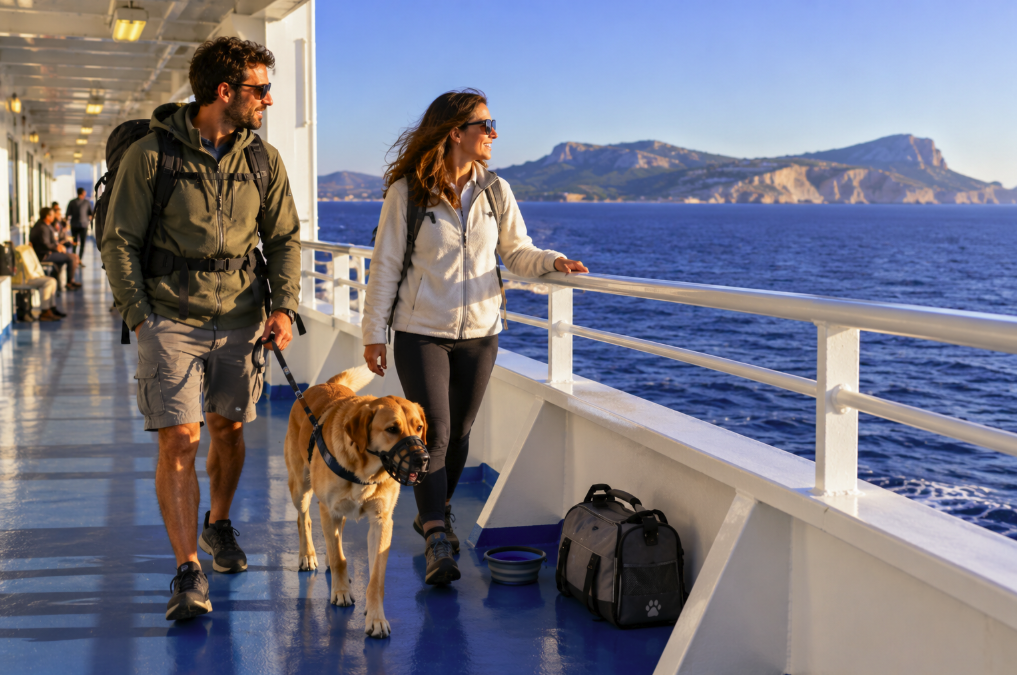
Taking your dog and car from Civitavecchia to Sardinia is straightforward once the paperwork is in order, but American travelers need to separate two different sets of rules: the documents required to bring a U.S.-resident dog into the European Union, and the rules imposed by the ferry company for the domestic crossing to Sardinia. On board, expect to need a pet ticket, leash and muzzle, and do not plan to leave your dog in the car during the voyage.
The exact accommodation rules depend on the operator and ship. Grimaldi Lines and the Moby/Tirrenia group both carry pets on Sardinia routes, but a normal passenger cabin does not automatically mean your dog can sleep there. If you want the dog with you overnight, book the appropriate pet-access cabin or pet-in-cabin service when available.
First: if your dog came from the United States, EU entry rules matter
The Civitavecchia–Sardinia crossing is domestic Italian travel. However, an American visitor who has brought a dog from the United States must already have complied with the European Union's rules when the animal first entered the EU.
Under current EU rules for non-commercial pet travel, a dog entering from a non-EU country must be identified with a compliant microchip and have a valid rabies vaccination. The vaccination cannot predate the identification or reading of the microchip. For a first rabies vaccination, at least 21 days must pass before the vaccination becomes valid for travel.
The animal must also travel with the required health documentation. For a U.S.-resident dog entering the EU, this will normally mean the EU animal health certificate completed for the trip and the owner's declaration that the movement is non-commercial. The certificate records the microchip and rabies information and is subject to the current EU validity rules.
EU pet-entry rules changed in 2026, so travelers should be especially careful with old online guides. The European Commission states that animal health certificates drawn up under the previous Regulation 577/2013 model remain valid for entry if issued before October 1, 2026; newer travel follows the updated 2026 framework.
Whether a rabies antibody titration test is required depends on the country from which the animal enters the EU and the current EU country lists. Do not assume that a rule written for a dog arriving from North Africa applies to a dog arriving from the United States. Check the European Commission's current pet-travel requirements for your exact origin before departure.
Once you are in Italy: what the ferry wants
For the domestic trip from Civitavecchia to Sardinia, the ferry company has its own boarding requirements. Grimaldi's current information for the Civitavecchia–Olbia route states that dogs on national routes need canine-registry/microchip documentation, a veterinary health document, leash and muzzle.
Grimaldi's general conditions say that for domestic routes a valid health booklet is required and dogs must be registered through their microchip; a valid pet passport may be presented as an alternative. Travelers whose dog entered Italy from the United States should keep the original EU-entry documentation with them as well rather than leaving it buried in luggage inside the car.
Moby and Tirrenia likewise require the animal to be included on the ticket and tell passengers to bring a muzzle and leash. Their current pet information recommends a veterinary check before departure and reminds travelers that entry and health requirements depend on the journey.
The safest practical approach is to carry a small folder containing the dog's microchip information, rabies record, EU animal health certificate or valid pet passport where applicable, and any veterinary health documentation required by the operator.
Yes, bring a muzzle
This is one of the easiest details for American travelers to miss. Even if your dog has never worn a muzzle at home and is exceptionally calm, pack one and make sure it fits before reaching the port.
Grimaldi's current passenger guidance explicitly lists a muzzle and leash as essential equipment. Its pet page says dogs walking on exterior decks must have both; its general conditions state that dogs outside a carrier must always be leashed and may be required to wear a muzzle when there is a safety risk or when competent authorities request it. Failure to comply can result in boarding being refused.
Moby and Tirrenia also tell passengers to bring a muzzle and leash, and their transport conditions require dogs on board to be leashed and to carry a muzzle.
Do not buy an unfamiliar muzzle five minutes before check-in and expect the dog to accept it happily. If your dog is not used to wearing one, introduce it gradually before the trip using positive training.
Your dog cannot stay in the car at sea
This is the other major point to plan around. A ferry is not like a road trip where the dog can sleep in the back seat while you take a break.
Grimaldi's current conditions state that animals cannot remain inside accompanying vehicles during navigation. Moby's transport conditions likewise say pets must not be left in the car, and its passenger guidance directs animals to exterior decks, suitable onboard kennels where available or designated pet-access cabins.
When boarding with a vehicle, therefore, prepare a separate dog bag before you drive onto the ship. Once the garage is secured, you may not have normal access to the car during the crossing.
Book the dog when you book the ferry
Do not simply arrive with a dog in the passenger seat. Add the animal to the ferry reservation.
Grimaldi requires pets to be included in the booking. Its current pet-in-cabin service costs €10 per cabin per leg and allows the animal into the chosen cabin with special bedding and additional cleaning. The service has limited availability, and Grimaldi says cabins can accommodate up to three pets.
Moby and Tirrenia also require pets to have a ticket. Their dedicated pet-access cabins are limited and can take up to three pets. If the booking system no longer shows the pet-cabin option, the company warns that the allocation for that sailing may already be sold out.
For a long or overnight crossing, reserving the correct cabin early can make a significant difference, particularly with an older dog, a nervous traveler or a pet that does not settle comfortably in a kennel environment.
Where can the dog go on the ship?
On Grimaldi, pets can use exterior decks with their owners under the required leash/muzzle rules. Dogs and cats can use dedicated onboard accommodation where available, and animals may stay in the passenger cabin if the pet-in-cabin service has been purchased.
Current Grimaldi conditions also allow dogs and cats in seating lounges if they remain inside an appropriate carrier that is ventilated, waterproof and large enough for the animal to turn and lie down. Access to other common areas can depend on the purser and the animal being inside a suitable carrier.
Moby and Tirrenia use a somewhat different arrangement. Their current passenger information says animals are not permitted in ordinary cabins, seating rooms or common areas; they are allowed on exterior decks, in suitable onboard shelters where available, and in specifically booked pet-access cabins. Bars and restaurants are excluded from pet access.
Because policies differ, choose the ferry based partly on your dog's needs rather than only the cheapest departure time.
What to put in the dog's ferry bag
Keep the essentials with you rather than in the vehicle. Bring the leash, muzzle, documents, water, a bowl, food if needed, waste bags and any medication the dog requires. A small absorbent towel or mat is useful on a long crossing, as is a familiar blanket if the dog is using a pet cabin.
Grimaldi specifically tells owners to provide their own animal food and bowls and to clean up after their pets. Hygiene bags may be available at reception, but carrying your own avoids depending on onboard supplies.
Water is particularly important in warm weather. Ferry exterior decks can be sunny and windy at the same time, so seek shade and do not assume the sea breeze means your dog cannot overheat.
What about large dogs?
Large dogs can travel, but advance planning matters more. A Labrador or German shepherd cannot simply be placed into the type of small carrier that makes access to some interior areas possible. That makes a pet-access cabin, onboard kennel or exterior-deck arrangement more important.
The muzzle also needs to be correctly sized. For a long trip, a basket-style muzzle that allows the dog to pant is generally more practical than a restrictive design, but owners should discuss individual fit and suitability with their veterinarian or a qualified trainer.
Driving from Rome to Civitavecchia
If you have just flown into Rome with the dog and rented or collected a car, leave generous time before the ferry. International pet travel already involves documents, luggage and animal care; adding a tight ferry check-in is unnecessary stress.
Give the dog a proper walk and toilet break before entering the port. Once vehicles begin loading, your choices become more limited, and the animal may already be dealing with unfamiliar noises, ramps and crowds.
Keep the ferry confirmation and pet paperwork where they can be reached from the driver's seat. Do not pack the health certificate into a suitcase underneath everything else.
The practical checklist
- Add the dog to the ferry ticket.
- Book a pet-access cabin or pet-in-cabin service early if you want the dog with you overnight.
- Carry the dog's microchip and health documentation, plus the EU entry certificate or valid pet passport where applicable.
- Bring a leash and a properly fitted muzzle.
- Prepare food, water, bowls, waste bags and medication before entering the vehicle deck.
- Do not leave the dog in the car during navigation.
- Check the exact operator and sailing because onboard pet areas differ between Grimaldi and Moby/Tirrenia.
For Americans traveling with a dog, the ferry itself is usually the easy part. The important work happens before you reach Civitavecchia: enter the EU with the correct veterinary paperwork, reserve the right onboard accommodation and arrive with the leash and muzzle the ferry expects. Do that, and taking your own car across to Sardinia can be one of the most practical ways to explore the island with a dog.