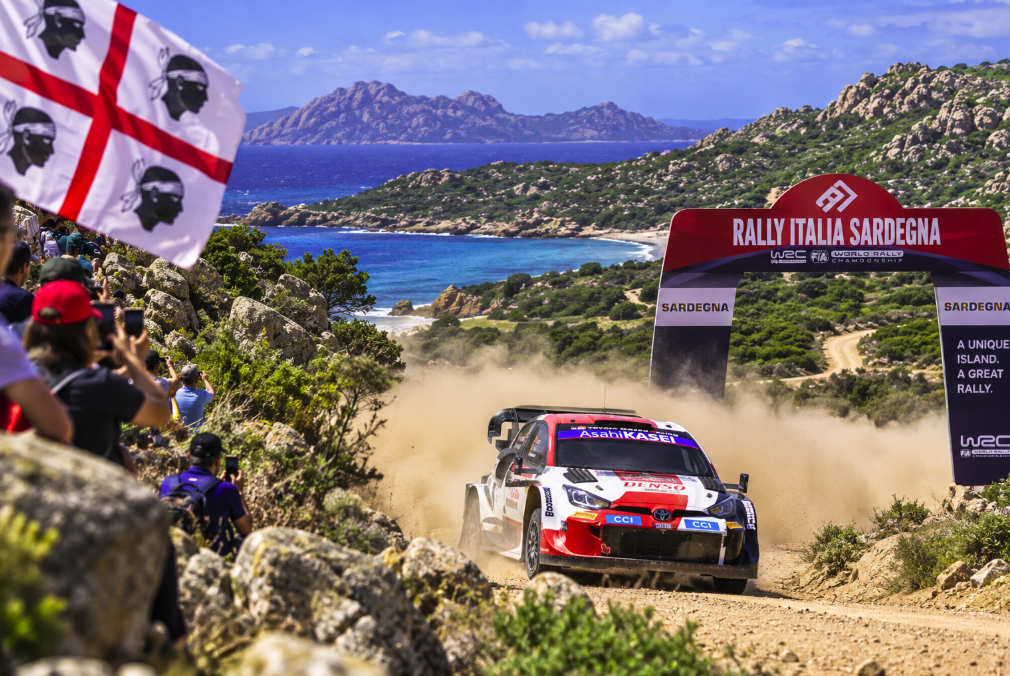
Rally Italia Sardegna returns to Alghero from October 1 to 4, 2026, bringing the FIA World Rally Championship back to north-western Sardinia for one of the final and potentially decisive rounds of the season. The official entry list is now published, spectator maps are available, and organizers say 60 crews are due to start the 23rd edition of the island rally.
The 2026 event is round 13 of 14 in the WRC calendar and the final European round before the championship concludes in Saudi Arabia. That late position in the season gives Sardinia extra sporting importance, while the move to October changes the atmosphere of an event more commonly associated with early-summer heat and dust.
Alghero is the rally base again
After the 2025 edition was based in Olbia, the rally returns to Alghero in 2026. WRC confirms that this will be the tenth time the city has hosted the event since it first became the base in 2014. The service park is planned for Lungomare Barcellona, close to the Mediterranean and within the urban area.
The ceremonial finish is scheduled beneath Alghero’s historic bastions, giving spectators a chance to experience part of the event without travelling out to the gravel stages. For visitors already staying in Alghero, the return of the service park also makes the city a practical base for following the rally over several days.
The dates have a historical symmetry: the 2026 edition runs from October 1 to 4, exactly the same dates as the inaugural Sardinian WRC event in 2004. It is only the fourth time the island rally has occupied an autumn slot.
17 stages and more than 300 competitive kilometres
Organizers describe the 2026 itinerary as compact, with 17 special stages and more than 300 kilometres of competitive driving. The route is concentrated mainly across Monte Acuto, Anglona and Nurra, with only limited involvement of Gallura.
That means the rally reaches well beyond Alghero itself. Municipalities involved with the event include places across the province of Sassari and northern Sardinia, among them Ittiri, Uri, Usini, Sassari, Osilo, Ozieri, Pattada, Buddusò, Tula, Erula, Tergu and Porto Torres.
Sardinia’s WRC identity is built around gravel. The roads are known for abrasive surfaces, rocks, deep ruts and demanding tyre management. WRC notes that cooler October temperatures and the possibility of more variable weather could add another complication in 2026. Visitors should therefore expect the character of individual stages — and the dust or mud around spectator areas — to depend heavily on conditions during rally week.
How to watch safely
The most important planning tool for anyone heading out to a special stage is the official spectator information. Rally Italia Sardegna has published an overview map, a dedicated spectator-zones map, the itinerary and individual maps for Thursday, Friday, Saturday and Sunday. Rally Guide 2, published on September 9, is also available in English.
Use those official documents rather than choosing an attractive roadside position from a generic online map. Rally stages involve closed roads, fast competition cars and controlled spectator areas. Access points and safe viewing locations are part of the event organization, and road closures can begin well before the first competitive car arrives.
For international visitors, downloading the English Rally Guide and the maps before leaving accommodation is sensible, especially when heading into rural areas where mobile reception may be inconsistent. The organizers also provide a downloadable KMZ file for geographical route information.
Conditions at gravel stages can be rough even for spectators. Closed shoes are a better choice than sandals, while water, sun protection and clothing for changing weather are useful in October. Spectators should never enter prohibited areas or move onto the competitive road simply because there appears to be a long gap between cars.
Getting to Sardinia for the rally
Alghero Airport is the nearest airport to the rally base, but visitors can also build trips around Olbia or Cagliari depending on available flights and the rest of their Sardinia itinerary. Anyone planning to follow several rural stages will generally find a car useful, although rally road closures mean that normal navigation routes may not always work during the event.
For spectators bringing a vehicle by ferry, Rally Italia Sardegna has renewed its agreement with Grimaldi Lines for 2026. The official event website currently advertises a 30 percent discount on the base ticket price, excluding specified fixed charges, EU ETS costs and onboard services, using promotional code RIS2026. Eligible booking dates run from May 15 to October 10, 2026, for departures between September 21 and October 11 on selected routes including Barcelona–Porto Torres, Livorno–Olbia and connections from Civitavecchia to Olbia and Porto Torres. Travellers should verify the conditions when booking.
Why the 2026 edition matters
Beyond its return to Alghero, the timing makes this an unusually important edition. Only one championship round follows Sardinia, so title battles could be directly affected by what happens on the island’s gravel roads. WRC also highlights another milestone: Sardinia will be the final European appearance for the current generation of Rally1 machinery before revised top-category technical regulations arrive in 2027.
The rally has a history of producing extremely close finishes. In 2018, Thierry Neuville beat Sébastien Ogier by 0.7 seconds after the final stage. In 2024, Ott Tänak defeated Ogier by just 0.2 seconds, one of the narrowest winning margins in WRC history.
For spectators, however, Rally Italia Sardegna is as much about geography as statistics. The event moves from Alghero’s waterfront to remote gravel roads across northern Sardinia, passing landscapes that most summer visitors never see. With the service park back on the Coral Coast, 60 crews on the entry list and four days of competition scheduled, October 1–4 is one of the key dates on Sardinia’s 2026 sporting calendar.