You do not need to travel into a remote corner of Sardinia to see one of the island’s most photogenic wildlife spectacles. Pink flamingos live in the wetlands of Molentargius-Saline, a protected park of roughly 1,600 hectares between Cagliari and Quartu Sant’Elena, immediately behind the Poetto waterfront. The birds have become a symbol of Cagliari, and visitors can explore the wetland on foot, by bicycle and through organized activities — while respecting the distance required by a major nesting site.
For travelers searching “pink flamingos Sardinia where to see,” Molentargius is one of the most straightforward answers. It is internationally important, protected under the Ramsar Convention since 1977, and recognized for the stopping, wintering and nesting of aquatic birds. In March 2026, the Sardinian regional government described it as one of the Mediterranean’s most important wetland systems, with more than 120 bird species and a stable presence of greater flamingos.
Why are there flamingos beside Cagliari?
Molentargius is a landscape created by both nature and centuries of salt production. Its system includes freshwater and saltwater basins, including Bellarosa Maggiore, Bellarosa Minore and Perdalonga, together with the former Cagliari saltworks. Commercial salt extraction ended in 1985, but the resulting wetland mosaic became extraordinarily valuable for birds.
The park’s name also preserves that working history. According to Cagliari’s official tourism service, is molentargius were the people who led donkeys — su molenti in Sardinian — used to carry harvested salt.
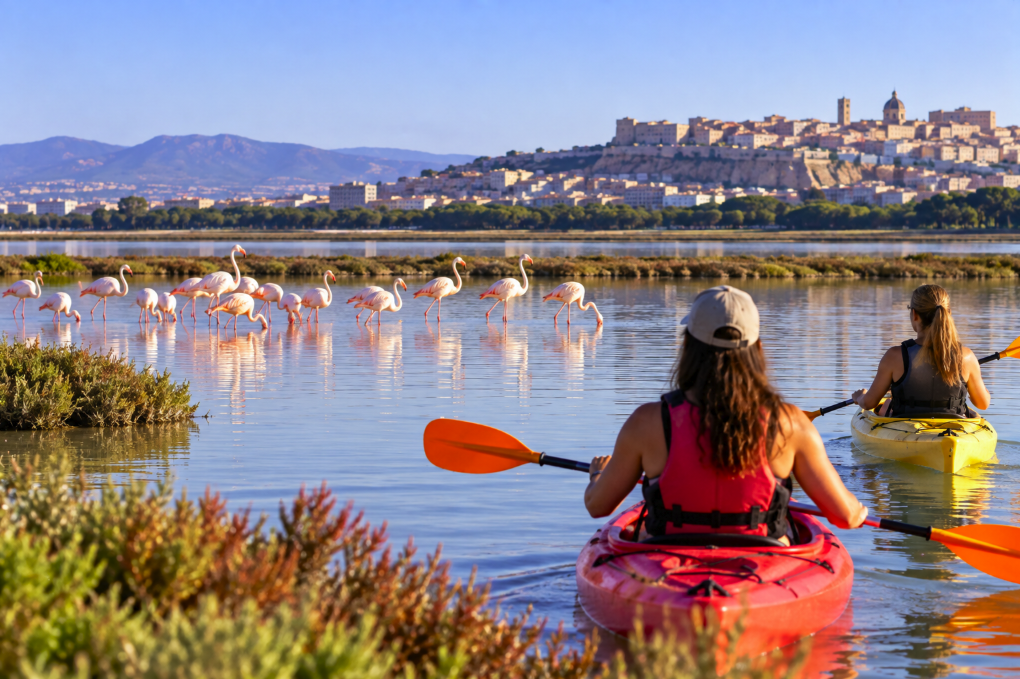
Today the most famous residents are the greater flamingos, locally associated with the Sardinian expression sa genti arrubia, “the red people.” Their color can range from pale pink to much stronger tones, and groups can often be seen feeding in the shallow basins or flying across the city skyline.
Can you visit Molentargius for free?
Yes. Cagliari Turismo currently lists free entrance to the park, with access from the Cagliari and Quartu Sant’Elena sides. The main information point is at the Sali Scelti building on Via La Palma, where visitors can ask about guided activities and current conditions.
Walking is the simplest option. The park has routes through the wetland landscape, and bringing binoculars is strongly recommended because the goal is to observe wildlife without approaching it. The official tourism service notes that binoculars can also be rented at the infopoint for €1.
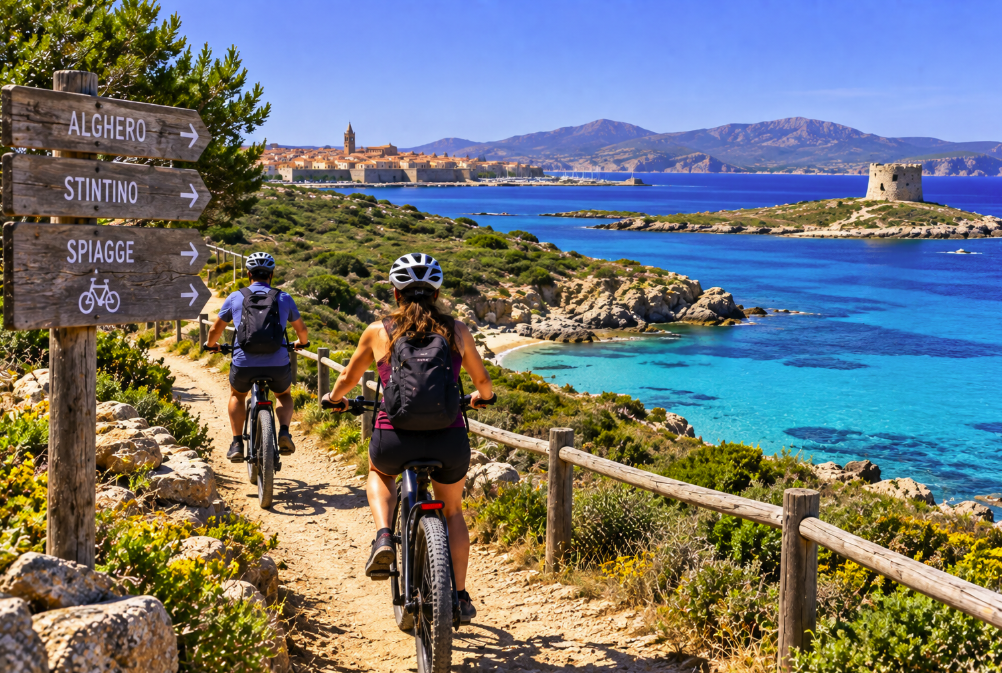
Cycling is another excellent way to cover more ground. The flat terrain makes Molentargius a natural extension of a bike ride along Poetto, and a September 2026 sustainable-tourism pilot organized with the Municipality of Cagliari specifically combined cycling through Molentargius with exploration of the coastal ecosystem.
What about kayaking with the flamingos?
This is where travelers should be careful with social-media expectations. Molentargius is a protected wetland and important nesting habitat, not an unrestricted lagoon where visitors should launch a kayak and paddle directly toward flamingo colonies.
Official Italian tourism information says the park can be explored through organized boat experiences as well as on foot, by bicycle and by electric minibus. However, visitors should verify the specific water activity, route and authorization with the park before booking or launching any craft. Rules can depend on the basin, conservation requirements and current wildlife conditions.
In other words, “kayaking with flamingos” should never mean chasing or approaching birds for photographs. If an authorized guided paddle is available for your dates, the operator should follow the park’s rules and maintain an appropriate wildlife distance. If it is not, cycling and walking provide excellent viewing without entering sensitive water areas.
The park’s own infopoint is the best place to confirm current guided-tour and water-based options rather than relying on an old tour listing or a viral video.
When is the best time to see flamingos?
Flamingos are a stable presence at Molentargius, so this is not a destination that only makes sense for a few days each year. What changes is their position, numbers in a particular basin, behavior, light and the conditions of the wetlands.
Early morning and later afternoon are often the most comfortable periods for visitors because temperatures are lower and the light is better for photography. Wildlife, however, does not follow a sightseeing timetable. A flock may be close enough for excellent binocular views one day and farther across the basin the next.
Spring and the breeding period are particularly sensitive times. Never cross barriers, leave marked visitor areas or try to move closer to nesting birds. A longer camera lens is a better investment than disturbing a colony for a phone photograph.
Combine flamingos with Poetto
One reason Molentargius works so well for travelers is its location. The wetland lies beside Poetto, Cagliari’s long city beach, so a nature-focused morning can easily become a beach afternoon without a long transfer.
A practical day might begin with a walk or bike ride through the park, continue along the Poetto waterfront and finish with lunch or a swim. This gives visitors a surprisingly varied picture of Cagliari: protected wetlands, urban life and the Mediterranean coast are compressed into the same corner of the city.
For cruise passengers, Molentargius is also realistic as a shore excursion because it is much closer to Cagliari than many of southern Sardinia’s famous archaeological sites and beaches. Royal Caribbean itself highlights the Molentargius wetlands among attractions associated with its Cagliari destination.
How to photograph the flamingos responsibly
Bring binoculars or a telephoto lens and accept distance as part of wildlife photography. The most evocative images do not necessarily require a close portrait: flamingos flying above the salt basins, reflected in shallow water or framed against Cagliari can tell more of the story of Molentargius than a tightly cropped bird.
Avoid loud movements and bright clothing when birdwatching. Cagliari Turismo recommends comfortable outdoor clothing and water-resistant footwear and specifically advises visitors to avoid disturbing the animals.
Dogs are permitted under conditions published by the park tourism information, including keeping them on a leash, but wildlife-focused visitors may find the experience simpler without a pet.
Why Molentargius is more than an Instagram stop
The flamingos are the visual hook, but Molentargius is also a story about the transformation of an industrial salt landscape into protected urban nature. Its 2026 park plan reinforces conservation, accessibility and sustainable use while recognizing the ecological importance of freshwater and saline habitats within the Cagliari metropolitan area.
That makes it one of Sardinia’s most unusual outdoor experiences. You can have breakfast in Cagliari, watch flamingos feeding in a Ramsar wetland, cycle beside historic salt basins and reach Poetto beach without spending half the day in a car.
For travelers hoping to kayak, the responsible approach is simple: ask the park which guided water activities are currently authorized and do not assume every lagoon is open to independent paddling. For everyone else, walking and cycling already offer an exceptional chance to see Sardinia’s famous pink flamingos almost on the doorstep of the city.