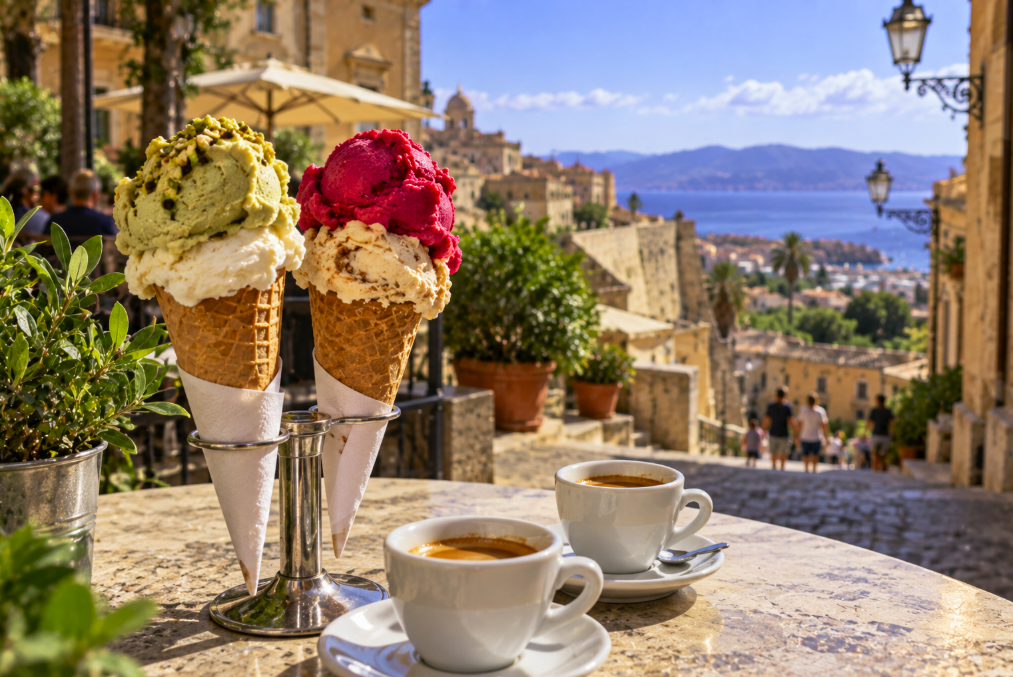
Some of the best-value food experiences in Sardinia cost less than a beach-club cocktail. In Cagliari, serious artisan gelato makers turn Sardinian ricotta, honey, citrus, herbs, wine and seasonal fruit into flavors that are difficult to find elsewhere, while a straightforward espresso can still be found for around €1.40–€1.50 at current city bars. For travelers trying to keep daily spending under control, gelato and coffee are two pleasures that do not require a restaurant budget.
There is no objective single “best gelato” in Cagliari, but the city has several addresses repeatedly recognized by Italian food guides. The useful question is what kind of gelato you want: Sardinian ingredients and experimental flavors, meticulous classics, seasonal fruit or something to eat while walking through the center.
I Fenu: Sardinia in a gelato cup
I Fenu is one of the clearest places to start if the goal is gelato that actually tastes connected to Sardinia. The work of Fabrizio Fenu and Maurizia Bellu has long focused on regional ingredients, from sheep’s ricotta and local honey to citrus, wine and aromatic plants.
In 2026, Italian food publication Dissapore included I Fenu among its five standout gelaterias in Sardinia and also placed it in its national selection of artisan gelato shops. Earlier Gambero Rosso guides awarded the shop its top “Three Cones” recognition.
The appeal is not just technical quality. Flavors have included combinations inspired by Sardinian sweets and ingredients such as s’aranzada, made around orange peel, almonds and honey, as well as ricotta, abbamele and local spirits. The exact counter changes, so treat these as examples rather than a promise that every flavor will be available on the day you visit.
The current address associated with I Fenu in Cagliari is Piazza Galileo Galilei 35, close to the San Benedetto area.
Soncini: a Cagliari institution since 1977
Soncini – Gelato per Passione dal 1977 is another essential name. Gambero Rosso’s current 2026 listing describes it as a city institution built by Luisa and Luca Soncini over decades of work.
Its strength is balance rather than gimmicks: classic hazelnut, stracciatella and chocolate sit beside more distinctive combinations. Gambero Rosso has highlighted flavors such as Malaga and s’aranzada, connecting the shop’s classic gelato craft with Sardinian references.
Soncini is at Via Dante Alighieri 123. If you are comparing current guides online, pay attention to the address rather than only the business name: Cagliari’s gelato scene has evolved and some older articles contain locations that have since changed.
Gli Stefini: fewer flavors, strong seasonal focus
Gli Stefini built its reputation around a deliberately limited selection and careful ingredients rather than a huge wall of brightly colored tubs. Gambero Rosso has praised its seasonal fruit sorbets and classic creams, including pistachio, hazelnut and zabaglione.
The philosophy is useful for travelers learning how to judge artisan gelato. An enormous number of flavors is not automatically a sign of quality. A smaller selection that changes with fruit seasons can be more interesting than fifty permanent options.
Recent Gambero Rosso material places Gli Stefini in Via Giuseppe Garibaldi 194 and also notes its presence around Cagliari through mobile formats. Because seasonal outlets can change, check the current location before making a special trip.
Other Cagliari names worth knowing
Cagliari has enough good gelato that there is no need to cross the city for one supposedly definitive cone. Gambero Rosso’s recent city selections have also included Chiccheria and Il Gelato Aresu, while 2026 specialist coverage has highlighted Gelatificio di Federico among Sardinia’s notable contemporary gelaterias.
Chiccheria is known for polished classic technique and creative combinations, while Aresu has built a following around fresh, seasonal ingredients. Gelatificio di Federico appears in Dissapore’s 2026 selection of five Sardinian gelaterias worth attention.
The best strategy is to choose one near the neighborhood you are already exploring, then order one familiar flavor and one Sardinian or seasonal flavor. Pistachio is useful as a quality benchmark; ricotta, citrus, honey, local wine or Sardinian-dessert-inspired flavors make the second scoop more memorable.
How much does gelato cost?
Unlike a restaurant menu, gelateria prices can be surprisingly difficult to verify online. Cone and cup prices change with size and individual shop, and many of Cagliari’s most respected artisan businesses do not maintain a fully current public price list.
For that reason, it is better not to invent a citywide “average cone price.” Check the board at the shop before ordering. Artisan gelato remains one of the cheaper ways to try high-quality local ingredients, but premium pistachio, special cones or larger portions can cost more.
Also remember that Italian gelato portions are usually ordered by cone or cup size rather than by a standardized American-style scoop count. A small cup can often include more than one flavor.
What does an espresso cost in Sardinia in 2026?
Coffee is easier to benchmark because current bar menus publish exact prices. In Cagliari, Aura by Anthigori currently lists a traditional espresso at €1.40 and a cappuccino at €1.80. La Scala’s current bar menu lists espresso at €1.50, decaf at €1.80, an Americano at €2 and cappuccino at €2.
Those examples make roughly €1.40–€1.50 a realistic current reference for a basic espresso at ordinary Cagliari establishments, but it is not a regulated Sardinia-wide price. Premium hotels, table service, airports, tourist locations and specialty coffee bars may charge more.
The difference between drinking at the counter and sitting at a serviced table can also matter. Italy has a long tradition of quick standing coffee at the bar, while venues with waiter service may apply different pricing. Always look at the displayed menu if budget is important.
Espresso, caffè and Americano: what Americans should order
If you ask for un caffè in Sardinia, you will normally receive an espresso. There is no need to say “espresso” unless you want to be explicit.
An Americano is a different drink: espresso diluted with hot water. Current Cagliari menus show why the distinction also affects price. At La Scala, for example, the espresso is €1.50 while the Americano is €2.
A cappuccino is still inexpensive by U.S. specialty-coffee standards, with current examples around €1.80–€2. Italians traditionally associate cappuccino strongly with breakfast, but a café will not confiscate your passport if you order one in the afternoon.
If you want a little milk without a full cappuccino, ask for a caffè macchiato. If you want decaf, ask for decaffeinato.
A €5 Sardinia food ritual
One reason gelato and espresso work so well for budget travelers is that they can turn an ordinary city walk into a food experience without planning a meal.
Have an espresso standing at a neighborhood bar in the morning. Walk through San Benedetto, Castello, Marina or Villanova. Later, stop at an artisan gelateria and choose a flavor connected to Sardinia rather than automatically ordering the same vanilla or chocolate you eat at home.
Depending on the gelato size and shop, the combined spend can remain modest. The coffee component, at least, is easy to quantify: current Cagliari examples show that €1.40–€1.50 still buys a standard espresso.
The larger lesson is useful for anyone who assumes Sardinia must be expensive because of Costa Smeralda. Luxury resorts are only one part of the island. Everyday Italian bar culture and small artisan food businesses can still deliver excellent quality for a few euros.
How to recognize better artisan gelato
Do not rely only on the word artigianale on the door. Gambero Rosso itself has repeatedly stressed that “artisan” is not automatically a guarantee of quality.
Look for seasonal flavors, ingredient information and colors that resemble the real ingredient rather than fluorescent versions of it. Pistachio should not need to glow green. Fruit sorbets should change as local produce moves through the year.
A shop that proudly identifies its milk, nuts, fruit, honey or regional suppliers is giving you more useful information than one displaying mountains of identical-looking gelato decorated with plastic fruit.
In Cagliari, the strongest gelaterias go a step further by using frozen desserts to tell a Sardinian story. That might mean sheep’s ricotta, citrus peel, abbamele, local honey, herbs or wine. Those flavors make a €3-or-so treat — whatever the current shop price happens to be — more culturally interesting than many far more expensive desserts.
Pair that with a €1.40–€1.50 espresso and you have one of Sardinia’s simplest low-cost pleasures: two everyday Italian rituals, done particularly well in a city that increasingly takes both food craftsmanship and local ingredients seriously.