Cannonau and Vermentino may dominate Sardinia’s drink itineraries, but two other products offer an equally revealing taste of the island: extra-virgin olive oil and mirto. Olive farms are increasingly welcoming visitors for tastings and mill experiences, while the dark, aromatic myrtle liqueur remains one of the most recognizably Sardinian bottles to look for after dinner. For American travelers, the two products also raise practical questions: what does “Sardegna DOP” actually guarantee, and can authentic Mirto di Sardegna be bought back in the United States?
The short answer is yes to both experiences, with a few qualifications. Sardinia now formally regulates olive-oil tourism, while Sardegna DOP identifies an oil produced under a protected specification. Mirto di Sardegna is likewise a protected geographical name, but U.S. availability depends on licensed importers, distributors and state alcohol rules rather than on a single national Sardinian store.
What Sardegna DOP means on an olive oil bottle
Not every extra-virgin olive oil made in Sardinia carries the DOP designation. “Sardegna” DOP — the Italian equivalent of PDO, Protected Designation of Origin — is a protected denomination governed by a production specification. It gives travelers something more precise to look for than a generic bottle decorated with an image of the island.
The designation is actively promoted and protected by the Consorzio di Tutela dell’Olio Extravergine di Oliva DOP Sardegna. In March 2026, the Sardinian regional government took 13 island producers and the DOP consortium to Olio Capitale in Trieste, emphasizing both product quality and the identity of Sardinia’s olive sector.
Quality is not limited to DOP oils, of course. Sardinia produces excellent extra-virgin oils both with and without the denomination. The 2026 regional selections for the Ercole Olivario national olive-oil competition included Sardegna DOP oils from producers such as Cooperativa Valle del Cedrino, Azienda Agricola Giuseppe Fois and Accademia Olearia, alongside a broader field of Sardinian extra-virgin oils. The useful lesson for visitors is to taste rather than shop by label alone, while understanding what a protected designation represents.
Olive oil tourism is becoming a real Sardinian experience
Sardinia passed a regional law regulating oleoturismo in 2023, creating a framework for tourism activities connected with olive cultivation and oil production. The implementing rules include professional requirements for businesses offering these experiences, and in 2026 the regional agricultural agency Laore ran dedicated 50-hour training courses for olive-oil tourism operators.
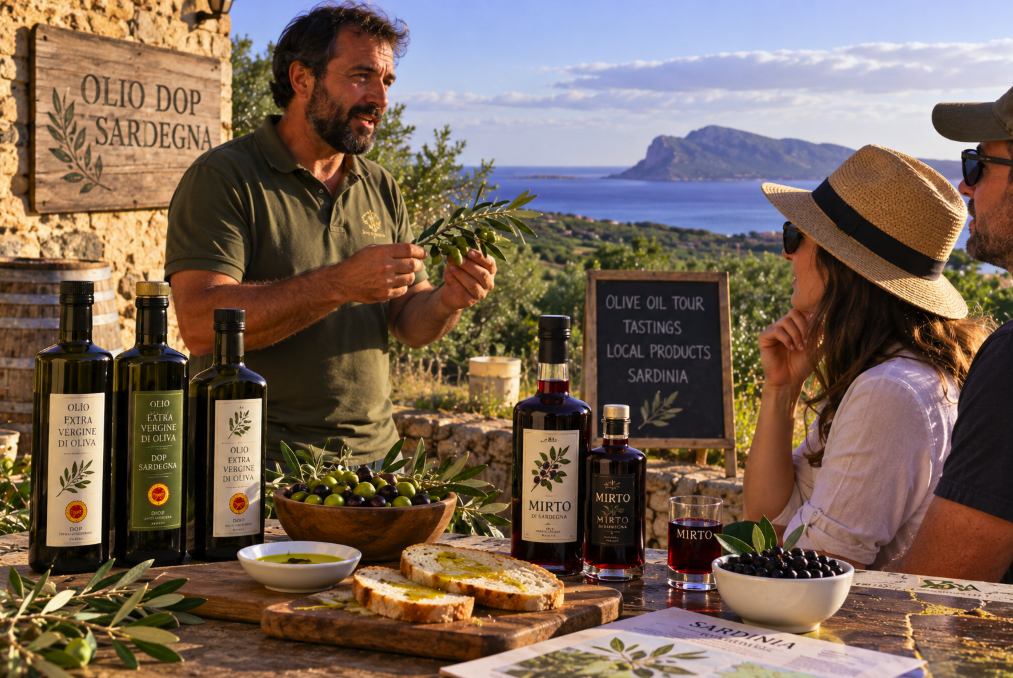
That formalization matters because an olive-oil visit can be much more than walking into a shop and sampling a spoonful of oil. Depending on the producer and season, an experience may involve an olive grove, explanation of local cultivars, a mill visit, sensory tasting and guidance on recognizing characteristics and defects in extra-virgin olive oil.
Autumn is particularly interesting because it coincides with the olive harvest and milling period, although exact timing varies by area, cultivar and year. A working mill may be extremely busy during harvest, so visitors should never assume that production areas are open for casual drop-ins. Book directly with the farm or mill and confirm what the visit includes.
When tasting, pay attention to aroma, bitterness and the peppery sensation that good extra-virgin oil can produce in the throat. Those characteristics are not automatically flaws. Comparing two or three oils side by side is often more informative than tasting a single “premium” bottle with bread.
What is Mirto di Sardegna?
Mirto is a liqueur associated strongly with Sardinian hospitality and is commonly served chilled as a digestif after a meal. The best-known version is made from the dark berries of the myrtle plant, an evergreen shrub characteristic of Mediterranean vegetation.
Mirto di Sardegna is not merely a descriptive cocktail name. It is a protected geographical indication for a spirit drink with an official Italian technical specification. The specification links the product to Sardinia and describes traditional production based on the hydroalcoholic infusion of ripe myrtle berries. It excludes the use of other flavorings, colorings and preservatives in the traditional protected product.
That makes the label worth reading when shopping. A bottle called “myrtle liqueur” somewhere outside Sardinia is not necessarily the same thing as a product legitimately sold under the protected Mirto di Sardegna geographical name.
Can you buy Sardinian mirto in the United States?
Authentic imported mirto can reach the U.S. market, but there is no reliable nationwide answer to “which store has it?” Alcohol distribution in the United States is fragmented by importer, distributor and state law, and online sellers may ship only to selected states.
The U.S. Alcohol and Tobacco Tax and Trade Bureau requires commercial importers of distilled spirits to hold a federal basic importer’s permit. Imported bottled spirits also generally need a TTB Certificate of Label Approval, or COLA, before commercial importation. The TTB maintains a public COLA registry, which can be useful for checking whether a particular imported brand or label has received federal approval.
For shoppers, the practical strategy is to search specialist Italian wine and spirits stores for the exact brand and the words “Mirto di Sardegna,” then confirm that the retailer can legally ship to your state. Inventory changes frequently, so a bottle shown in an old article or search result should not be treated as current stock.
One established Sardinian producer, San Martino, currently directs retail customers in Italy to specialist shops and online sellers and notes availability in Sardinian airport boutiques. That can make buying a bottle before the flight home simpler than trying to locate the same producer later in America. Travelers carrying alcohol into the United States should still follow U.S. Customs rules and any applicable state restrictions.
A different Sardinian tasting itinerary
For a food-focused trip, olive oil and mirto work particularly well because they reveal different sides of the island. An olive-oil visit takes travelers into agricultural Sardinia and explains a product used every day at the table. Mirto belongs to the end of the meal, linking wild Mediterranean vegetation with a deeply established local ritual.
Neither needs to replace the island’s famous wines. A more complete tasting itinerary can include Vermentino on the north-east coast, Cannonau farther inland, a visit to an olive producer and a small chilled glass of mirto after dinner. The result is a broader picture of Sardinia than wine tourism alone can provide.
For visitors who want to take that experience home, the best rule is simple: look for traceable producers and protected names rather than souvenir packaging. “Sardegna DOP” on olive oil and “Mirto di Sardegna” on a liqueur have specific meanings. Understanding those labels makes both the tasting in Sardinia and the search for the bottle back in America considerably more interesting.