For travelers who know Sardinia mainly for Cannonau, a wine tour around Olbia reveals the island’s other essential grape: Vermentino. In northeastern Sardinia, Vermentino di Gallura is not simply a local white wine but a DOCG tied to the granite landscapes of Gallura. Several producers are within easy reach of Olbia, making a winery visit one of the simplest additions to a Costa Smeralda or northeastern Sardinia itinerary.
The denomination is unusually specific. Under the official production rules, Vermentino di Gallura DOCG must contain at least 95% Vermentino, with a maximum of 5% other permitted non-aromatic white grapes. Its production zone covers Gallura municipalities including Olbia, Monti, Berchidda, Arzachena, Palau, San Teodoro, Golfo Aranci, Luogosanto, Tempio Pausania and Santa Teresa Gallura.
Why Gallura Vermentino is different
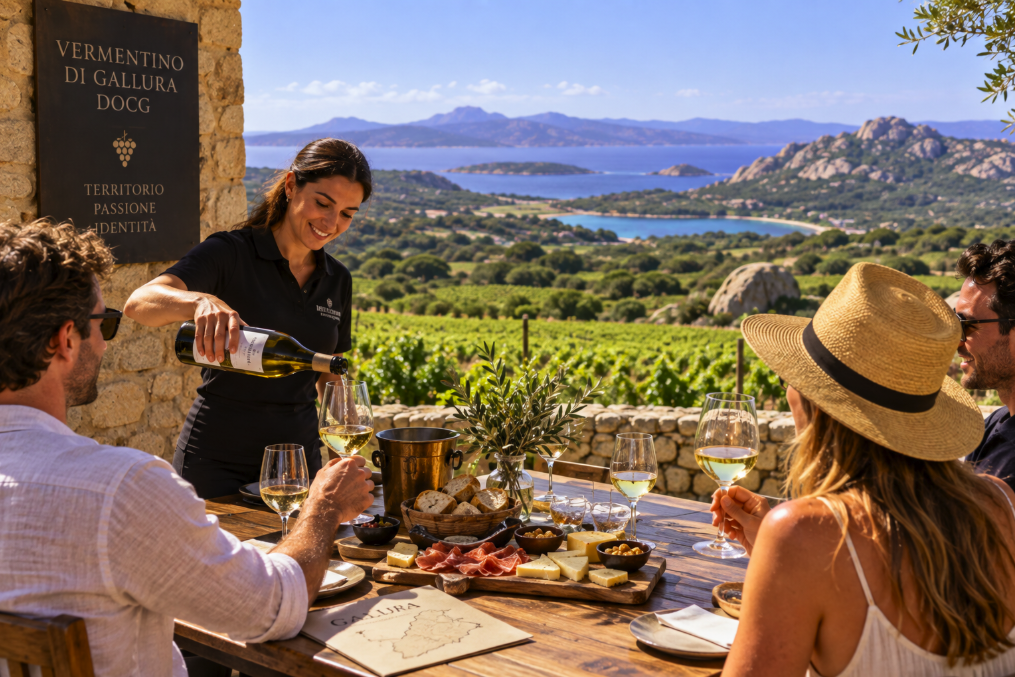
The landscape is part of the explanation. Gallura is granite country, shaped by wind and weather into the pale rock formations that characterize northeastern Sardinia. The DOCG rules specify suitable vineyards on soils formed through granite decomposition and at elevations no higher than 500 metres. The official consortium describes rock, light and wind as central elements of the territory.
That does not mean every bottle tastes identical. Producers work with different sites and winemaking choices, and the denomination includes several styles: standard Vermentino di Gallura, Superiore, sparkling, semi-sparkling, late-harvest and passito. The regulations set a minimum 12% alcohol for the standard wine and 13% for Superiore.
For visitors, the useful lesson is to taste comparatively. Trying a fresh young Vermentino beside a more structured Superiore can explain the denomination better than simply ordering one glass at dinner.
Wine tasting close to Olbia
Olbia itself is inside the official Vermentino di Gallura DOCG production area, so travelers do not have to drive deep into the countryside before reaching producers. The consortium lists several wineries in or around Olbia, including Tenute Olbios, Cantina Murales, La Contralta, Gregu, Zanatta and Mancini.
Cantina Murales is a particularly straightforward option for international visitors because its current 2026 booking system is available in English and explicitly lists English among the languages offered. One current experience includes a winery visit, three wines and a platter of homemade vegetarian specialties and local cheeses. The published adult price is €35, with a duration of about 90 minutes and multiple scheduled times during the day.
Those details are useful as a real-world benchmark rather than a universal price for Gallura. Tastings vary considerably depending on the winery, number of wines, food, vineyard tour and whether the experience is private. Always check the producer's current booking page before traveling, especially outside the main tourist season.
Beyond Olbia: build a Gallura wine route
A car opens up a much broader wine landscape. Monti, a short drive inland from Olbia, is one of the denomination’s important centers and is also home to the Consorzio di Tutela del Vermentino di Gallura DOCG. The official consortium winery network includes producers in Monti such as Cantina del Vermentino, Masone Mannu and Tanca Raina.
Farther north, Arzachena places wine country within easy reach of Costa Smeralda. The consortium includes Surrau and Capichera among its Arzachena producers, making this area practical for travelers staying around Porto Cervo or Cannigione who want to combine a winery visit with a coastal holiday.
Berchidda offers another perspective. Vineyards here lie toward the slopes of Monte Limbara, and the consortium describes the area around the Consorzio San Michele as having its own distinctive microclimate, with vineyards at roughly 300 metres above sea level. Berchidda is also strongly associated with Sardinian music and cultural events, so it can make sense as part of a more substantial inland day rather than a quick tasting stop.
How to choose a winery
The Vermentino di Gallura consortium maintains a directory of member wineries and identifies visitor services with icons, including tastings, food, accommodation, archaeological sites nearby, events, bicycle rental and vineyard trekking. This is a useful starting point because not every producer offers the same kind of wine-tourism experience.
Travelers who mainly want to understand the wine should prioritize a guided tasting with several Vermentino styles. Those interested in landscape may prefer a vineyard walk. Families or mixed groups can look for estates with food and other activities, while visitors staying on Costa Smeralda may value a winery that minimizes driving.
English-speaking service should be confirmed when booking. Some wineries, such as Murales, explicitly publish English among their tasting languages; at others, English may depend on the day and staff available. Asking in advance is preferable to assuming that an English-language website guarantees an English-language cellar tour.
Do not drive after a serious tasting
Wine tourism in Gallura is spread across rural roads, so transportation deserves as much planning as the tasting itself. If everyone in the group wants to drink, arrange a driver, taxi or organized tour rather than building a self-drive itinerary around multiple wineries. Even a tasting that appears modest can involve several pours, and adding a second or third cellar makes driving inappropriate.
For self-driving groups, designate a driver who is not tasting and keep the itinerary geographically realistic. Olbia and nearby countryside can fill half a day without trying to cover every corner of Gallura. A separate route around Arzachena and Luogosanto makes more sense for travelers based near Costa Smeralda.
Reservations are also advisable. Small wineries may not operate like open-door tasting rooms in major U.S. wine regions, and some visits are organized only at specific times. During harvest, staffing and access can change as production takes priority.
A different side of a Costa Smeralda trip
The appeal of a Vermentino tour is partly the contrast it creates with the coast. Within a relatively short drive of Olbia’s airport, beaches and marinas, the landscape shifts toward vineyards, cork oaks, granite and small inland towns. The wine makes more sense when tasted in that setting.
It also gives visitors a useful way to read a Sardinian wine label. “Vermentino” identifies the grape, but “Vermentino di Gallura DOCG” identifies a protected wine from a defined part of northeastern Sardinia and made under specific production rules. That distinction is worth understanding before comparing it with other Vermentino wines produced elsewhere on the island or around the Mediterranean.
For a first Gallura wine day, there is no need to make the itinerary complicated. Start with a booked tasting near Olbia, compare at least two Vermentino styles, add local cheese or seafood if the winery offers food, and leave enough time to enjoy the landscape. The best introduction to Sardinia’s great white wine is not a race between cellars, but a chance to understand why Gallura and Vermentino have become so closely connected.