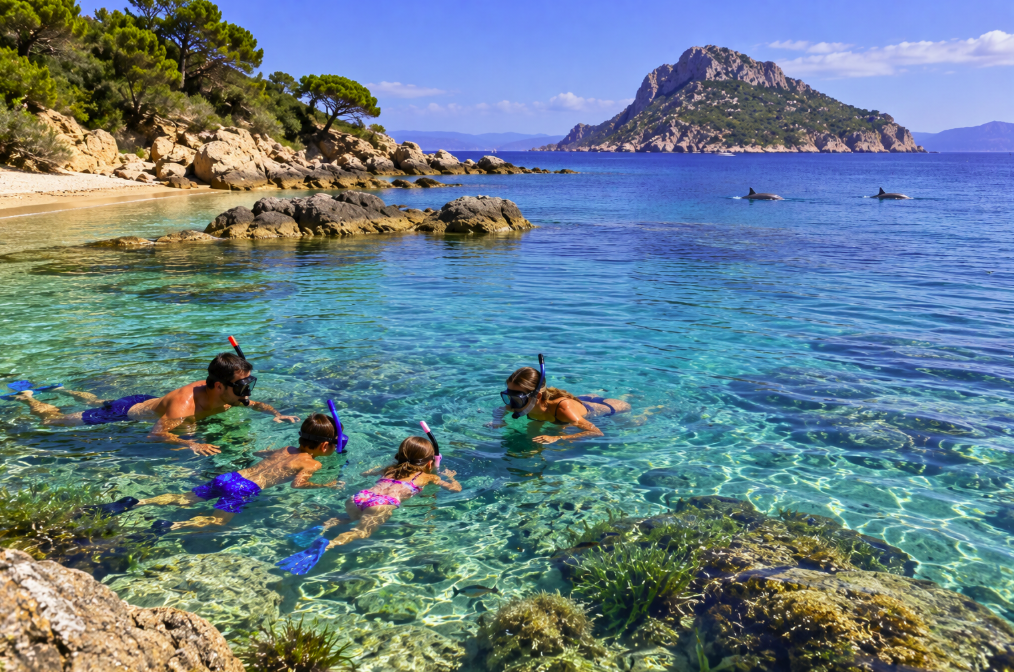
Cala Moresca near Golfo Aranci is one of the most convincing places to introduce children to snorkeling in north-eastern Sardinia. The little bay combines transparent water, patches of sand and rock, a sheltered setting and marine life close enough to shore that beginners do not need a boat to start exploring. There is another reason American families often hear about the area: bottlenose dolphins are regularly observed in the waters around Golfo Aranci and Figarolo. But that does not mean families should expect to snorkel with dolphins at Cala Moresca. Dolphin watching and family snorkeling are two separate experiences.
That distinction matters. A child can have an excellent morning looking for small Mediterranean fish around the rocks at Cala Moresca without seeing a dolphin at all. If seeing wild dolphins is important, the more responsible option is a dedicated wildlife-watching excursion with an operator following local codes of conduct.
Why Cala Moresca works for family snorkeling
Cala Moresca sits on the Capo Figari promontory, just over two kilometres from Golfo Aranci and around 20 kilometres from Olbia. The bay contains two small golden-sand beaches separated by rocks, with Figarolo island directly offshore.
The Municipality of Golfo Aranci describes the seabed as shallow for the first few metres before becoming deeper, with both rocky and sandy sections. Its tourism information specifically identifies Cala Moresca as suitable for snorkeling. SardegnaTurismo also describes the inlet as sheltered from winds, although families should still judge the sea on the actual day rather than treating any beach as permanently calm.
The mixture of habitats is what makes the water interesting. Around rocks and patches of seagrass, children can learn to slow down and look rather than expecting tropical-style coral. Mediterranean snorkeling is about details: small fish feeding around algae, schools moving through the water column and the contrast between sandy bottom, rock and Posidonia oceanica.
The nearby Tavolara–Punta Coda Cavallo Marine Protected Area describes its shallow illuminated rocky habitats as rich in macroalgae and small invertebrates, supporting fish including wrasses and seabream. Its educational snorkeling material notes that these environments can be explored easily with mask and fins.
Getting to Cala Moresca with children
This is not a beach where families park directly behind their towel. Motor vehicles cannot continue all the way to the shore. The official municipal page lists access by land or sea but not by motor vehicle, while local tourism information describes a walk of roughly ten minutes after leaving the car.
For most school-age children that can be straightforward, but it is worth knowing before arriving with coolers, inflatables and half the contents of a hotel room. Pack light, bring water and use footwear suitable for the approach and rocky edges.
There is pine forest behind the beaches, useful for shade during hotter hours. Cala Moresca itself is essentially a natural beach rather than a full-service family lido, so parents should not assume that food, rental equipment, lifeguards or changing facilities will be available when needed.
Because the bay is small and popular in high season, an early start is preferable. It gives children calmer surroundings, makes parking easier and usually avoids the busiest part of the beach day.
What can kids actually see underwater?
The most successful first snorkeling session is usually the one with modest expectations. Instead of swimming far offshore, stay around shallow rocky edges where children can repeatedly lift their heads, return to standing depth and build confidence.
Common Mediterranean coastal fish families include seabream and wrasses, while rocky habitats and seagrass support a much wider community of small marine animals. The Tavolara Marine Protected Area emphasizes the ecological importance of Posidonia oceanica meadows and the high biodiversity of its coastal marine habitats.
Do not encourage children to stand on seagrass, chase animals, collect shells containing living organisms or turn over rocks. A simple game of spotting different fish colors or counting species is more educational and less disruptive.
A mask that fits properly is more important than expensive equipment. Test it before the beach. For younger children, a flotation vest or other appropriate buoyancy aid can help, but it never substitutes for close adult supervision.
And what about the dolphins?
Golfo Aranci really is associated with wild bottlenose dolphins. The municipality’s tourism information describes the area as a dolphin-watching hotspot and reports a resident presence of more than 50 bottlenose dolphins linked partly to abundant prey around a local aquaculture facility.
That does not turn Cala Moresca into a dolphin-swimming beach. Dolphins are wild animals moving through a much larger marine area. They may be observed around Golfo Aranci and Figarolo, but nobody can responsibly promise that a family snorkeling from shore will encounter them.
Local boat operators offer trips combining dolphin observation with separate swimming or snorkeling stops around Figarolo, Cala Moresca and nearby waters. Their routes can change according to weather and the location of the animals. Families should read that wording carefully: a “dolphin watching and snorkeling” tour does not necessarily mean entering the water beside dolphins.
The best operators keep the wildlife encounter observational. Golfo Aranci’s “Gulf of Dolphins” initiative was developed with conservation organizations including Worldrise and Friend of the Sea to encourage more sustainable dolphin-watching practices.
A conservation project families can actually join
Cala Moresca has another unusually good feature for families interested in marine life. Worldrise’s SEATY Golfo Aranci project created a local marine conservation area extending for about 1,300 metres from Spiaggia dei Baracconi to Cala Moresca.
Its 2026 program has offered free guided snorkeling sessions with a marine biologist, normally at 11:00 and 15:00 every day except Thursday, with advance registration. The project also runs educational activities explaining the local marine environment.
Because programs and remaining seasonal dates can change, families should check the current Worldrise schedule rather than arriving on the assumption that a session is operating. When available, however, a guided biology-focused snorkel is an excellent alternative to simply renting masks and hoping children identify what they see.
Other family snorkeling areas in north-eastern Sardinia
If Cala Moresca is windy or crowded, the coast between Olbia and San Teodoro offers many alternatives. The Tavolara–Punta Coda Cavallo Marine Protected Area covers about 15,000 hectares of sea from Capo Ceraso toward Cala Finocchio and includes Tavolara, Molara and Molarotto.
The protected area is valuable precisely because of its underwater habitats, including extensive Posidonia oceanica meadows and rocky environments. Beaches around Porto Taverna, Porto Istana, Capo Coda Cavallo and the San Teodoro coast can provide family swimming and snorkeling opportunities depending on wind, waves and the exact access rules at each location.
Do not select a spot only from a “best snorkeling” list. For children, the best location on any given morning is often the one with the calmest water, easiest entry and clearest visibility rather than the one with the most famous name.
How to make a Sardinia snorkel day work with kids
Go early, particularly in July and August. Bring properly fitting masks, sun protection, drinking water and water shoes if children are uncomfortable around rocks. A rash guard reduces the amount of sunscreen needed and protects shoulders during long periods floating face-down.
Keep the first sessions short. Ten enjoyable minutes followed by a break can be more effective than pushing a nervous child through an hour-long swim. An adult should remain within immediate reach of inexperienced swimmers, even in shallow water.
Never snorkel when visibility, waves or currents make you uncomfortable. Cala Moresca may be described as sheltered, but wind and marine conditions change. If the sea does not look right, use the day for the beach or Capo Figari scenery and try again another morning.
Most importantly, let the wildlife be a bonus. Cala Moresca is worth visiting because the bay itself provides an accessible introduction to Sardinia’s underwater world. The possibility of seeing dolphins elsewhere in the Gulf of Aranci makes the wider area even more interesting, but a family does not need a dolphin encounter for the snorkel to be memorable.
For parents planning around Olbia or Costa Smeralda, that combination makes Golfo Aranci particularly useful: a child-friendly shore snorkel at Cala Moresca, conservation activities when scheduled, and the option of a responsible boat-based dolphin-watching trip nearby. Just keep the promise accurate — clear water and marine life are realistic; swimming with wild dolphins is not something to sell to the kids in advance.