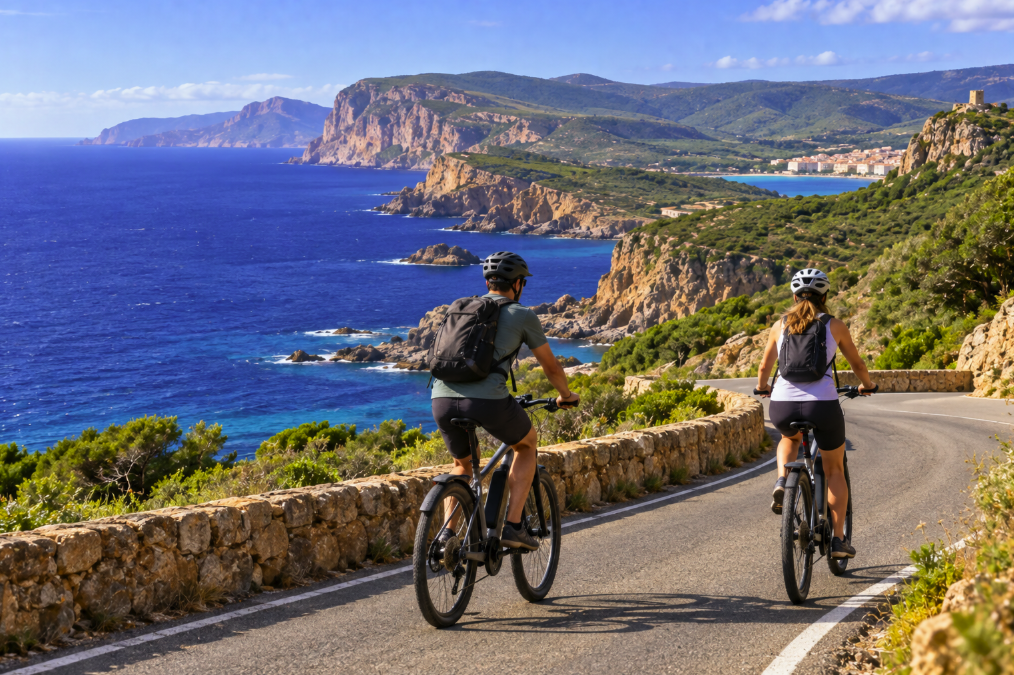
The coastal road between Alghero and Bosa is one of the rides that explains why Sardinia is becoming a serious cycling destination rather than simply a beach holiday with bikes available. The route follows the island’s wild north-western coastline for roughly 45–50 kilometres, with cliffs dropping toward the Mediterranean, long sections of undeveloped landscape and repeated climbs that make an e-bike genuinely useful. It can be ridden independently, but “self-guided” should not be confused with “easy”: this is a real public road with traffic, substantial climbing and very few places to buy water once Alghero is behind you.
Komoot’s current 2026 data underline its popularity. Its Alghero–Bosa Coastal Road loop is the platform’s number-one road-cycling route around Bosa, with more than 600 recorded riders and a 4.7 rating. The complete loop shown by Komoot is 75.7 kilometres with 1,480 metres of climbing and is rated hard. A separate west-coast loop from Alghero reaches 108 kilometres and 1,900 metres of elevation. For visitors on e-bikes, however, the most attractive plan is often simpler: ride the coastal road one way toward Bosa and arrange the return separately rather than turning the day into a demanding inland loop.
Why the Alghero–Bosa road is special
South of Alghero, the urban coast quickly gives way to the SP105, the panoramic road that traces the cliffs toward Bosa. The scenery changes from low Mediterranean scrub to volcanic-looking headlands, small coves and increasingly dramatic views over open sea.
There are few buildings along much of the route. That is part of the attraction and also the main logistical issue. Komoot contributors repeatedly flag the limited water supply, and current route descriptions note that the coastal section has little infrastructure. One highlighted water point is around ten kilometres after Alghero, but riders should never plan a long Mediterranean cycling day around a single fountain being available.
The road also crosses the wider Capo Marrargiu landscape, known for its griffon vultures. Spotting one circling above the cliffs is possible, but riders should keep their attention on the road rather than treating wildlife as guaranteed entertainment.
How hard is it on an e-bike?
The answer depends on what you mean by e-bike. A good trekking or road-oriented pedal-assist bike makes the repeated climbs considerably more manageable, especially for recreational cyclists who want to enjoy the scenery rather than spend the day chasing performance numbers.
It does not remove the distance, heat, wind or descents. Riders still need to be comfortable controlling a bicycle on a winding road and sharing it with cars and motorcycles. The route is mostly paved, but it is not a protected cycle path.
Komoot currently rates its 75.7-kilometre Alghero–Bosa coastal loop as hard, with about 1,480 metres of ascent. Its longer 82.8-kilometre Bosa–Montresta–coast loop has approximately 1,730 metres of climbing. Those figures make clear why the route should not be marketed to complete beginners simply because electric assistance is available.
For a leisure rider, a one-way coastal itinerary is more forgiving. The exact distance depends on the start and finish chosen, but the continuous scenic coastal road is roughly 45–50 kilometres. Allow far more time than a road cyclist’s moving-time estimate because viewpoints, food stops and photographs are the point of the day.
Self-guided does not mean following Google Maps blindly
A navigation app such as Komoot is useful for loading the route offline and seeing the elevation profile before departure. Download the course while you have hotel Wi-Fi or reliable mobile data and carry a phone mount or compatible bike computer rather than stopping at every junction.
Do not blindly accept an automatically generated detour. Cycling apps can propose unpaved tracks or shortcuts that make sense for gravel bikes but not for a rented city-style e-bike. If the goal is the classic ride, the SP105 coastal road is the defining section.
Komoot’s current route pages describe the road as predominantly well paved. The surface is therefore less of a challenge than the climbing, exposure and lack of services.
Can you rent an e-bike in Alghero?
Yes. Alghero has several bicycle-rental businesses, and the city’s official tourism portal currently lists Ecomania as offering pedal-assist e-bike rental and service. Its second seasonal rental point at Alghero’s tourist port operates from May 1 to October 31.
The current tourism listing publishes basic daily rental prices starting from €15 between July 1 and September 30, although that figure should not be assumed to represent the price of a high-capacity trekking e-bike suitable for an Alghero–Bosa ride. Riders should request the exact model and daily rate before booking.
For this route, ask specifically about battery capacity, real-world range with climbing, charger availability, puncture kit, spare tube, pump, lock and roadside assistance. A rental shop may have several types of electric bicycle intended for very different uses.
Also tell the shop that you intend to ride to Bosa. The staff can confirm whether the bike is appropriate and whether one-way collection, delivery or recovery can be arranged. Do not assume a bicycle can simply be left in Bosa.
Battery planning matters more than the advertised range
E-bike range figures are highly dependent on rider weight, assistance level, wind, climbing, tire pressure and temperature. A battery advertised for a long distance on flat terrain can drain much faster when high assistance is used repeatedly on coastal climbs.
Start with a full battery and use Eco or a lower assistance mode on easier sections. Save stronger assistance for the climbs rather than leaving the bike in maximum mode from Alghero.
If you plan to ride all the way to Bosa and then return by bicycle, discuss that exact distance with the rental company. A roughly 90–100-kilometre out-and-back with significant elevation is a completely different battery problem from a one-way ride.
For many visitors, the better self-guided design is to cycle one direction and organize a transfer for riders and bicycles. That preserves the best coastal section without making battery anxiety the defining feature of the afternoon.
Traffic and road safety
The Alghero–Bosa route appears in cycling guides because it is beautiful, not because it is separated from motor vehicles. Cars, motorcycles and tour traffic use the same road.
Ride predictably, keep to the appropriate side of the road, avoid sudden stops at viewpoints and use proper lights if visibility is poor. A helmet is an obvious choice even for riders who normally treat an e-bike as casual transport.
Be especially careful on descents. Electric assistance makes climbing feel easier, which can tempt less experienced cyclists into a route whose downhill corners demand more handling confidence than expected.
Summer heat adds another risk. Komoot riders specifically recommend September over the hottest summer period, and that is sensible for a self-guided visitor. Spring and autumn can offer much more comfortable cycling temperatures, although wind and rain still need checking on the day.
What to carry when there are almost no shops
Take more water than you expect to drink, particularly from late spring through early autumn. Carry food rather than assuming a café will appear after the next headland.
A basic repair kit should include at least a spare inner tube or tubeless repair solution appropriate to the rental bike, tire levers and a pump. Ask the rental company what is already supplied. A power bank is useful for navigation, but it is not a substitute for an e-bike charger.
Sun protection is essential because much of the road is exposed. Pack a light layer as well: coastal wind can make conditions feel very different after a long stop or later in the day.
Where does Bosa fit into the day?
Bosa makes a natural finish because it is worth visiting rather than merely serving as a turnaround point. The town sits on the Temo River below the medieval Castello di Serravalle, with colorful houses rising behind the waterfront.
For a relaxed itinerary, leave Alghero in the morning, ride the coast with plenty of stops, have a late lunch in Bosa and return by a pre-arranged vehicle capable of carrying the bicycles. That turns the route into a travel experience instead of a mileage challenge.
Stronger riders can build a loop through the inland hills, including Montresta, but the numbers climb quickly. Komoot’s current Bosa–Montresta–coastal circuit is 82.8 kilometres with 1,730 metres of ascent, while a larger west-coast circuit from Alghero is 108 kilometres with about 1,900 metres. Those are training-day routes, not casual sightseeing rides.
A gentler alternative for families and beginners
If the coastal road to Bosa sounds intimidating, Alghero itself offers a much easier cycling day. The waterfront and northern coastal cycle infrastructure provides a flatter ride toward Maria Pia and Fertilia, allowing visitors to use an e-bike without committing to long climbs or an exposed road journey.
That is a better first-day test for someone who has not ridden an e-bike before. Learn the controls, braking behavior and battery display close to town, then decide whether the Bosa road matches your confidence.
The distinction is important because the Alghero–Bosa ride is sometimes presented online as a scenic activity anyone can do. The scenery is accessible; the physical and road demands still require judgment.
Is September the best time?
September is an excellent candidate. The strongest summer heat usually begins to ease, while daylight remains generous and tourism services are still operating. It is also specifically recommended by riders on current Komoot route notes compared with the hotter midsummer period.
That does not guarantee ideal conditions. Sardinia’s west coast is exposed to the mistral, and a strong north-westerly wind can radically change the difficulty of a ride. Check wind direction and speed, not just temperature and rain probability.
For a one-way route, wind direction can even influence whether Alghero-to-Bosa or Bosa-to-Alghero is the more comfortable choice on a particular day. A local rental shop can help interpret the forecast before departure.
The best self-guided e-bike ride is therefore not a rigid GPX file booked months in advance. It is a route with a clear plan, a suitable bike, enough battery and water, and enough flexibility to change direction or postpone if the west-coast weather is wrong.
Done that way, the Alghero–Bosa road delivers exactly what cycling in Sardinia should: long stretches where the landscape is the destination, a historic town waiting at the end and electric assistance that helps ordinary travelers experience terrain that would otherwise belong mainly to trained road cyclists.