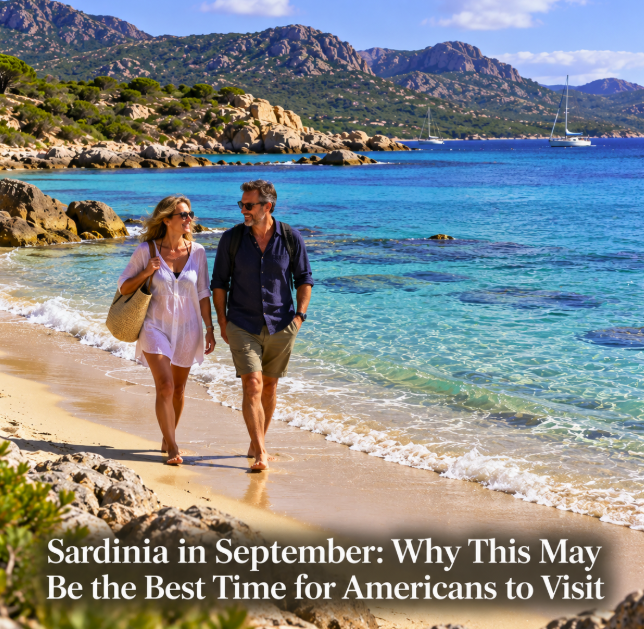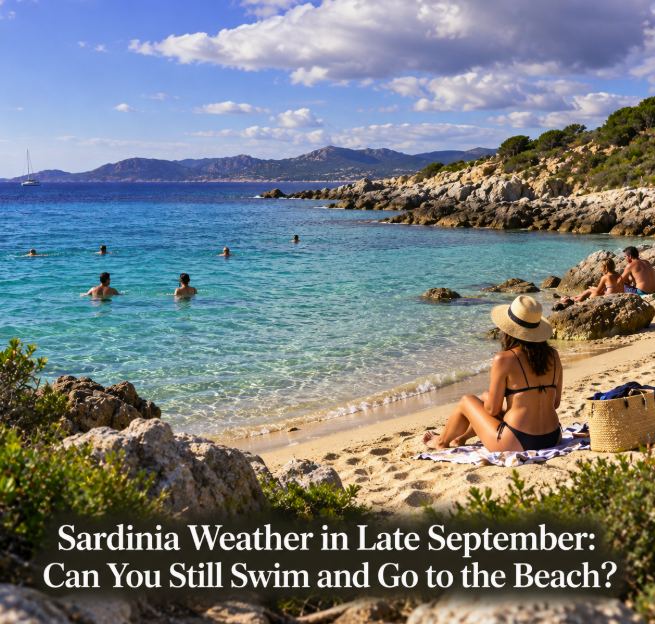
Late September can still be excellent beach weather in Sardinia, and the sea usually retains much of the warmth accumulated during summer. September averages put seawater at about 23.4°C around Alghero, 23.9°C around Cagliari and roughly 23°C around Baia Sardinia. For many travelers, that is comfortable enough for swimming. The important difference from July and August is that beach weather is less predictable, so it pays to choose the coast according to the daily wind and forecast rather than planning every beach weeks in advance.
Late September is therefore not “too late” for a Sardinian beach holiday. It is better described as a shoulder-season trip in which you may have beautiful swimming days, cooler evenings and the occasional unsettled spell within the same week.
How warm is Sardinia in September?
Climate averages remain pleasantly warm across the island. Cagliari averages a September daytime high of about 26.2°C and a nighttime low around 19.4°C. Alghero averages approximately 24.3°C during the day and 20.4°C at night. In the northeast around Baia Sardinia, the September average high is around 25°C.
Island-wide climate data gives an average September high around 27.4°C, but that figure should not be treated as a late-September forecast. Temperatures normally trend downward as the month progresses, and local geography makes a significant difference.
On a sunny afternoon in the final week of September, shorts, swimwear and a beach towel can still be entirely appropriate. After sunset, a light jacket, overshirt or sweater becomes much more useful than it was in August.
Is the sea still warm enough to swim?
For most people who are comfortable swimming in water around 23–24°C, yes. The Mediterranean cools more slowly than the air, so Sardinia often keeps favorable swimming temperatures after the peak summer heat has passed.
September's average sea temperature is around 23.9°C at Cagliari and 23.4°C at Alghero. Even Baia Sardinia in the north averages about 23°C. These are monthly averages rather than guaranteed readings for a particular beach or date, but they give a useful indication of why swimming remains common in September.
Wind can change how comfortable the same water feels. A calm sunny day with 23°C water can feel inviting; the same water after a swim can feel much cooler when a strong mistral is blowing. For travelers sensitive to cold, midday and early afternoon are usually more comfortable than an early-morning swim.
Late September is more changeable than summer
The main trade-off is weather stability. September rainfall is higher than in midsummer. Alghero averages about 25 mm of rain over 10.7 rainfall days during the month, while Cagliari averages about 21 mm over 8.4 days. Baia Sardinia averages around 32 mm over eight days.
A “rainfall day” does not mean an entire day is necessarily washed out. Mediterranean weather can bring a shower or thunderstorm followed by sunshine. But travelers should not expect the nearly automatic blue-sky pattern associated with July.
For a late-September trip, check the short-range forecast every morning. A flexible itinerary is more useful than trying to identify one part of Sardinia that is guaranteed to be sunny.
Wind may decide which beach is best
Wind is often more important than temperature when choosing a Sardinian beach. The island is exposed to several wind directions, and a coast that is uncomfortable and choppy on one day can be calm when the wind changes.
The mistral, arriving from the northwest, can produce rougher conditions on exposed western and northwestern coasts. Depending on the day's direction and strength, beaches on another side of the island may be more sheltered.
This is why travelers staying in Alghero, Cagliari, Olbia or another coastal base should check wind as well as rain probability. If you have a car, keeping two or three beaches facing different directions in your plan can substantially improve the chances of a good beach day.
Alghero in late September
Alghero is still a practical beach base at the end of September. The monthly sea average of 23.4°C remains swimmable for many visitors, while average daytime temperatures are in the mid-20s Celsius.
The advantage is flexibility. If the weather is not ideal for swimming, the historic center, city walls, restaurants and nearby countryside provide alternatives without turning the day into a loss. On a clear calm day, nearby beaches can still feel distinctly summery.
September also has shorter days than August. By the final day of the month, sunset in Alghero is around 7:10 p.m., compared with almost 8 p.m. at the start of September. Plan long beach days accordingly.
Cagliari and southern Sardinia
Cagliari is slightly warmer on average in September than Alghero, with a monthly high around 26.2°C and sea temperature around 23.9°C. Poetto makes it easy to decide on a beach visit at short notice because the coast is immediately accessible from the city.
Southern Sardinia also gives drivers multiple coastal options, from the Cagliari area toward Villasimius or the southwest. This does not guarantee better weather, but it creates more possibilities for adapting to local wind and cloud conditions.
The same shoulder-season warning applies: beach establishments, lifeguard coverage and seasonal services may reduce their operations after the peak summer period. Never assume that every lido, beach bar, shuttle or rescue service operates exactly as it did in August.
What should you pack?
Pack for both summer and early autumn rather than choosing one season. Swimwear, sun protection, sunglasses and a hat are still useful. September's average maximum UV index around Cagliari and Alghero is 6, so the weaker-looking autumn sun can still burn exposed skin.
Add a light jacket or sweater for evenings, particularly in windy locations. A compact rain layer is sensible, and closed shoes are useful if a cloudy day becomes an opportunity for hiking or exploring inland towns.
If you are planning boat excursions, remember that sea conditions rather than sunshine alone can determine whether trips operate. Keep some flexibility in the schedule instead of leaving the one boat trip you care about until the final day.
Is late September a good time for a beach holiday?
It is a good period for travelers who want to combine beaches with sightseeing, food, walking and road trips. It is less suitable for someone who expects seven consecutive days of guaranteed hot sun and resort services operating at full August intensity.
The upside is that the island is moving out of its busiest summer phase. Popular coastal areas can feel less intense, while the sea is still relatively warm. Temperatures are also more comfortable for visiting archaeological sites, walking through historic centers or hiking on days when the beach is not ideal.
The most realistic expectation is to think of swimming as highly possible rather than guaranteed. Check the weather and wind each day, use a car or flexible transport plan when possible, and keep an inland alternative ready.
Sardinia does not suddenly stop being a beach destination when the calendar reaches the final week of September. On the right day, the water can still be turquoise, the sand warm and the sea comfortable enough for a long swim. The difference is that autumn has started to enter the conversation — and travelers who adapt to it usually get much more from the island.