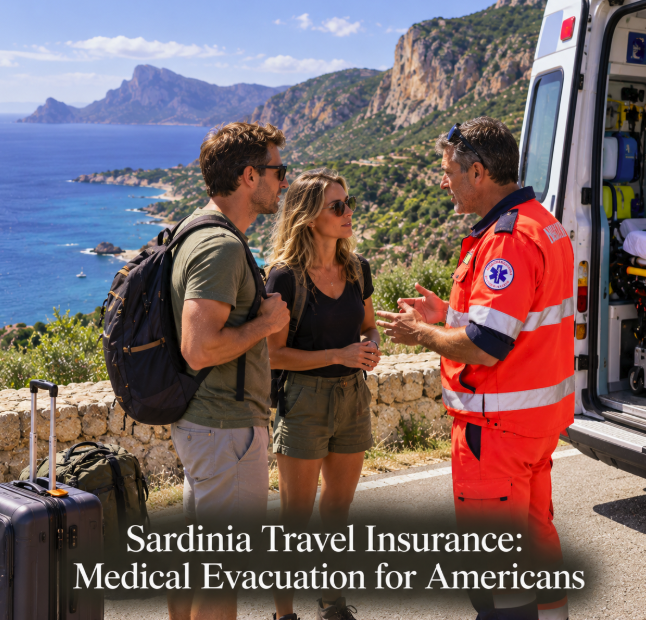
Americans traveling to Sardinia do not need to panic because of Italy’s current terrorism advisory, but it is a sensible moment to check what their travel insurance actually covers. The US Department of State currently lists Italy at Level 2: Exercise Increased Caution due to terrorism, with the advisory updated on September 10, 2026. The same official Italy guidance encourages US citizens to purchase medical evacuation insurance — a recommendation that matters for accidents and serious illness as much as for any security incident.
Medical evacuation coverage is different from ordinary trip cancellation insurance. Its purpose is to pay for medically necessary transportation when appropriate treatment cannot be provided where the traveler is located, potentially including transfer to another hospital or, under some policies and circumstances, repatriation to the United States.
What the current Italy advisory actually says
The State Department's September 2026 advisory tells travelers to exercise increased caution in Italy because of terrorism. It says attacks may occur with little or no warning and identifies possible targets including tourist locations, transportation centers, markets, hotels, restaurants, religious sites, airports and public events. Travelers are advised to remain alert, follow local news and prepare contingency plans.
The advisory applies to Italy; it is not a Sardinia-specific evacuation order. Travelers should therefore distinguish a general national security advisory from evidence of an immediate local emergency. Anyone visiting Sardinia should follow current official alerts and instructions rather than treating social-media discussion as proof that evacuation is necessary.
Why medical evacuation insurance can still make sense in Sardinia
Sardinia has hospitals, emergency services and air-rescue capability. In a serious emergency, 112 is the number to call, and Italy's Health Ministry confirms that ambulance and primary emergency helicopter services operate within the national emergency system.
The issue for an American traveler is not that Sardinia lacks healthcare. It is that a severe injury or illness can require specialized transportation, a transfer between facilities or an eventual medically supervised return home. The State Department warns that medical evacuation by air ambulance to the United States can cost approximately $20,000 to $200,000, depending on location and medical condition.
It also states that the US government does not pay travelers' medical bills and that Medicare and Medicaid do not cover medical care abroad. Travelers with private US health insurance should check their own policy because overseas coverage varies.
Medical evacuation is not the same as an ambulance
The term “medical evacuation” can create the impression that an insurance company will automatically fly a traveler back to America after any accident. Policies are usually much more specific.
Emergency transport from a beach, road or village to a Sardinian hospital is part of the immediate local rescue system. Travel-insurance evacuation benefits generally become relevant when medically necessary transportation to a suitable facility is required beyond ordinary local emergency response.
Policies also differ on the destination. Some cover transportation to the nearest adequate medical facility, while others may include transportation home when medically appropriate. Travelers should read those definitions before buying rather than assuming that “$500,000 evacuation coverage” automatically means an air ambulance to the hospital of their choice in the United States.
What Americans should check before buying a policy
A useful policy should clearly state its limits for emergency medical treatment and emergency medical transportation. The State Department recommends checking whether coverage is valid in the countries being visited, lasts for the full trip, covers medical transportation back to the United States, addresses existing medical conditions where needed and covers the activities planned during the holiday.
That last point is particularly relevant in Sardinia. Hiking, cycling, sailing, diving, climbing and other outdoor activities may be subject to exclusions or additional conditions. A traveler planning a coastal trek or an active holiday should verify those activities specifically.
Look for a 24-hour assistance service as well. In a serious case, the assistance company may need to coordinate directly with doctors, hospitals and transport providers. Policies can require prior authorization for expensive transfers except where an immediate emergency makes that impossible.
Also check whether the insurer pays providers directly or expects the traveler to pay first and seek reimbursement. The State Department warns that hospitals and doctors abroad may sometimes require payment before service or admission, so access to funds can still matter even when insured.
US travelers should not rely on an EHIC
The European Health Insurance Card is useful for eligible people insured in EU and certain EFTA systems, but it is not a general tourist health card available to American visitors simply because they are traveling in Europe. Italy's Health Ministry explains that the EHIC system gives eligible European travelers access to medically necessary public or affiliated healthcare during temporary stays under the applicable European rules.
Americans should therefore check their US health insurance and buy appropriate travel medical coverage when needed rather than expecting the European card system to cover them.
What happens in an emergency in Sardinia?
For an immediate emergency, call 112. Give the operator your location as accurately as possible and describe what happened. In remote coastal or mountain areas, precise coordinates, a named trail, road number or recognizable landmark can be especially useful.
Insurance comes after immediate safety. Do not delay calling emergency services while trying to obtain approval from an insurer. Once the situation is stabilized, the policy's assistance line can help coordinate covered treatment or transport according to its terms.
US citizens can also enroll in the State Department's Smart Traveler Enrollment Program, or STEP, to receive security information and help the US Embassy communicate with travelers during emergencies. Sardinia falls within the consular district of the US Embassy in Rome.
Does terrorism coverage require something different?
Travelers buying insurance specifically because they have seen the current terrorism alert should read the exclusions carefully. Coverage for terrorism, civil disturbance, trip cancellation and evacuation for security reasons can be defined differently from medical evacuation.
A medical evacuation benefit normally concerns a medical necessity. A policy does not necessarily pay to leave Sardinia simply because a traveler feels unsafe after an advisory or news report. Likewise, trip cancellation benefits generally apply only to the specific covered reasons written into the policy.
For that reason, someone concerned about both health emergencies and security disruptions should compare the medical, evacuation, interruption and cancellation sections separately rather than focusing on a single headline coverage amount.
A practical insurance approach for a Sardinia trip
Before departure, Americans should first ask their existing health insurer exactly what emergency treatment is covered in Italy. Then check whether that plan pays for medical evacuation or repatriation. If the answer is no — or the coverage is too limited — a dedicated travel medical policy or supplemental evacuation benefit can fill the gap.
Save the insurer's 24-hour assistance number offline, carry the policy number, and give a copy to a traveling companion or family member. Keep enough accessible funds for unexpected expenses, and know that 112 — not the insurance company — is the first call when immediate emergency help is required.
The September 2026 terrorism advisory is a reason to stay informed, not evidence that travelers need to evacuate Sardinia. Medical evacuation insurance is better understood as broader preparation for the rare serious event: a major accident, sudden illness or other medical emergency where ordinary travel health coverage is not enough.