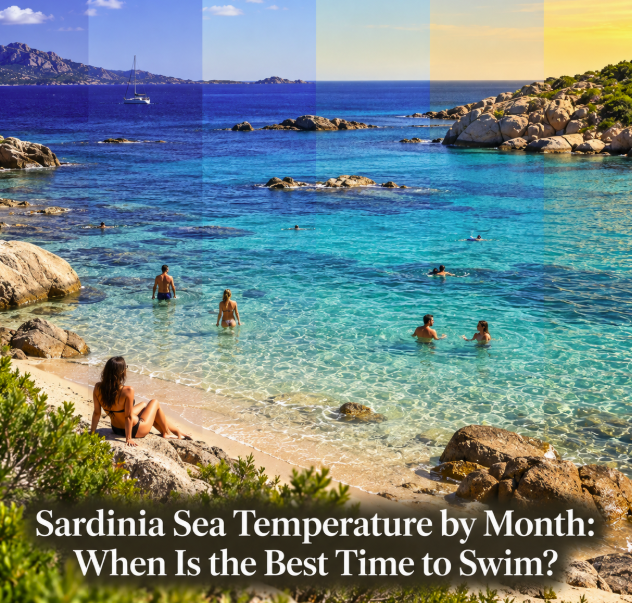
If swimming is central to your Sardinia vacation, the calendar matters. The Mediterranean around the island is coldest in late winter, warms rapidly from May into June and usually reaches its highest average temperatures in August. September remains notably warm because the sea loses summer heat more slowly than the air, while October can still produce good swimming days for travelers comfortable in cooler water.
There is no single temperature for the whole island. Sardinia has hundreds of kilometers of coastline, and water temperature varies by coast, weather, wind and local conditions. A useful way to understand the annual pattern is to compare two opposite sides of the island: Alghero on the northwest coast and Cagliari in the south.
Sardinia sea temperature chart: month by month
The following figures are approximate long-term monthly averages in degrees Celsius. They are climate guides, not forecasts for a particular beach or day.
- January: Alghero 14.5°C; Cagliari 15.0°C
- February: Alghero 13.8°C; Cagliari 14.3°C
- March: Alghero 14.1°C; Cagliari 14.3°C
- April: Alghero 15.4°C; Cagliari 15.5°C
- May: Alghero 17.9°C; Cagliari 18.0°C
- June: Alghero 21.5°C; Cagliari 21.7°C
- July: Alghero 24.1°C; Cagliari 25.0°C
- August: Alghero 24.9°C; Cagliari 26.3°C
- September: Alghero 23.7°C; Cagliari 25.0°C
- October: Alghero 21.6°C; Cagliari 22.5°C
- November: Alghero 18.9°C; Cagliari 19.4°C
- December: Alghero 15.9°C; Cagliari 16.5°C
The curve is more useful than any individual decimal. Water remains around 14–16°C through winter and early spring, approaches 18°C in May, passes roughly 21°C in June and becomes warmest from July through September. The south around Cagliari tends to show somewhat warmer averages at the summer peak than Alghero.
January to April: cold-water territory
Winter beaches in Sardinia can be beautiful, but this is not conventional swimming season. Average sea temperatures around Alghero and Cagliari sit roughly between 14°C and 16°C from January through April.
People accustomed to cold-water swimming may still enter the sea, and surfers or open-water athletes may use suitable thermal protection. For the average vacationer imagining a long relaxed swim followed by sunbathing, however, these months are much better considered walking, sightseeing and coastal-road-trip season.
May: beach weather does not always mean warm water
May is where expectations can diverge from reality. Sunny days may feel genuinely summery on land, yet the sea has only begun recovering from winter. Long-term averages are around 18°C in both Alghero and Cagliari.
That does not make swimming impossible. On a warm, calm afternoon, especially toward the end of the month, plenty of visitors will go in. But travelers who dislike cool water should not choose May solely for a classic warm-sea holiday.
The advantage is everything surrounding the swim: green landscapes, long daylight, lower seasonal pressure than August and pleasant conditions for walking and exploring.
June: the swimming season changes gear
June brings one of the largest practical changes of the year. Average sea temperatures rise above 21°C in both sample locations, and warm air makes getting into and out of the water more comfortable.
Early June can still feel fresh to swimmers who prefer tropical water, but by later June Sardinia is firmly functioning as a summer beach destination. The month is particularly attractive for travelers who want long days and a full coastal holiday without automatically choosing the peak of August.
July and August: the warmest sea
July brings average water temperatures around 24°C in Alghero and 25°C in Cagliari. August is warmer still, averaging about 24.9°C around Alghero and 26.3°C around Cagliari in the decade-based dataset used for this guide.
For travelers whose main criterion is the warmest possible sea, this is the key period. Long swims, snorkeling and repeated dips throughout the day generally feel easier than in spring.
The compromise is demand. July and especially August are peak travel periods, with pressure on hotels, rental cars, parking and the most famous beaches. Some environmentally sensitive beaches use reservation or controlled-access systems during the summer.
September: summer stays in the water
September is one of Sardinia's most interesting swimming months because the sea retains heat accumulated during July and August. Average water temperatures remain around 23.7°C in Alghero and 25°C in Cagliari.
That means a September visitor can often enjoy genuinely warm swimming even as air temperatures become less intense. For travelers interested in combining beaches with towns, archaeological sites, road trips and inland festivals, that balance can be more useful than the absolute August temperature maximum.
Conditions do become more variable as autumn approaches. Wind, rain and individual weather systems can change the character of a beach day quickly, so September is best approached with a flexible itinerary.
October: still possible, but less predictable
October averages remain surprisingly mild at roughly 21.6°C around Alghero and 22.5°C around Cagliari. On sunny, calm days, swimming can still be very enjoyable, especially for visitors comfortable with moderately cool water.
The bigger difference is outside the sea. Air temperatures, wind and cloud cover increasingly influence how warm a swim feels, while beach bars, lifeguard services, boat excursions and seasonal facilities may operate reduced schedules or close.
October therefore works better for a general Sardinia trip with possible beach days than for a vacation requiring guaranteed daily swimming.
November and December: the sea cools again
By November, averages fall below 20°C, and December drops toward 16°C. Sardinia remains rewarding for food, cities, archaeology, hiking and quiet coastal scenery, but the conventional summer swimming season is over.
Specialist open-water swimmers are a different audience and should evaluate water temperature, weather, exposure and appropriate equipment according to their experience rather than a tourism calendar.
So what is the best time to swim in Sardinia?
If warm water is the only priority, July through September is the clearest window, with August normally around the annual peak. Travelers who want warm water plus somewhat less peak-season intensity may prefer June or September, accepting that conditions and crowds vary by location and date.
October is the bonus month: the sea often remains warmer than first-time visitors expect, but the overall weather is less dependable. May is the reverse situation — the air can suggest summer while the water still remembers winter.
Water temperature is only one part of choosing a beach. Sardinia is exposed to changing winds, including the mistral, and conditions can differ dramatically between coasts on the same day. A 24°C sea with strong wind and waves may feel less inviting than 22°C water in a sheltered bay.
Use monthly temperatures to choose the season, then check the current sea, wind and weather conditions for the specific coast shortly before your beach day. That combination is far more useful than expecting one island-wide temperature to describe every Sardinian beach.