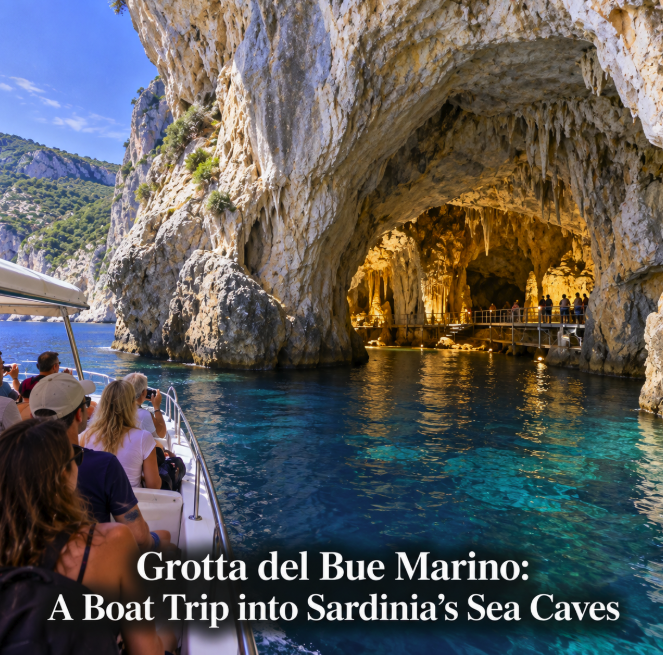
Grotta del Bue Marino is one of the classic boat excursions on Sardinia’s Gulf of Orosei, combining a journey beneath the limestone cliffs with a guided walk inside a cave system of underground lakes, stalactites and stalagmites. The entrance opens directly onto the sea in the territory of Dorgali, south of Cala Gonone, so for ordinary visitors the experience begins on a boat rather than at a roadside parking area.
The cave can be visited as a focused excursion or included in a longer day exploring the Gulf of Orosei. The important detail is that the cave admission and the boat transport are separate elements. Current municipal information confirms that visitors need both access to the grotto and transportation by sea.
Why is it called Bue Marino?
Bue marino, literally “sea ox,” was a traditional local name for the Mediterranean monk seal. The animals once used these marine caves, and their association with the site gave the grotto its modern name.
The cave belongs to the enormous karst landscape connected with Codula di Luna. Regional tourism information describes the Bue Marino cavities as extending for around 15 kilometers in total and forming part of a much larger underground system in the Supramonte and Gulf of Orosei area.
For visitors, however, only a small prepared section is relevant. The accessible southern branch has an illuminated tourist route of roughly 900 meters. The rest is not an ordinary sightseeing trail.
What happens during the cave visit?
After arriving by boat, visitors enter with a guide and follow equipped walkways through the southern branch. The visit lasts approximately one hour according to Sardinia’s official tourism information.
Inside, seawater penetrates the cave while freshwater from underground systems creates additional pools and lakes. Stalactites, stalagmites, sandy sections and reflections on the water create the scenery for which the grotto is known.
The tourist route eventually reaches the area traditionally known as the seals’ beach, recalling the period when Mediterranean monk seals used the cave environment. The grotto is also associated with prehistoric rock engravings, adding an archaeological dimension to what is primarily a geological visit.
How do you reach Grotta del Bue Marino?
The most straightforward departure point is Cala Gonone, the seaside village of Dorgali. Boats leave from its harbor, and the grotto is a standard destination for local excursion operators.
Regional tourism information also lists boat services from Orosei, La Caletta, Arbatax and Santa Maria Navarrese. The exact journey, duration and combination of stops depend on the departure port and operator.
Visitors staying around Cala Gonone have the advantage of being close to the cave and to the wider collection of Gulf of Orosei excursions. Travelers based farther north or south should compare the total boat day rather than assuming every departure offers the same itinerary.
Cave-only excursion or a full Gulf of Orosei day?
There are two basic ways to structure the experience. The first is a morning or shorter excursion focused primarily on the grotto. The second combines the cave visit with stops along the Gulf of Orosei coast.
A longer cruise can include time near beaches and coves such as Cala Luna and other famous stretches of the gulf, depending on the operator, sea conditions and itinerary. This option makes sense for travelers who have only one day in Cala Gonone and want to combine geology with swimming and coastal scenery.
A shorter visit may suit families, travelers with limited time or anyone who wants to spend the rest of the day independently in Cala Gonone.
The cave ticket and boat ticket are not the same thing
This is the planning detail most likely to cause confusion. The Municipality of Dorgali confirmed in 2026 that Grotta del Bue Marino can be reached by visitors only by sea and that anyone entering therefore needs to purchase transport as well as the ticket for the cave visit.
The municipality currently allows grotto tickets to be sold online, at physical ticket offices and through authorized external agencies connected with boat operators. Availability is capacity-controlled, so the last places for a particular visit can disappear while a booking is being attempted.
When comparing excursions, check whether the advertised price includes cave admission or only the boat journey. Do not assume that a “Bue Marino boat tour” automatically includes every ticket needed to enter the guided section.
Should you book in advance?
Advance booking is sensible during the main visitor season. Sardinia’s official tourism guidance recommends reserving ahead rather than arriving at the harbor and assuming there will be space on the desired boat and cave visit.
This matters particularly when combining the grotto with a longer Gulf of Orosei itinerary. Boat capacity, cave admission times and weather all have to work together.
Before paying, confirm the departure port, meeting time, cave ticket arrangements, planned beach stops, approximate return time and cancellation procedure if sea conditions prevent the trip.
What should you wear?
Even on a hot Sardinian day, a cave environment feels different from the beach outside. Comfortable walking shoes with secure soles are more useful than loose flip-flops for the guided route. A light layer can also be welcome inside.
If the excursion continues to beaches, bring swimwear, sun protection, water and whatever food the operator recommends. Boat itineraries differ: some provide services or refreshments, while others expect passengers to bring their own supplies.
Use a compact bag and protect electronics from spray. The Gulf of Orosei can be calm and glassy one day and considerably rougher on another.
Weather can change the plan
Access depends on sea conditions. A clear sky does not necessarily mean the coast is suitable for every boat operation, and wind can affect departures, landing procedures and the wider itinerary.
Travelers should avoid building an inflexible schedule around the excursion. If the cave is a priority, placing it earlier in a multi-day stay around Cala Gonone gives some room to reschedule if conditions interfere.
Likewise, advertised beach stops should never be treated as absolute guarantees. The skipper and operator may need to adjust the day according to safety and marine conditions.
Combine the cave with Cala Luna
Grotta del Bue Marino lies only a few kilometers from Cala Luna, one of the Gulf of Orosei’s most recognizable beaches. That proximity makes the two natural partners for a boat day, and many excursion itineraries are designed around the same stretch of coastline.
Cala Luna can also be reached by hiking routes, but combining it with the grotto by sea creates a less demanding introduction to the gulf. Visitors should still verify the exact stops promised by their chosen operator rather than assuming every boat makes the same beach landings.
Is the Bue Marino cave worth making part of a Sardinia itinerary?
The grotto is particularly useful for travelers who want something beyond another beach. The experience links several features that define eastern Sardinia: sheer limestone coast, deep karst systems, the history of the Mediterranean monk seal and the remarkable geography of the Supramonte meeting the sea.
It also works for mixed groups. Strong hikers can spend other days tackling the Gulf of Orosei on foot, while the cave boat excursion gives less adventurous companions access to the same dramatic coastline without a long trek.
The best approach is to treat Grotta del Bue Marino as two connected reservations: a sea journey and a timed guided cave visit. Once those pieces are coordinated, the excursion becomes one of the most distinctive ways to see what lies both along — and underneath — Sardinia’s eastern coast.