Sardinia is part of Italy, but planning a trip there is different from organizing a few days in Rome or Florence. The island is large, many of its best-known beaches and inland landscapes are easiest to reach by car, and distances that look short on a map can involve slower roads. For Americans planning a Sardinian vacation in 2026, the most useful preparation is to get the Italian entry rules right, choose the correct airport and base, and decide early whether the trip needs a rental car.
Americans can visit without a tourist visa for short stays
US citizens traveling for tourism can currently enter Italy without a visa for stays of up to 90 days within a 180-day period in the Schengen Area. Sardinia follows exactly the same immigration rules as mainland Italy.
Your passport must be valid for at least three months beyond the date you plan to leave the Schengen Area. US authorities recommend six months of validity as a practical precaution. Travelers should also be prepared to show the purpose of the trip, sufficient funds and onward or return travel if requested at the border.
One important 2026 detail is ETIAS. The European Union's official ETIAS website currently states that ETIAS is not yet in operation and applications are not being collected. Do not pay unofficial websites claiming they can obtain a current ETIAS for your Sardinia trip. Check the official EU position shortly before departure because the launch date can change.
The EU Entry/Exit System, or EES, is a separate border system being introduced for short-stay non-EU travelers. It records passport and biometric information at participating external borders. It is not a paid travel authorization and does not replace the normal passport and 90-in-180-day rules.
Choose the airport according to your itinerary
Sardinia's three principal commercial airports are Cagliari in the south, Olbia in the northeast and Alghero in the northwest. There is no single airport that is best for every trip.
Cagliari is useful for the capital, the southern coast, Villasimius and southwestern Sardinia. Olbia is the natural gateway for much of Gallura, the Costa Smeralda, San Teodoro and northeastern beaches. Alghero works well for northwest Sardinia, including Alghero itself, the Sassari area, Stintino and routes toward the west coast.
Most American itineraries involve a connection through a European hub or mainland Italy rather than a nonstop flight from the United States. When comparing tickets, consider the final Sardinian airport rather than automatically booking the cheapest connection and then driving across the island.
Sardinia is larger than many first-time visitors expect
A common planning mistake is trying to cover the entire island in a few days. Sardinia is roughly 270 kilometers from north to south, and driving time is shaped by terrain as well as distance. Mountain and coastal roads can be slow, winding and far more tiring than an equivalent mileage on a US interstate.
For a one-week trip, one or two bases usually make more sense than changing hotel every night. With ten days or two weeks, combining different regions becomes easier.
Alghero, Cagliari and Olbia all work as first bases, but they create very different trips. Alghero combines a walkable historic center with northwest beaches. Cagliari offers the strongest city experience and easy access to southern Sardinia. Olbia is more practical as a gateway to the northeast than as a substitute for every destination in that region.
Do Americans need special documents to drive?
Italy requires drivers with non-EU licenses to have the appropriate translation or international documentation. For US travelers, the practical approach is to obtain an International Driving Permit before leaving the United States and carry it together with the valid US driver's license. The IDP is not a replacement license.
Rental companies may have their own documentation requirements in addition to Italian law, so check the booking terms before paying. The name on the license, credit card and reservation should match where required.
Italian cars are generally smaller than typical American vehicles. That is an advantage in Sardinian villages, parking garages and narrow historic streets. Unless your group genuinely needs a large vehicle, compact is often easier.
Automatic rental cars should be booked early
Manual transmissions remain common in Italy. Travelers who only drive automatic cars should select an automatic transmission explicitly rather than assuming one will be available at the counter.
Summer rental demand can be intense, particularly around airports. Book early for July and August, and inspect the vehicle carefully at pickup. Photograph existing scratches, wheels and glass before leaving the lot.
Before driving away, locate the reflective vest and warning triangle and save the rental company's roadside-assistance number. In remote parts of Sardinia, mobile coverage can be inconsistent, so offline maps are useful.
Beaches can have access rules
Sardinia's beaches are public landscapes, but that does not mean every famous beach can be visited spontaneously in peak season. Some sensitive and heavily visited sites use reservations, visitor caps, parking restrictions or access fees.
Rules can change from one season to another. If La Pelosa, Cala Brandinchi, Punta Molentis or another highly popular beach is central to the trip, check the municipality or official local system shortly before visiting rather than relying on an old travel blog.
Do not remove sand, shells or pebbles from Sardinian beaches. The island actively protects coastal material, and taking it away can result in penalties.
Cards are widespread, but keep some euros
Credit and debit cards are widely accepted in Sardinia, especially in hotels, restaurants, supermarkets and established tourism businesses. Travelers do not need to carry large amounts of cash.
A modest euro reserve is still useful for small purchases, parking, markets and situations where a terminal or connection is unavailable. When a card terminal or ATM offers to convert the transaction into US dollars, remember that this is dynamic currency conversion. Paying in euros generally allows your own card network or bank to perform the conversion instead.
Before departure, check whether your card charges a foreign transaction fee and whether your bank imposes separate ATM charges.
Phones and electricity are easy to manage
Italy uses 230-volt electricity and European/Italian plug types, including Type C and Type L. Most modern phone, tablet and laptop chargers accept 100–240 volts; check the tiny input label on the charger. If it does, an adapter changes the plug shape and a voltage converter is unnecessary.
US travelers can use international roaming, a local SIM or an eSIM. Coverage is generally good in cities and populated coastal areas but can weaken in mountainous and remote inland zones. Downloading offline maps before a road trip is sensible even with a generous data plan.
Prescription medicine deserves advance preparation
Bring necessary medication in clearly labeled original packaging and carry a copy of the prescription and a physician's letter identifying the active ingredient and dose. Controlled narcotic or psychotropic medicines can require specific Italian documentation, so check the Italian Ministry of Health rules for the exact active ingredient before departure.
Do not assume that an American prescription can simply be refilled at a Sardinian pharmacy. Drug names, availability and prescription rules differ, and an Italian medical consultation may be necessary.
Travel insurance can fill gaps in US coverage
Americans should verify how their health insurance works outside the United States. Original Medicare generally provides little coverage for medical care abroad except in limited circumstances, while Medicare Advantage and supplemental policies vary.
Travel medical insurance and medical evacuation coverage are therefore worth evaluating based on your existing coverage, age, health needs and planned activities. Keep the insurer's assistance details accessible rather than only inside checked luggage.
The European emergency number is 112 for genuine emergencies in Sardinia.
Restaurants and daily schedules may feel different
Dinner often starts later than many Americans expect, particularly outside tourist-oriented restaurants. Some kitchens close between lunch and dinner, and smaller businesses may have weekly closing days or seasonal schedules.
Reservations are useful for popular restaurants in summer. Tipping is not expected at US percentages; service practices and any cover charge should be understood in the Italian context rather than automatically adding 20 percent.
Learning a few Italian phrases helps, especially outside major tourism areas. Sardinia also has its own languages and regional varieties, including Sardinian and Catalan in Alghero, but Italian is the standard language visitors will use for everyday travel.
When should Americans visit Sardinia?
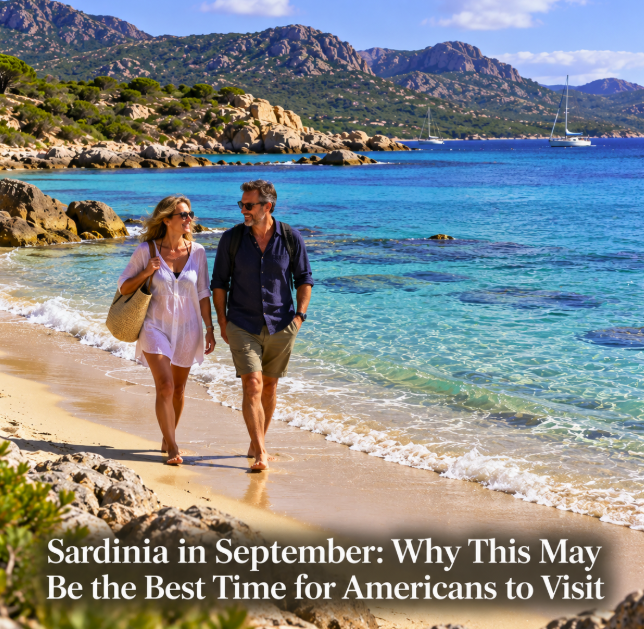
July and August offer the most reliable beach weather but also bring the highest demand, heavier traffic around famous coastal areas and peak accommodation prices. June and September are strong alternatives for travelers who still want swimming and beach time with somewhat less summer intensity.
Spring and autumn are better suited to hiking, archaeology, food, villages and road trips, although weather is less predictable and some seasonal coastal businesses close outside summer. Winter is quiet and offers a more local experience, but it should not be planned as a conventional beach-resort holiday.
A practical first-trip strategy
Start by choosing the experience rather than trying to tick off an island-wide checklist. For beaches and polished resorts, northeast Sardinia is an obvious candidate. For a historic seaside city with a strong sense of place, consider Alghero. For urban life combined with southern beaches, use Cagliari. For hiking and a more rugged landscape, build time around Ogliastra or the Supramonte.
Then match the airport and rental-car plan to that region. Verify passport validity, check the latest ETIAS status on the official EU website, arrange the correct driving documentation, and reserve any restricted beaches that matter to you.
Sardinia rewards slower planning. Americans who treat it as a large Mediterranean island rather than a single beach destination usually spend less time driving and more time enjoying what brought them there in the first place.