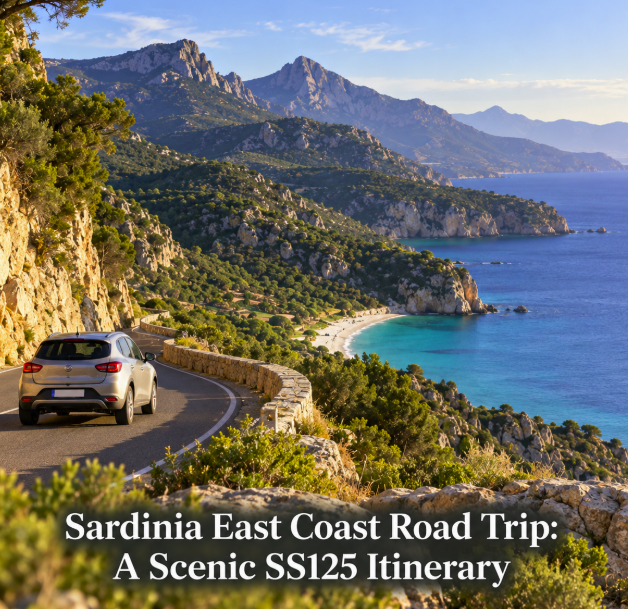
The SS125 Orientale Sarda is the road to build around if you want a driving trip through Sardinia’s eastern side. Rather than treating it as a race from Cagliari to Olbia, give the coast at least five days and use the road as a spine for detours to beaches, mountain villages and the Gulf of Orosei. A practical itinerary runs from Cagliari through Villasimius and the southeast, continues into Ogliastra around Tortolì and Baunei, crosses the dramatic inland section toward Dorgali and Cala Gonone, and finishes around Orosei before continuing north toward Olbia.
The important detail is that today’s SS125 is not one uninterrupted postcard road beside the sea. The route mixes older winding sections with newer SS125 Var stretches built to improve travel between southern Sardinia and Ogliastra. The best road trip therefore combines efficient sections with deliberate scenic detours instead of blindly following the fastest navigation setting.
Day 1: Cagliari to Villasimius and the southeast coast
Leave Cagliari and make the first day about the southeast rather than mileage. The coast around Villasimius and Capo Carbonara gives you turquoise bays and granite scenery before the road trip moves into the wilder landscapes farther north.
If you are traveling in summer, start early. Famous beaches around Villasimius and Castiadas can become busy, and parking restrictions or paid parking may apply. One or two beach stops are enough; trying to collect every cove turns the first day into a parking exercise.
Stay around Villasimius, Costa Rei or Castiadas. Costa Rei is especially convenient if you want to shorten the next morning’s drive north.
Day 2: Costa Rei to Ogliastra
Continue north toward Muravera, Villaputzu and Tertenia. This is where the road begins to feel less like a resort itinerary and more like a journey through Sardinia’s eastern landscape.
ANAS, the Italian state-road authority, classifies the SS125 as the Orientale Sarda and currently manages SS125 sections through Villaputzu, Girasole, Orosei and Olbia as well as several SS125 Var sections. The newer variant has changed the rhythm of the journey: it is faster and safer for through traffic, but some older alignments and local roads remain more rewarding when the objective is scenery rather than speed.
ANAS opened a 5.6-kilometre section of the SS125 Var between the Tertenia area and Osini in 2021 specifically as part of improving connections between southern Sardinia and Ogliastra. That modern infrastructure explains why parts of this road trip move surprisingly quickly between more dramatic stretches.
For the night, base yourself around Tortolì, Arbatax or Santa Maria Navarrese. Arbatax is useful for its port and red porphyry rocks, while Santa Maria Navarrese puts you closer to Baunei and the Gulf of Orosei.
Day 3: Baunei and the wild Gulf of Orosei
This is the day not to rush. Drive into Baunei, the mountain village overlooking one of Sardinia’s most dramatic coastal territories. The limestone Supramonte rises behind a coastline famous for Cala Goloritzé, Cala Mariolu and other coves that cannot simply be reached by driving down from the SS125.
That limitation is part of the appeal. Use the car to reach trailheads, viewpoints or Santa Maria Navarrese, then switch to walking or a boat excursion if you want to experience the coves themselves.
Cala Goloritzé, for example, is protected and reached on foot via a substantial trail or viewed from the sea under specific access rules. Do not build a road itinerary around the idea that every famous beach has a parking lot beside it.
If you want a driving-focused day instead, continue on the old SS125 sections above Baunei. This is where the Orientale Sarda becomes a mountain road, with limestone scenery replacing the lower coastal plains.
Spend a second night in the Baunei/Santa Maria Navarrese area if hiking or boating is a priority. Otherwise continue toward Dorgali.
Day 4: Baunei to Dorgali and Cala Gonone
The drive north toward Dorgali is one of the key transitions of the itinerary. The SS125 crosses rugged terrain rather than hugging the shoreline, reminding drivers that Sardinia’s east coast is shaped as much by mountains as by beaches.
Take your time on winding sections, especially if you are unfamiliar with narrow mountain roads. Distances that look short on a map can require more concentration than an equivalent motorway drive.
From Dorgali, descend to Cala Gonone. The seaside town is a useful base for the central Gulf of Orosei and for boat trips toward the Bue Marino caves, Cala Luna and other coastal sites.
If you have already taken a boat from Santa Maria Navarrese, use the afternoon for Dorgali itself or for a shorter coastal stop rather than repeating an almost identical full-day excursion.
Day 5: Cala Gonone to Orosei, then north
Continue toward Orosei, where ANAS’s current road network documentation again identifies the SS125 as the principal state road through the area. Orosei makes a natural final overnight stop if you want a relaxed five-day trip, with beaches and the historic town nearby.
From here you can extend the journey north through Siniscola, Budoni and the Olbia area. The SS125 ultimately reaches the Olbia zone, but the character changes as you approach the busier northeast.
If your flight leaves from Olbia, allow an extra night around Orosei or the northeast rather than planning a long scenic driving day immediately before departure.
How many days do you need?
Five days is a useful minimum for a road trip that includes actual stops rather than simply driving the route. Seven days is better if you want both hiking and boat time.
With three days, focus on one section. A Cagliari–Villasimius–Ogliastra trip works well in the south, while Olbia–Orosei–Dorgali–Baunei gives you the most dramatic central-eastern landscapes without trying to cover the whole island.
Driving Cagliari to Olbia as quickly as possible misses the point of choosing the SS125 as a travel experience.
Old SS125 or the faster variant?
Modern navigation apps tend to favor faster SS125 Var sections where available. That is useful when you need to make progress, but road-trippers should understand the difference between a transport route and a scenic itinerary.
Use the faster road when you have a reservation, boat departure or hotel check-in to reach. Choose older/local alignments only when they are legally open, conditions are good and you have time for slower driving.
Do not assume that an old road is automatically a scenic viewpoint route or that every lay-by is safe for stopping. Pull over only in designated or clearly safe places.
When to drive the east coast
May, June, September and early October are particularly practical for this itinerary because they combine long enough days with less peak-season pressure than August. July and August still work, but beach parking, accommodation and traffic around the main resorts require more planning.
Inland sections can be hot in summer, while mountain weather can differ from conditions at sea level. Check the forecast before hiking or making a long detour into the Supramonte.
Outside summer, some seasonal beach services and boat schedules reduce or stop, so verify individual activities rather than assuming everything operates year-round.
Driving practicalities
A small or medium rental car is enough for this itinerary; a large SUV is not necessary for normal paved roads. The more important qualities are comfortable brakes, sensible luggage space and a vehicle you are confident handling on bends.
Refuel before long rural sections rather than waiting for the warning light. Download offline maps because mobile reception can weaken in mountainous areas, and never follow a navigation shortcut onto an unpaved or restricted track simply because it appears shorter.
ANAS road information should be checked before departure for closures, works or restrictions. The east-coast road network has been progressively modernized, and temporary works can alter the route.
A road trip, not a checklist
The SS125 works best when you leave room for one unplanned stop each day. The attraction is the contrast: resort beaches in the southeast, agricultural valleys, Ogliastra villages, limestone mountains and the Gulf of Orosei all appear within the same journey.
A sensible five-day sequence is Cagliari → Villasimius/Costa Rei → Tortolì or Santa Maria Navarrese → Baunei → Dorgali/Cala Gonone → Orosei, with Olbia as the natural northern exit if your trip continues that way.
It is not the shortest way to understand Sardinia, and that is precisely why it works. The Orientale Sarda turns the east coast into a sequence of landscapes rather than a transfer between airports, giving the drive itself a reason to be part of the holiday.