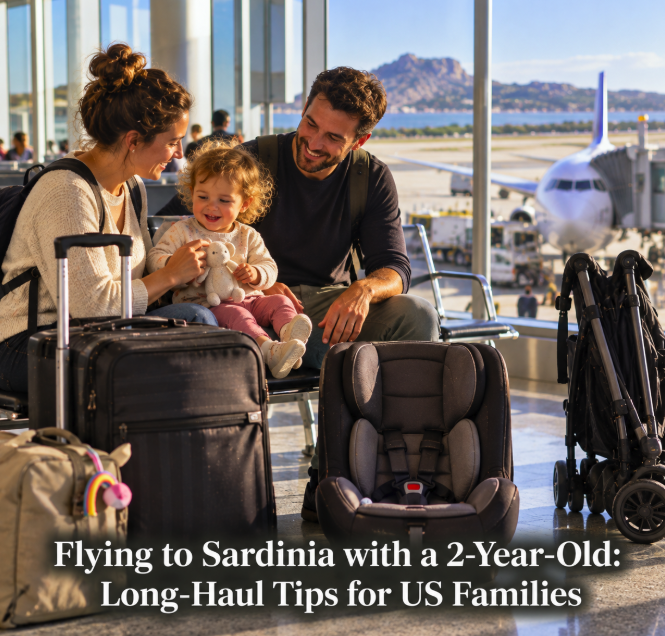
Flying from the United States to Sardinia with a 2-year-old is much easier when the trip is planned around the child's seat, sleep and ground transport rather than around the shortest-looking airfare. At age two, the child needs their own airline seat, and families also need to think ahead about the car restraint they will use after landing in Italy. The good news for 2026 is that Sardinia is better connected to the United States than before: Delta now operates a seasonal nonstop from New York JFK to Olbia, while families from other U.S. cities can reach the island with one or more connections.
The best itinerary is not automatically the one with the fewest minutes on paper. With a toddler, a slightly longer connection can be much easier than sprinting through a large European airport after an overnight flight.
At age two, plan on a separate airplane seat
For U.S. flights, the familiar “lap infant” exception applies only to children who have not reached their second birthday. A 2-year-old therefore travels in their own passenger seat.
The Federal Aviation Administration strongly recommends an approved child restraint system for young children when the device fits the child and is approved for aircraft use. If you bring a U.S. car seat into the cabin, check the label before leaving home: the FAA says an acceptable U.S. restraint should state that it is certified for use in motor vehicles and aircraft.
An alternative for some toddlers is the FAA-approved CARES aviation restraint. The FAA currently approves the genuine CARES device for children capable of sitting upright who are up to 40 inches tall and weigh 22 to 44 pounds. It is much lighter than carrying a full car seat through the airport, but it is for aircraft use only and does not replace a car seat after arrival.
Check the airline's child-restraint policy before departure. Airlines can specify where an approved seat may be installed, and child restraints cannot block an emergency escape path or be used in an exit row.
A nonstop to Olbia can remove a connection
Delta's seasonal JFK–Olbia service began on May 20, 2026 and operates four times weekly during its published season. It is the first nonstop air connection between the United States and Sardinia.
For families who can reach JFK conveniently, removing a European connection can simplify the trip considerably. You avoid transferring through Rome, Milan, Paris or another hub with a tired toddler, then land directly in northeastern Sardinia.
The trade-off is that getting to JFK may itself require a domestic flight or airport transfer. A family starting in California, Texas or another distant state should compare the entire door-to-door itinerary rather than focusing only on the transatlantic segment.
If your final destination is around Costa Smeralda, San Teodoro, Palau or La Maddalena, Olbia is particularly convenient. Families heading toward Cagliari, Pula or southwestern Sardinia may prefer an itinerary into Cagliari even if it involves a European connection.
Do not make the connection too tight
A connection that looks efficient for two adults can become stressful with a stroller, child seat, toddler and carry-on bags. When entering the Schengen area through an airport such as Rome, passport formalities take place at that first Schengen entry point before the domestic connection to Sardinia.
If the Sardinia flight is on a separate ticket, allow substantially more margin. Depending on the ticket and baggage arrangement, you may have to collect checked luggage and check it again. If the transatlantic flight is delayed, the second airline may not have the same obligation to rebook you as it would on a protected through itinerary.
For a family with a toddler, an airport meal and an hour of free movement can be more valuable than shaving an hour from the connection.
Use the stroller strategically
A compact stroller can be one of the most useful pieces of equipment in a large airport. It gives the child somewhere to sit during long walks and provides a place to contain a tired toddler when adults are handling passports and luggage.
Airline policies for gate-checking or cabin stowage vary by carrier and stroller size. Verify the exact policy before travel rather than assuming the stroller will be returned at the aircraft door after landing. At some airports, gate-checked equipment may be delivered through oversized baggage instead.
If you are also carrying a car seat, a luggage trolley or car-seat travel cart can reduce the number of separate objects you have to manage through the terminal.
Pack the cabin bag for delays, not just the scheduled flight
For a long-haul trip, pack enough diapers, wipes, spare clothing and familiar snacks for the scheduled journey plus a reasonable delay. Include at least one full change of clothes for the child and a spare top for the accompanying adult.
Small, unfamiliar activities can work better than one large toy. Stickers, reusable drawing boards, picture books and downloaded videos can be introduced one at a time instead of all at once.
Download entertainment before leaving home. Airport and aircraft Wi-Fi should be treated as a bonus, not as the only plan for keeping a toddler occupied.
Keep one familiar comfort object accessible. The favorite stuffed animal buried in checked luggage is not useful during an overnight meltdown.
Sleep: aim for familiar cues rather than perfection
Parents cannot guarantee that a toddler will sleep on an overnight flight. What they can do is reproduce parts of the normal bedtime routine: pajamas, familiar story, comfort toy and reduced stimulation when the cabin quiets down.
Avoid building the entire itinerary around the assumption that the child will sleep for eight hours. Some toddlers sleep surprisingly well; others are too interested in the new environment.
Keeping the child properly restrained while seated is also important because turbulence can occur unexpectedly. The FAA advises passengers to remain buckled while seated and recommends approved child restraints for young children.
Think about the car seat before you land in Sardinia
Italy requires children under 1.50 metres tall to use an approved child restraint appropriate to their size. Automobile Club d'Italia also notes that when traveling in an Italian-registered rental vehicle with a child under four, the anti-abandonment alarm requirement applies.
This creates an important planning issue for U.S. families. A car seat that is FAA-approved for an American aircraft is not automatically the same thing as a restraint approved for road use under European regulations. ACI advises using a seat carrying the appropriate European type-approval marking.
If you rent a car in Sardinia, reserving an appropriate child seat with the rental company can simplify compliance. Confirm the child's age, height and weight, and ask what type of restraint will actually be supplied. Availability should be confirmed rather than assumed at the airport counter.
If you plan to bring your own seat from the United States, research its European road approval before relying on it in an Italian rental car.
Make the arrival day deliberately easy
After an overnight flight, avoid planning a long cross-island drive immediately after landing if you can. Adults may be sleep-deprived, and a toddler may be either exhausted or unexpectedly wide awake.
For an Olbia arrival, a first stay in northeastern Sardinia can reduce the amount of driving. For a Cagliari arrival, beginning around the south before moving north can serve the same purpose.
If your final accommodation is several hours away, consider whether one night near the arrival airport would make the trip safer and more comfortable. A vacation does not need to begin with the longest possible drive.
Pressure changes during takeoff and landing
Young children cannot always explain that their ears feel uncomfortable as cabin pressure changes. Swallowing can help equalize pressure, so having a drink or an age-appropriate snack available during descent may be useful if the child is awake and willing.
If your child has significant ear pain, an ear infection or another medical issue before travel, ask their pediatrician for individualized advice rather than relying on a travel hack or medication suggested online.
A practical family-flight plan
For a 2-year-old, the simplest plan is to book their own seat, decide in advance whether you will use an aircraft-approved car seat or an eligible CARES restraint, and verify the airline's rules before departure. Choose a connection with enough time for passport control and toddler needs, or consider the seasonal JFK–Olbia nonstop if it works for your origin and Sardinian destination.
Carry the essentials needed for an extended delay, keep the stroller available for as much of the airport journey as your airline allows, and have the Italian road-restraint plan settled before you collect the rental car.
Most importantly, keep the first day in Sardinia simple. A beach walk, early dinner and nearby hotel are often a better start for a family than immediately trying to cover half the island. Long-haul travel with a toddler rarely becomes effortless, but removing unnecessary connections, uncertain car-seat arrangements and an exhausting arrival-day drive can make the journey much more manageable.