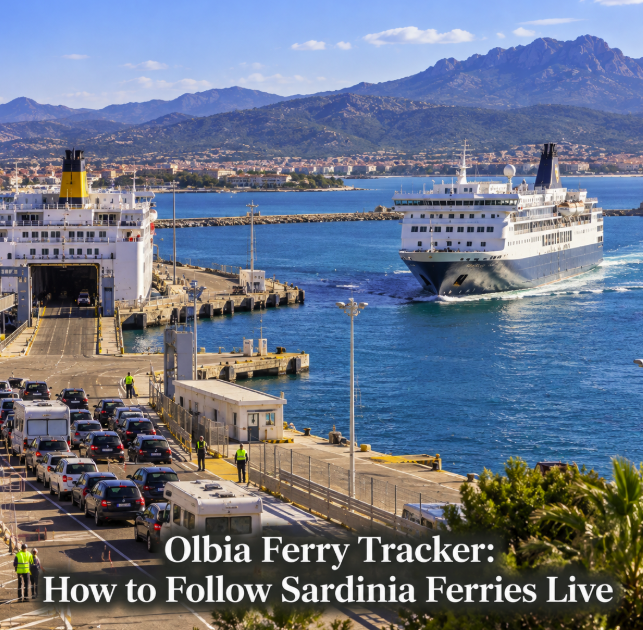
If you are waiting for a ferry in Olbia — or wondering whether one is running late — the most useful starting point is the official Port of Olbia live arrivals and departures board. It shows the vessel, company, scheduled time, actual time when available, operating status and berth. For seeing where a ship is physically located at sea, an AIS vessel tracker can then provide a map position. Using the two together is more useful than relying on a timetable alone.
This distinction matters because a ferry can be delayed even when the published timetable has not changed. The scheduled departure tells you when the ship should sail; the port's operational status tells you what is actually happening at the terminal.
Start with the official Olbia port board
The Autorità di Sistema Portuale del Mare di Sardegna, which manages Olbia and Sardinia's other principal ports, publishes an arrivals and departures panel for Olbia. The data includes ferry company, ship name, origin or destination, scheduled time, actual time, status and quay.
Status messages can be much more informative than a generic ferry search. Recent official listings have shown stages such as expected, boarding in progress, boarding closed, departed and disembarkation completed. When an actual arrival or departure time is recorded, it appears alongside the scheduled time.
The official Porto di Olbia passenger website also displays current arrivals and departures. Its web app advertises real-time ferry and bus information, ship following and notifications when a vessel's status changes.
That makes it particularly useful on a phone while traveling. Instead of repeatedly searching the ferry company and route, you can monitor activity at Olbia itself.
What you can see on a live Olbia listing
A typical live port entry contains the ferry name — for example a Moby, Tirrenia, Grimaldi Lines or GNV vessel — together with its destination or origin and the berth assigned at Olbia.
The berth is useful because Olbia has more than one operational area. The passenger port at Isola Bianca handles much of the ferry traffic, while entries beginning with IND on the Porto di Olbia information service refer to Porto Cocciani.
If you are meeting someone, dropping off a passenger or arriving with a vehicle, checking the quay can therefore save confusion at a busy terminal.
How to see the ferry moving on a map
The port status board is best for operational information, but it is not the same thing as a live nautical map. For that, search the ship name on an AIS vessel-tracking service.
AIS — Automatic Identification System — transmits information including a vessel's identity, position, course and speed. Public tracking platforms process these transmissions and display ships on maps.
VesselFinder, for example, has a dedicated Port of Olbia page based on AIS data. Other maritime tracking services provide similar ship-name searches.
Remember that public AIS is an informational tool, not a guarantee of an exact arrival time. Position reports can be delayed or unavailable depending on receiver coverage, transmission conditions and the data service being used.
The easiest way to track your own ferry
First, find the ship name on your ticket, booking message or the Olbia port board. Searching only for “Livorno to Olbia ferry” is less precise because several companies can operate similar routes and there may be both daytime and overnight departures.
Next, check the official Olbia arrivals board for the ship's current status. If the vessel has not yet arrived, search its name on an AIS tracker to see its last reported position.
Finally, use the operating company's own messages and website for changes that affect your booking. The Port of Olbia passenger site explicitly advises travelers to refer to the individual ferry companies for the authoritative route and timetable information because its displayed schedules are informational.
Moby and Tirrenia at Olbia
Moby and Tirrenia operate major services through Olbia. Moby's current port information identifies the passenger terminal at Isola Bianca and provides separate Olbia ticket-office contacts for Moby and Tirrenia.
During the period from June 1 to September 30, Moby's Olbia instructions currently tell foot passengers to report at least one hour before departure and passengers traveling with a vehicle to report within the required 90-minute pre-departure window. Outside that period, the foot-passenger requirement is shorter, while vehicle passengers still need to respect the company's stated check-in time.
Do not interpret a visible ship in port as permission to arrive late. Boarding can close before the ferry physically leaves the berth.
Grimaldi Lines at Olbia
Grimaldi Lines also serves Olbia, including the year-round Livorno route and seasonal services. Its current Olbia port instructions require passengers to arrive no later than one hour before departure without a vehicle and no later than two hours before departure with a vehicle.
For September 21–27, 2026, Grimaldi's published Livorno–Olbia schedule shows a daily daytime sailing from Livorno at 10:00 arriving at 18:30, plus overnight departures. The return Olbia–Livorno schedule includes daily departures at 10:30 and 22:00 for that period.
Schedules can change around holidays or operational disruptions, so live status and the carrier's current information remain more important than copying an old timetable.
Why the ship icon may not match the port status
It is normal for different systems to appear slightly out of sync. An AIS tracker may show a ferry approaching Olbia while the port board still lists it as expected. After docking, the port may update the status to disembarkation in progress or completed.
Likewise, a ship can appear stationary at the quay even after boarding has closed. The important status for a passenger is not whether the ferry is still visible but whether check-in and boarding remain open.
For this reason, use AIS to answer where is the ship? and the official port or carrier information to answer what is happening with my departure?
Tracking delays when meeting an arriving passenger
If you are collecting someone at Olbia, the official board's actual arrival time is more useful than the original schedule. A ferry may reach the berth late and still need time to unload vehicles and passengers.
The status field can indicate when disembarkation has finished. That is more practical than watching an AIS icon and guessing how long unloading will take.
During busy summer operations, leave some flexibility around pickup times. A ferry's arrival at the harbor entrance, docking and the moment a car finally leaves the vessel are three different events.
Do not use a tracker as your boarding clock
One of the easiest mistakes is to see that a ferry is running late and assume you can also arrive late. Do not do this unless the carrier explicitly changes your check-in instructions.
A delayed vessel can still require passengers to present themselves according to the original boarding deadline. Port operations may recover time, and the company needs vehicles and passengers processed before sailing.
Follow the check-in deadline on your booking and any official update sent by the carrier, not an estimated arrival calculated by a third-party ship tracker.
A practical three-screen setup
For a ferry day in Olbia, keep three sources available on your phone: the Port of Olbia live board for operational status and berth, an AIS tracker for the vessel's approximate position, and the ferry company's own booking information for check-in and passenger instructions.
The official Porto di Olbia web service is especially convenient because it is designed for mobile use and can provide status notifications without requiring a traditional app-store installation.
Together, these tools answer the questions travelers actually have: Has my ferry reached Sardinia? Is it delayed? Which quay is it using? Has boarding started? And where is the ship right now?
For Olbia, there is no need to rely on rumors in the terminal or repeatedly refresh a generic timetable. Start with the port authority's live information, use AIS for the map, and treat the ferry company as the final authority for whether and when you must board.