Yes, Americans can potentially buy property in Sardinia, and owning an Italian home does not require becoming an Italian citizen. But the viral idea of arriving from the United States, handing over one euro and walking away with a Mediterranean house badly oversimplifies both Italian property law and Sardinia’s €1-house projects. For a U.S. buyer, the sensible starting point is a notary, a tax code and careful due diligence — not a social-media listing.
The most important legal point for a non-EU buyer is Italy’s reciprocity rule. Italy’s National Council of Notaries explains that non-EU citizens who are not legally resident in Italy can carry out certain legal acts only where reciprocity exists: broadly, where an Italian would be permitted to carry out the equivalent act in the buyer’s country. The Italian notary handling the transaction is responsible for checking this on a case-by-case basis, with assistance from the Ministry of Foreign Affairs where necessary.
For an American considering a specific Sardinian property, that means the correct question is not simply “Can Americans buy?” but “Can I buy this property under my particular legal and residence status?” Have the notary confirm that point before signing a binding purchase offer or paying a substantial deposit.
What an American needs to buy a house in Sardinia
One of the first practical requirements is an Italian codice fiscale, the tax identification code used for property transactions and many other administrative activities. Italian consular guidance for foreign citizens specifically addresses obtaining a codice fiscale for real-estate purchases and explains that a foreign buyer can authorize a representative to request it from the Agenzia delle Entrate in Italy.
A property transaction ultimately goes through an Italian notary. The notary is not merely there to witness signatures: the National Council of Notaries describes checks involving ownership, mortgages, liens, pre-emption rights, identity, legal capacity and other elements of the transaction. Foreign-buyer status adds the reciprocity or residence documentation check.
The usual buying process can involve a written purchase proposal, a preliminary contract and finally the notarized deed, known as the rogito. A purchase proposal can become legally significant once signed and accepted, so foreign buyers should resist the temptation to treat it as the equivalent of an informal U.S. expression of interest.
Independent technical checks are also important. Old village houses can have cadastral, planning, structural or renovation issues that are not visible in an attractive online photograph. A local surveyor or other qualified technician can be valuable alongside the notary, particularly for a property requiring major restoration.
How much tax do you pay when buying?
The headline price is not the final cost. According to the Agenzia delle Entrate and the National Council of Notaries, a normal residential purchase from a private seller without “first home” tax benefits generally carries a 9% registration tax, plus fixed mortgage and cadastral taxes of €50 each. Under qualifying circumstances, Italy’s prezzo-valore system can allow a private individual buying residential property in a transaction subject to registration tax to calculate that tax using the property’s cadastral value rather than the sale price.
Qualifying purchases benefiting from Italy’s prima casa regime can have a 2% registration tax instead of 9%, with €50 mortgage and €50 cadastral taxes. But the first-home regime has specific conditions, including rules connected with the location of the property and the buyer’s residence or activity. An American purchasing a holiday home should not simply assume that the 2% rate applies.
Purchases from a business can follow different VAT rules. The Agenzia delle Entrate guide explains that where VAT applies to a residential sale, the ordinary residential rate can be 10%, or 4% for a qualifying first-home purchase, with different treatment for certain luxury cadastral categories. Fixed registration, mortgage and cadastral taxes also apply in VAT transactions.
On top of taxes, budget for the notary, any real-estate agency commission, technical inspections, translations or interpreting where required, renovation work, utilities, insurance and ongoing local property costs. Financing can also be more complicated for a non-resident foreign buyer, so mortgage availability should be investigated before committing to a purchase.
What is the Sardinia €1 house scheme?
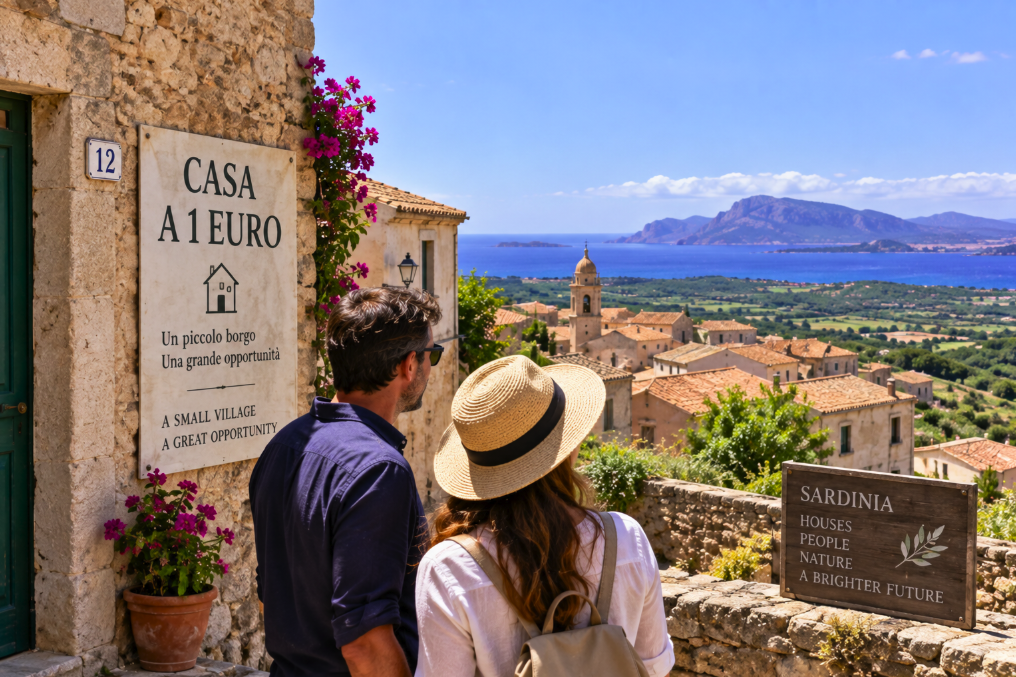
Sardinia does have genuine one-euro-house initiatives, but there is no single island-wide catalogue where every abandoned property costs €1. The best-known example is Ollolai, a mountain village in the Barbagia area that has used low-cost property initiatives as part of a wider strategy to counter depopulation and bring new residents and investment into the historic centre.
As of September 2026, Ollolai’s community cooperative still maintains a dedicated “Case a 1 Euro” section and currently displays available projects, including a historic house in Via La Marmora. The cooperative also offers support for visits, finding local professionals, renovation and administrative procedures.
The initiative is not merely an old viral story. In May 2026, a German physiotherapist formally received the keys to a €1 house in Ollolai after spending time evaluating the village and developing a life project there. The current program therefore has real transactions behind it.
But the euro is the symbolic purchase price, not the cost of owning a finished home. These programs are designed to recover neglected buildings and revitalize communities. Buyers should expect renovation obligations, professional fees, taxes, permits and deadlines or project conditions set by the relevant initiative. The renovation can cost many thousands of euros — potentially far more than the market value of an inexpensive house elsewhere in inland Sardinia.
Do not confuse two different “one euro” programs
There is another Sardinian €1 property story in 2026 that can easily create confusion. In April, the Regione Autonoma della Sardegna approved the transfer of an initial group of regional-government properties to municipalities and public consortia for the symbolic price of one euro. That program is intended to allow local authorities to recover and reuse public assets.
It does not mean the regional government is offering those buildings directly to American private buyers for one euro. It is a public-property transfer between institutions and should be distinguished from municipal or community initiatives involving private homes.
Sardinia is also funding broader anti-depopulation housing policies. In April 2026, the Region strengthened grants for buying and renovating first homes in municipalities with populations up to 5,000. Eligibility rules apply, and an overseas buyer should never assume that a grant intended to encourage permanent residence is automatically available to a non-resident purchasing a vacation property.
Is a €1 house actually the cheapest way to buy in Sardinia?
Not necessarily. A structurally sound house listed at €30,000 or €50,000 can ultimately cost less than a €1 building requiring a roof, new systems, structural repairs, professional design work and years of restoration. The only useful comparison is the total project cost.
This is particularly true in inland villages, where ordinary real estate can already be inexpensive compared with Porto Cervo, Alghero or the most desirable coastal areas. Buyers motivated primarily by price should compare €1-house projects with conventional listings in several small towns before deciding.
Location also matters after the novelty wears off. Ask how far the property is from an airport, hospital, supermarket and year-round services. Check broadband, winter heating, parking and whether the town has the daily life you actually want. A €1 house is a poor bargain if the owner never wants to stay there after the renovation is finished.
Buying property does not automatically give you Italian residency
This is one of the most important distinctions for U.S. buyers. Purchasing a Sardinian home and obtaining the right to live in Italy long term are separate legal questions. Property ownership should not be treated as an automatic residence permit or immigration route.
An American who intends to spend extended periods in Sardinia should investigate the appropriate Italian visa and residence rules separately from the purchase itself. The notary handles the property transaction; immigration status may require separate advice and applications through the appropriate Italian authorities.
The most sensible approach is therefore less romantic than the viral headline but much safer: identify the town, inspect the property in person, obtain a codice fiscale, choose an Italian notary early, commission technical due diligence and calculate the entire cost before signing. If the property happens to cost one euro, treat that as the beginning of the budget — never the end.
Sardinia’s €1 houses are real, and Ollolai remains an active example in 2026. For Americans, however, the opportunity is not really about buying a house for the price of an espresso. It is about taking responsibility for an old building in a small Sardinian community, navigating Italian property rules correctly and deciding whether the renovation and lifestyle make sense long after the viral video has disappeared from the feed.