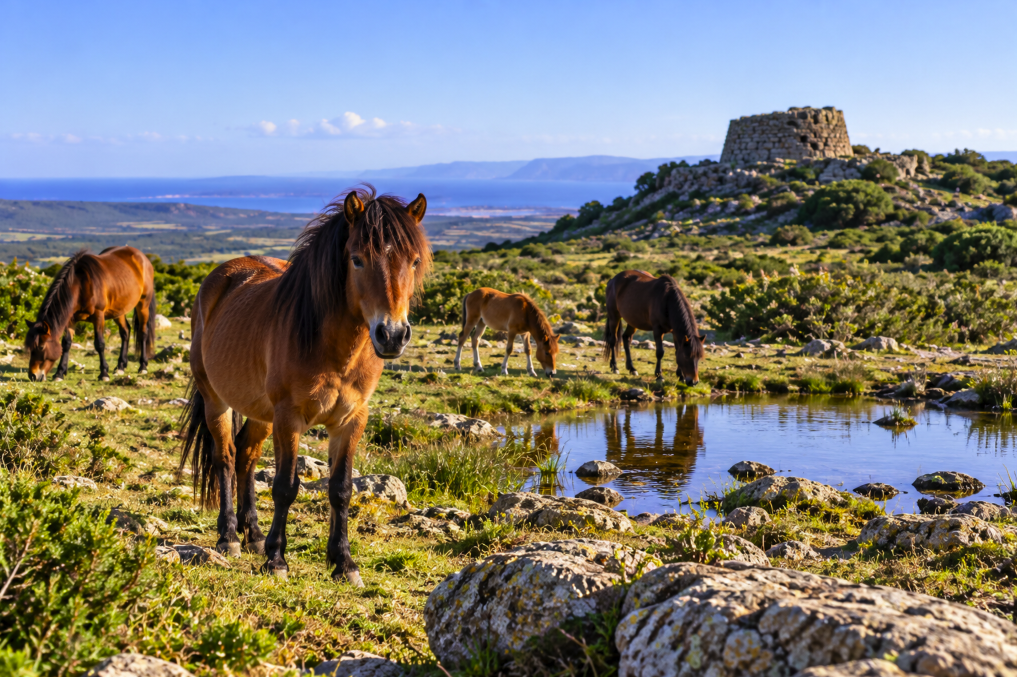
One of Sardinia’s most unusual wildlife experiences is found far from its famous beaches. On the Giara plateau in the island’s interior, small horses known as the Cavallini della Giara live in a rugged landscape of Mediterranean scrub, cork and holm oaks, rocky ground and seasonal wetlands. Visitors can explore the plateau on foot with local guides, and current 2026 tours start at just €10 per adult.
The animals are often described as Sardinia’s “wild horses,” although the story is more nuanced than that viral label suggests. They are a distinctive local horse population living in a largely free-ranging state on the plateau. The experience is not a safari park or a guaranteed close-up photo session: the horses move through a large natural area, and respectful observation is part of the point.
Where is the Giara?
The Giara is a broad basalt plateau in central-southern Sardinia, in the historical Marmilla region. The park is associated with the municipalities of Tuili, Gesturi, Setzu and Genoni and covers roughly 4,500 hectares. From its elevated edges, the landscape opens toward a wide section of inland Sardinia.
The plateau feels markedly different from the coastal scenery many international visitors expect. Shallow seasonal pools, locally called paulis, appear across the flat volcanic surface, while woodland and scrub create habitat for a surprisingly rich mix of plants and animals. The park reports more than 350 botanical species and more than 100 animal species.
The cavallini are the stars, but a guided walk is more interesting when it treats them as part of that ecosystem rather than as the only attraction.
How to see the Giara horses
The Parco della Giara currently runs guided excursions every day, but advance reservation is required. Standard guided visits last around two hours and cost €10 for adults, €6 for children and teenagers aged 6–17, while children under six join free. A private excursion is listed at €150 and can be customized in duration, route and departure time.
In September, the published guided-tour times are 10 a.m. and 3 p.m. The park notes that schedules can sometimes be adjusted on request, so travelers with a fixed itinerary should contact the visitor service rather than simply arriving and expecting a departure.
Seasonal times vary. From June through August the listed departures are at 10 a.m. and 5 p.m.; October through March uses 10 a.m. and 2:30 p.m.; May has 10 a.m. and 3 p.m. April and September currently share the 10 a.m. and 3 p.m. schedule.
These details are particularly useful for U.S. travelers building a road trip through inland Sardinia, because the Giara is not the kind of attraction where a five-minute roadside stop does it justice. Allow time for the walk, the approach and the possibility that the horses are not standing beside the first trail you enter.
Will you definitely see the horses?
No responsible nature guide should promise a particular encounter. The horses are not arranged for visitors, and their position changes with grazing, water, weather and season. Local guides know the plateau and its patterns, which is one reason a guided visit can improve the experience.
When horses are present near a trail or wetland, give them space. Do not approach for a selfie, attempt to touch them, feed them or block their movement. A telephoto lens or the zoom on a camera is more useful than trying to make a wild-living animal part of a close portrait.
The seasonal pools can be especially evocative because they concentrate water in the landscape, but their appearance changes through the year. Images of horses beside reflective pools should not create the expectation that every visitor will find the same scene in every month.
What is a guided walk actually like?
The park describes its excursions as walks through the Giara’s trails, combining wildlife with vegetation and traces of human use of the plateau. Shepherds’ structures and archaeological remains are part of the wider landscape, so a guide can explain the relationship between people, animals and this unusual high plain rather than simply pointing toward horses.
A special park excursion held in April 2026, for example, covered about four to five kilometres and was described as suitable for adults and children. That event is not the standard daily tour, but it gives a useful sense of the Giara as a walking destination rather than a drive-through wildlife attraction.
Wear closed, comfortable shoes and bring water. Conditions can be exposed, and the plateau’s uneven natural surfaces are very different from a paved promenade. In warm weather, sun protection matters; in cooler or wet periods, check conditions before departure.
How to fit the Giara into a Sardinia itinerary
The Giara makes the most sense as part of an inland day rather than a rushed detour between beaches. It can be paired with the Marmilla countryside and archaeological sites in the broader central-southern area, giving travelers a day focused on nature, rural Sardinia and the island’s long history.
For visitors based in Cagliari, reaching the area is most flexible by car. The same is true for travelers crossing the island between the south and central or western regions. Public transport can require more planning, particularly when a guided visit has a fixed departure time.
The park also offers a food option by advance reservation: a local tasting board built around selected Sardinian cured meats, cheeses, bread and other products. It is an optional addition rather than part of every standard visit, and availability should be confirmed when booking.
Are the Giara horses really “wild”?
The English word is useful for explaining why the experience feels special, but it can oversimplify the animals’ history. The Cavallini della Giara are closely tied to human history in Sardinia while living free on the plateau. Calling them wild-living or free-ranging is often a more precise way to describe what visitors see today.
They are small, hardy horses adapted to the Giara environment, and their continued presence has become one of the defining symbols of this inland landscape. That makes the encounter more interesting than an exotic-animal photo opportunity: the horses belong to a specific Sardinian ecological and cultural setting.
Recent social-media attention may introduce the cavallini to travelers who had never heard of the Giara, but the plateau rewards a slower visit than a viral clip suggests. Book a guided walk, arrive prepared to spend time outdoors and accept that wildlife sets its own schedule. Seeing a group of small horses moving freely between scrub and seasonal pools is memorable precisely because it is not staged.