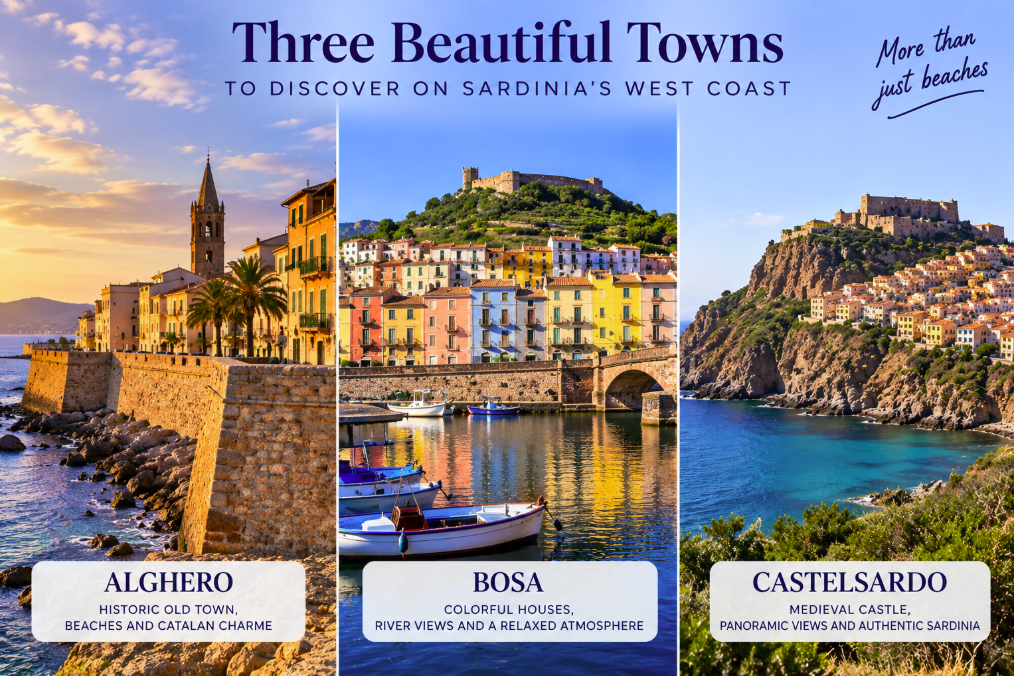
Sardinia’s west and northwest coast offers a very different trip from the polished marinas and luxury resorts of Costa Smeralda. Alghero has a walled old town shaped by centuries of Catalan history, Bosa climbs a hillside in layers of colorful houses above the Temo River, and Castelsardo wraps medieval streets around a Doria fortress overlooking the Gulf of Asinara. For travelers who want architecture, street life and places that reward walking as much as swimming, these three towns make a strong alternative itinerary.
They should not be treated as interchangeable “pretty villages.” Alghero is a lively coastal city with an airport, museums, restaurants and beaches. Bosa is smaller and more intimate, with its distinctive river landscape and Sa Costa neighborhood. Castelsardo is a compact hilltop settlement where the climb through the historic center leads naturally toward the castle and its museum of Mediterranean weaving.
Alghero: walk the walls of Sardinia’s Catalan city
Alghero is the easiest place of the three to use as a multi-night base. Its old town, known locally as l’Alguer Vella, is enclosed in part by historic walls and bastions facing the sea. The official tourism office describes Alghero as a Catalan linguistic island within Sardinia: Italian is spoken, but the local variant of Catalan remains part of the city’s identity.
The best introduction is simply to walk. Start around Piazza Civica and move through the narrow streets toward Via Carlo Alberto, where several of the old town’s most important religious buildings are concentrated. The Church and convent of San Francesco combine Catalan Gothic and later Renaissance elements, while nearby San Michele is recognizable by its colorful dome. Santa Maria Cathedral stands close to the bastions, and the old defensive towers and sea walls turn the edge of the historic center into one long viewpoint.
Alghero’s city archaeology museum, MŪSA, is another useful stop because it places the fortified city within a much longer history. Its collections trace human presence in the area through protohistoric, Nuragic, Phoenician, Roman and later periods, with particular attention to the relationship between Alghero and the sea.
Travelers planning several paid cultural visits can consider the current Alghero Ticket. The official tourism service lists the adult pass at €35 and the family version at €70, covering participating archaeological, museum and cultural sites. Individual attractions can also be visited separately, so the pass makes most sense when the itinerary includes several of them rather than only a walk through the old town.
Allow time for the bastions near sunset. The experience is less about checking off a monument than watching the old stone city meet the sea, with restaurants and pedestrian streets immediately behind you. That combination is one reason Alghero works particularly well for U.S. travelers who want history without giving up an evening restaurant scene or easy access to beaches.
Bosa: colorful houses above Sardinia’s only navigable river
Bosa delivers the most immediately recognizable photograph of the three. Its historic Sa Costa district rises up the slopes of Serravalle hill in a dense patchwork of pastel and brightly colored façades, with the Malaspina Castle above and the Temo River below.
The river is not just scenery. The Municipality of Bosa describes the Temo as Sardinia’s only navigable river for roughly its final six kilometers. Along its banks are reminders of the town’s industrial past, including the old tanneries that made Bosa known for high-quality leather production between the nineteenth and early twentieth centuries.
A good visit begins along the Lungotemo and around Ponte Vecchio before moving uphill through Sa Costa. The streets become narrower and steeper as you climb toward Serravalle Castle, also called the Malaspina Castle. Parts of the fortress date to the twelfth century, with later additions including towers and the defensive walls around the hill. Inside the walls is the small church of Nostra Signora de sos Regnos Altos, known for medieval frescoes with Iberian connections.
The climb is rewarded by the view back over Bosa: colored façades on one bank, former tanneries on the other, the bridge and the winding Temo below. It is one of those Sardinian panoramas that looks unusual precisely because it is not a beach scene.
There is also useful new practical information for 2026. Since July 13, Bosa’s main cultural sites have been operating daily under expanded opening hours. The Municipality says Malaspina Castle and Museo Casa Deriu are open from 10 a.m. to 8 p.m., while the Museo delle Conce is open from 10 a.m. to 6 p.m. A €12 combined ticket covers all three sites. Travelers should still check locally before visiting, especially outside the main season, because opening arrangements can change.
Bosa can be visited as a day trip from Alghero, but rushing down for a single photograph misses much of its character. The coastal drive between the two towns is part of the attraction, and staying for lunch or an evening gives more time to explore Sa Costa after the busiest daytime hours.
Castelsardo: a medieval fortress above the Gulf of Asinara
Castelsardo has the most dramatic hilltop silhouette. The historic settlement climbs a promontory above the sea, crowned by the fortress traditionally associated with the Doria family. SardegnaTurismo dates the construction probably to the thirteenth century, when the Genoese Doria used the stronghold to protect their Sardinian possessions and maritime connections.
The town changed rulers and names over the centuries. It became Castel Aragonese after the Aragonese conquest in 1448 and eventually Castelsardo under Savoy rule. Today the old fortress houses the Museo dell’Intreccio Mediterraneo, or Museum of Mediterranean Weaving.
The museum is not an arbitrary collection placed inside a castle. Basket and fibre weaving remain closely connected to Castelsardo itself. Its nine rooms explore techniques and objects made from vegetable fibres across Sardinia and the wider Mediterranean, while the streets of the old town continue to preserve the local tradition of women weaving palm, straw and raffia into baskets and other objects.
After the castle, continue through the historic center toward the Cathedral of Sant’Antonio Abate, whose bell tower stands dramatically above the water, and the Church of Santa Maria delle Grazie. The pleasure is in the sequence of steep lanes, small openings onto the sea and changing viewpoints rather than in a long list of major monuments.
Castelsardo works well as a half-day or full-day stop on a northern Sardinia road trip. It is also close enough to the coast to combine history with a swim around Lu Bagnu when conditions and season allow.
Can you see all three on one trip?
Yes, but not comfortably in one day. Alghero and Bosa pair naturally because they sit on the western side of the island and the road between them forms a scenic coastal journey. Castelsardo lies farther north, making it better as a separate day trip or as a stop when moving between Alghero and northern Sardinia.
A practical itinerary is to spend two or three nights in Alghero, devote one day to the old town and nearby coast, and use another for Bosa. Castelsardo can then be visited while continuing toward the Gulf of Asinara, Sassari or northeastern Sardinia.
Driving is the most flexible way to connect the three. The historic centers themselves, however, are best explored on foot. Expect cobbles, slopes and steps, particularly in Sa Costa and Castelsardo; travelers with limited mobility should check individual attractions and parking options rather than assuming that every medieval lane is easily accessible.
For travelers who have already seen — or simply do not want — the resort version of Sardinia, these towns show how varied the island’s northwest and west can be. Alghero gives you fortified Catalan history beside the sea, Bosa gives you color and a river landscape found nowhere else on the island, and Castelsardo gives you a medieval castle tied to a living craft tradition. The photographs are excellent, but the reason to go is that each place still has a story beyond the view.