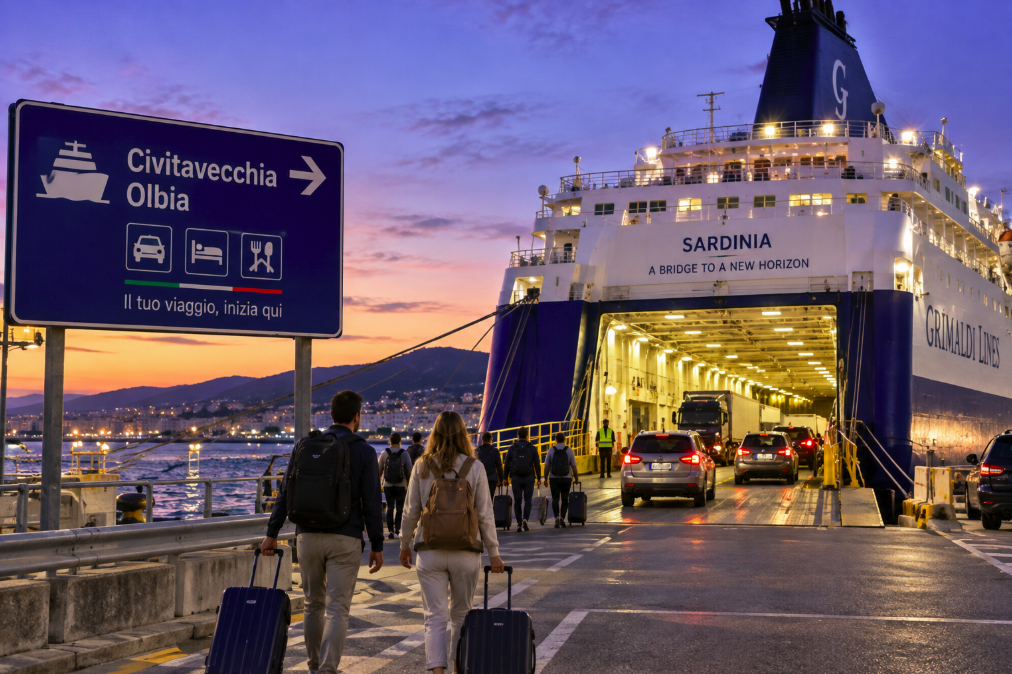
Flying is not the only practical way to continue from Rome to Sardinia. Travelers can go from Rome to the port of Civitavecchia and take an overnight ferry directly to Olbia, arriving in northeastern Sardinia the following morning. For U.S. visitors already spending time in Rome, the route can replace an additional airport transfer and domestic flight while offering something planes cannot: a private cabin, a full night aboard and the option of bringing a rental or personal vehicle across the Tyrrhenian Sea.
For 2026, the Civitavecchia–Olbia connection is particularly useful because overnight service operates throughout the year. Tirrenia’s current route information lists daytime crossings of roughly 7 to 7.5 hours and nighttime crossings of approximately 7.5 to 8 hours. During the summer, additional services increase the options available to travelers heading for Olbia and northern Sardinia.
Is there really a ferry from Rome to Sardinia?
Not from central Rome itself. The ferry leaves from Civitavecchia, the major passenger port on the Lazio coast northwest of the capital. Travelers therefore need to make the Rome–Civitavecchia journey first and allow enough time to reach the ferry terminal and complete check-in.
This distinction is important when comparing the ferry with flying. A flight from Rome to Olbia is much shorter once airborne, but the total journey also includes getting to the airport, security and boarding. The ferry requires a longer crossing but lets passengers travel overnight, effectively combining transport with a night’s accommodation when a cabin is booked.
For summer 2026, official operator information shows the Civitavecchia–Olbia route running both at night and during the day. Tirrenia describes its service as year-round, while Grimaldi Lines states that its own Civitavecchia–Olbia operation is seasonal from 1 June through 30 September 2026. Travelers should therefore search by their exact date rather than assuming the same operator and timetable apply throughout the year.
Why book a cabin on the overnight ferry?
For travelers coming from the United States, the cabin is what makes this route especially interesting. Tirrenia lists both inside and outside cabins on the Civitavecchia–Olbia route, including double and quadruple configurations. Reclining seats and traditional deck accommodation are also available, but a private cabin makes considerably more sense for travelers who want to arrive rested and begin driving or sightseeing the next morning.
An outside cabin has a window, while an inside cabin generally costs less and is designed primarily for sleeping. Availability and fares change according to date, demand, cabin type, passenger numbers and whether a vehicle is included, so there is no single meaningful fixed price for the journey. During peak summer weeks, booking the cabin early is more important than waiting for a last-minute fare.
When comparing the ferry with a flight plus hotel, consider the complete cost rather than the passenger ticket alone. A ferry booking may include two travelers, a private cabin and a car, whereas an airfare comparison may require adding checked baggage, airport transfers, a hotel night and a separate rental car after arrival.
Taking a car to Sardinia
The overnight ferry becomes even more useful for travelers already touring mainland Italy by car, provided their rental agreement permits taking the vehicle to Sardinia and transporting it by ferry. Never assume that every rental contract allows this: check the company’s terms before booking the crossing.
At Civitavecchia, Tirrenia currently requires passengers traveling with a vehicle to present themselves for boarding at least 90 minutes before departure. Passengers without a vehicle should arrive at least one hour before departure from 1 June to 30 September, or at least 30 minutes before departure from October through May. Valid original identification is required for passengers.
Once the vehicle has been parked on the ship’s garage deck, passengers should take everything needed for the night into the cabin because access to vehicle decks is restricted during navigation. A small overnight bag with documents, medication, chargers and clothes for the morning is much easier than carrying the entire luggage collection upstairs.
Arriving in Olbia
The ferry arrives at Olbia’s Isola Bianca passenger port, placing travelers directly in one of the main gateways to northeastern Sardinia. Olbia is well positioned for onward travel toward Costa Smeralda, San Teodoro, Palau and other parts of Gallura. Travelers arriving with a vehicle can drive onward after disembarkation; those arriving on foot can continue by local transport, taxi or arrange a rental car in Olbia.
This is one reason the Civitavecchia route works particularly well for an itinerary that combines Rome with northern Sardinia. Instead of returning to an airport for another flight, travelers can spend their final day in mainland Italy, transfer to Civitavecchia, sleep during much of the sea crossing and wake up in Sardinia.
Ferry or flight from Rome?
The ferry is not automatically better. Travelers with limited time and a convenient Rome–Olbia flight will usually reach Sardinia faster by air. The overnight ship becomes attractive when the journey itself solves another problem: transporting a car, avoiding another flight, saving a hotel night or simply creating a slower transition between Rome and the island.
For American visitors, it can also make the geography of the trip feel more coherent. Sardinia is an island separated from mainland Italy by a substantial stretch of sea, and an overnight crossing makes that transition tangible in a way a short flight does not.
The practical strategy for 2026 is to check both air and ferry options before locking the itinerary. If the overnight sailing fits the dates, compare an inside and outside cabin, add the vehicle only after confirming the rental-car rules, and arrive at Civitavecchia with plenty of time for boarding. Eight hours later, instead of another airport baggage carousel, the next stage of the trip begins at the port of Olbia.